





Gambiaj.com – (DAKAR, Senegal) – Senegal’s new authorities under the Pastef-led government have been linked to an alleged interest in powerful surveillance software, prompting growing concerns about the future of civil liberties and the true intentions of a regime elected on promises of democratic renewal.
According to investigative journalist Thomas Dietrich, the Senegalese police were shown a demonstration of a mass surveillance tool known as Robin in mid-2024, just months after President Bassirou Diomaye Faye assumed office following the March election.
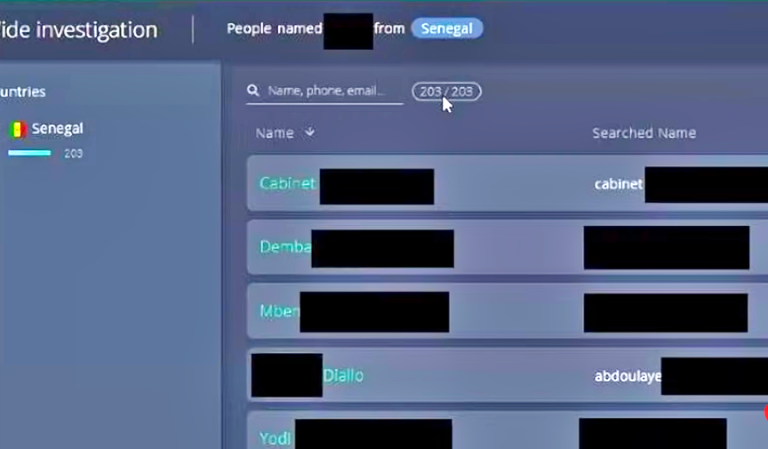
The revelations were made in Dietrich’s Chroniques de Françafrique and are supported, he says, by screenshots obtained from informed sources.
Robin is marketed by the Israeli firm Bolt Analytics, a company widely described as the successor to the controversial NSO Group, developer of the infamous Pegasus spyware.
A Surveillance Tool With Far-Reaching Capabilities
Dietrich reports that Robin allows users, simply by entering a phone number, to access a comprehensive map of that number’s communications: calls, messages, frequency of contact, and relational networks, visualized through an interactive web of connections extending across borders. Such capabilities, if deployed by state authorities, would amount to mass surveillance with minimal judicial oversight.
Bolt Analytics is also said to offer a second product, Toucan, which Dietrich describes as “the true heir to Pegasus.” Costing an estimated 50,000 dollars, Toucan allegedly enables the undetectable infection of a target’s phone, granting full access to its contents and allowing remote activation of the microphone—without any action required from the victim, such as clicking a malicious link.
While there is no official confirmation that the Senegalese state has purchased either tool, Dietrich insists that interest in these technologies is strong in Dakar, citing what he describes as an increasingly tense political climate at the apex of power.
Internal Pastef Tensions and Fears of Political Spying
According to Dietrich’s sources, President Bassirou Diomaye Faye and Prime Minister Ousmane Sonko—once close allies within Pastef—have become locked in a climate of mutual suspicion. He claims both men sought to monitor one another and their close associates amid what he describes as a “fratricidal war” over future political ambitions and the next presidential contest.
These allegations, if substantiated, would represent a striking contradiction of Pastef’s founding narrative. The party rose to power pledging to restore democratic norms, protect freedoms, and break decisively with the authoritarian reflexes of previous administrations.
The possible turn toward high-grade digital surveillance raises questions about whether state security is being conflated with political control.
The claims also emerge amid persistent speculation in Senegalese and international media over strains within the ruling camp, adding to anxieties that surveillance tools could be used not only against opposition figures, journalists, and activists, but also as instruments in internal power struggles.
From Pegasus to Robin: A Threat to Senegal’s Democratic Image
Bolt Analytics itself has drawn scrutiny for its origins and staffing. Founded by Israeli billionaire Schlomi Fogel, reportedly close to Prime Minister Benjamin Netanyahu, the company presents itself as specializing in mass data analysis.
However, intelligence industry sources cited by Dietrich say a majority of its employees previously worked for NSO Group, the firm behind Pegasus.
Pegasus became emblematic of digital repression worldwide after it was used to spy on journalists, human rights defenders, and political opponents, including Saudi journalist Jamal Khashoggi before his assassination in 2018. NSO was later blacklisted internationally and fined in the United States over the hacking of WhatsApp users.
Dietrich argues that Bolt Analytics represents a rebranding of the same surveillance ecosystem, now targeting African governments. He claims similar tools have been pitched or sold to regimes in Benin, Cameroon, Côte d’Ivoire, and the Democratic Republic of the Congo, often in highly contested political environments.
For Senegal, long regarded as one of West Africa’s more resilient democracies, the reported interest in Pegasus-style spyware carries serious implications. Human rights advocates warn that the adoption of such technologies could undermine press freedom, weaken political pluralism, and normalize intrusive state monitoring under the guise of security.
The Senegalese authorities have yet to issue an official response. As scrutiny intensifies, the controversy risks becoming an early and defining test of whether Pastef’s exercise of power will match its reformist rhetoric—or whether the new regime is prepared to deploy the same tools of surveillance and control it once denounced.