

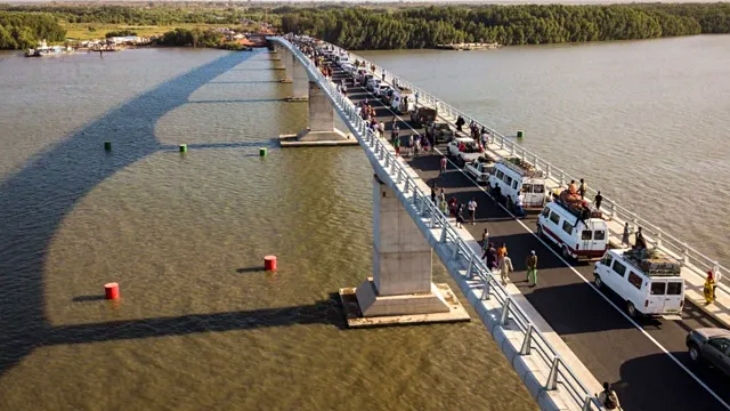
Gambiaj.com – (BANJUL, The Gambia) – The Gambia Ferry Service Company (GFSC) has lost tens of millions of dalasis through widespread revenue suppression and unpaid dues linked to its role in operating the Senegambia Bridge, lawmakers have heard.
The revelations emerged during the company’s 2022 annual report review before the Standing Committee on Public Enterprises, where auditors and management detailed significant financial leakages and mounting liabilities.
Officials from the National Audit Office (NAO) told lawmakers that internal investigations uncovered an estimated D7 million in suppressed revenue every month between 2019 and 2022, during which GFSC staff were responsible for collecting and banking bridge toll income.
Auditors described the practice as “pervasive,” involving multiple officers across the revenue collection chain.
A spot-check conducted over just four days in June 2022 alone revealed more than D4 million in unreported income, confirming what auditors said was a long-standing pattern of financial leakage.
In addition to the suppressed revenue, the ferry company is also owed more than D69 million by the bridge’s managing authorities.
The funds have remained unpaid despite repeated claims by GFSC and interventions sought from the Ministry of Finance and the Ministry of Works.
Lawmakers questioned why the company had continued to provide staff, equipment, and administrative support for bridge operations without receiving compensation, leaving it to absorb the financial burden.
Auditors also raised concerns over an uncleared suspense account exceeding D4 million, pointing to weak reconciliation processes and poor internal controls.
They warned that such accounting gaps distort the company’s true financial position and contribute to its worsening deficit. By the end of 2022, GFSC reported total liabilities of D1.5 billion against assets valued at D826 million, resulting in a negative equity position of D674 million.
GFSC management attributed part of the financial crisis to the closure of the Trans-Gambia ferry crossing in 2019, previously its most profitable route. The opening of the Senegambia Bridge sharply reduced ferry traffic along key crossings, further weakening revenue streams.
Although ferry tariffs were increased in 2018, management said the adjustment has failed to keep pace with operating costs, which have surged by more than 600 percent since 2001.
Despite these challenges, the company has invested heavily in rehabilitating its aging fleet, spending more than D450 million over five years on new engines and major repairs. However, management warned that unless the suppressed revenue losses are addressed and the outstanding bridge payments recovered, the company faces the risk of long-term insolvency.
The Committee is expected to summon officials from relevant ministries and bridge authorities as the scale of the losses triggers renewed calls for accountability and urgent reforms at the state-owned ferry operator.