


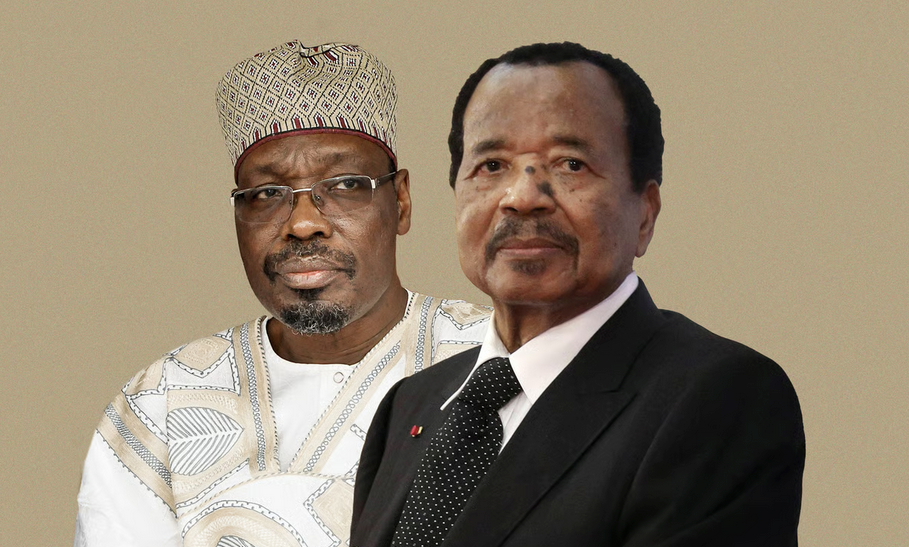
Gambiaj.com – (BANJUL, The Gambia) – The Government of The Gambia has confirmed that Cameroonian opposition figure Issa Bakary Tchiroma is still in the country under temporary humanitarian protection, while indicating that any future negotiations regarding his status would largely depend on initiatives from Cameroon, Tchiroma himself, and his key regional backer, Nigeria.
Foreign Affairs Minister Sering Modou Njie provided the update during a press briefing, offering rare insight into the diplomatic sensitivities surrounding Tchiroma’s stay and the broader regional optics tied to potential engagement with the government of Paul Biya.
Njie said Tchiroma fled Cameroon after declaring himself the winner of presidential elections even before official results were announced by the electoral commission, a move he said contravened Cameroon’s constitution and exposed the opposition leader to possible arrest.
“He ran away because he knew that he was going to be arrested and also be taken before the court of law,” Njie stated.
According to the minister, Tchiroma initially sought refuge in Nigeria before his relocation to The Gambia was facilitated by Nigerian authorities, a development that underscores Abuja’s pivotal role in managing the political fallout and potentially shaping future diplomatic engagement.
Nigeria’s Strategic Role and Regional Optics
The minister’s remarks highlight Nigeria’s position not only as Tchiroma’s immediate patron but also as a critical intermediary whose actions could influence whether negotiations with President Biya’s government materialize.
By facilitating Tchiroma’s transfer to The Gambia rather than retaining him on its own territory, Nigeria appears to have opted for a diplomatic balancing act, providing protection while avoiding direct confrontation with Yaoundé.
The arrangement allows Abuja to retain leverage while positioning Banjul as a neutral humanitarian host aligned with regional stability priorities.
Njie emphasized that The Gambia’s decision to host Tchiroma was taken “purely on a humanitarian basis” and in solidarity with regional efforts to preserve peace and stability in Cameroon.
However, he stressed that Tchiroma’s presence is temporary and strictly regulated.
“He was given some conditions: that he cannot use The Gambia to launch attacks or to cause any instability in Cameroon,” Njie said.
Government Signals Conditional Openness to Negotiations
Despite speculation about international mediation, the Gambian government indicated that it has not yet reached an advanced stage of facilitating negotiations between Tchiroma and President Biya’s administration.
Njie made clear that any diplomatic process would require formal initiative from the principal parties, particularly Cameroon, Tchiroma, or Nigeria.
“In the event that Cameroon and Bakary himself and Nigeria wanted to go ahead with the negotiation part, of course, then we will engage with the international partners,” he said.
This position effectively places Nigeria at the center of any future political settlement, reinforcing its influence over both Tchiroma’s immediate fate and the broader trajectory of relations with Biya’s government.
Humanitarian Hosting, Diplomatic Balancing
The Gambian government’s handling of the situation reflects a delicate diplomatic balancing act, offering humanitarian protection while avoiding actions that could be interpreted as interference in Cameroon’s internal affairs.
Officials insist that Banjul’s role remains limited to hosting under strict neutrality while leaving the door open for internationally supported dialogue if formally requested.
For now, Tchiroma’s continued presence in The Gambia stands as both a humanitarian gesture and a geopolitical signal, one shaped heavily by Nigeria’s strategic calculations and the unresolved tensions with President Biya’s administration.