


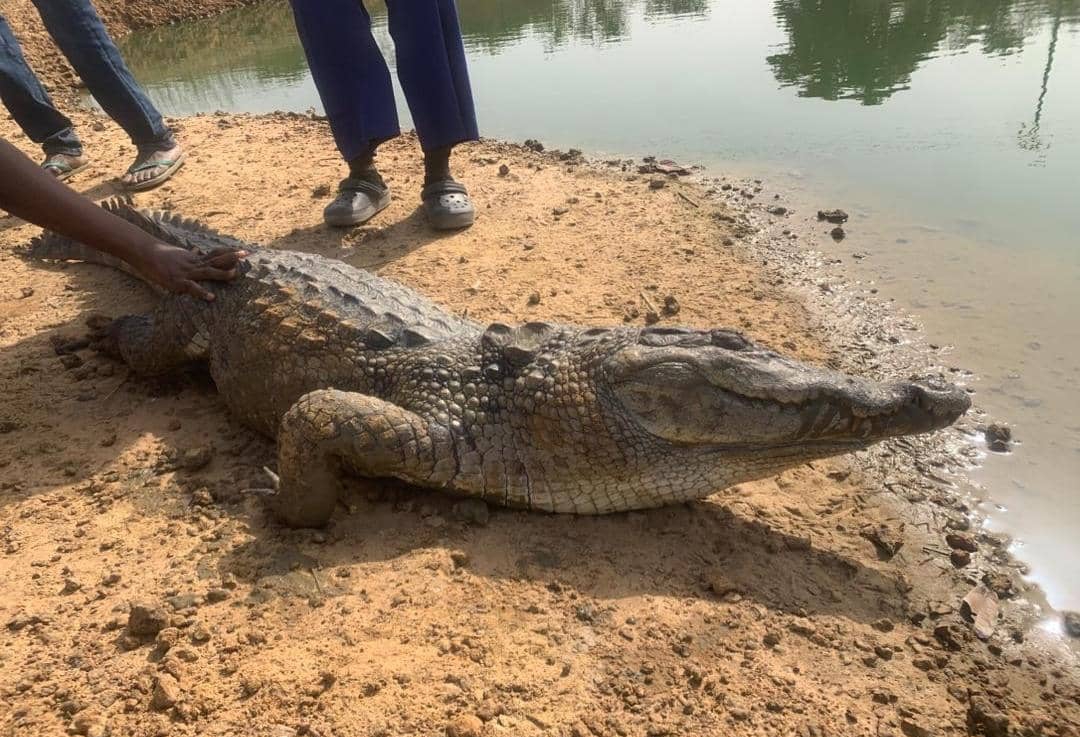
Gambiaj.com – (TUJERENG, The Gambia) – One of three crocodiles living in a pond at Tujereng, believed to be a former stone mining site, has died under circumstances residents suspect may be linked to deteriorating water quality and toxic conditions as the pond shrinks.
The discovery has alarmed community members, many of whom point to the poor state of the pond’s water, which has significantly receded this year, as a likely contributing factor.
Local residents say the pond, located opposite the Tujereng women’s garden and, once a reliable year-round water source, has experienced an unusual drop in water levels, raising concerns aboutthe concentrationn of contaminants and reduced oxygen levels—conditions known to threaten aquatic wildlife.
“This is one of the places bird watchers say never used to dry up throughout the year. But this year, we’ve seen a big decrease in the water,” a local source told this reporter.
Environmental observers note that as rainy season waters evaporate, stagnant ponds – especially those formed from abandoned mining pits – can become increasingly toxic. The reduction in water volume often concentrates harmful substances, including mineral residues from stone extraction, organic waste, and bacteria.
At the same time, lower water levels can reduce dissolved oxygen, creating hostile conditions for animals dependent on the habitat.
The pond is believed to be a remnant of stone mining activities dating back to the colonial period. Such sites can retain geological and chemical residues that, over time, alter water chemistry and pose risks to wildlife.
Residents said concerns about the pond were previously raised with the Tujereng Village Development Committee between 2022 and 2023, but they were informed that the land had already been sold to a private owner.
Despite this, some locals had hoped to preserve the site as a refuge for wildlife.
“When we saw the crocodiles around 2022, our plan was to fence the area and turn it into a small tourist site to protect both the reptiles and the people. But when we realized it belongs to someone, we couldn’t go ahead,” the source explained.
Many in the community believe the crocodiles may have originated from the private wildlife reserve of former president Yahya Jammeh in nearby Bato Kunku, where crocodiles were kept in captivity. Residents say heavy flooding in recent years could have allowed some of the animals to escape into surrounding waterways and eventually settle in the Tujereng pond.
“We know these crocodiles didn’t just appear from nowhere. With the heavy floods, they could have escaped from Jammeh’s garden. Three ended up in this pond, and now one is dead,” the source said.
This is not the first such incident reported in the area. Two years ago, another crocodile was found dead along the coastline, and residents say several freshwater points between Tujereng and Sanyang now host young crocodiles believed to have migrated from the former president’s estate.
Locals say the recent death highlights the vulnerability of wildlife living in shrinking and unmanaged water bodies, particularly those formed from abandoned industrial activity.
Community members are now calling for urgent attention to preserve the pond, warning that without intervention, worsening water conditions could threaten the remaining crocodiles and other wildlife that depend on it.
They argue that protecting and rehabilitating the site could not only safeguard the animals but also preserve an important part of the village’s natural heritage.