

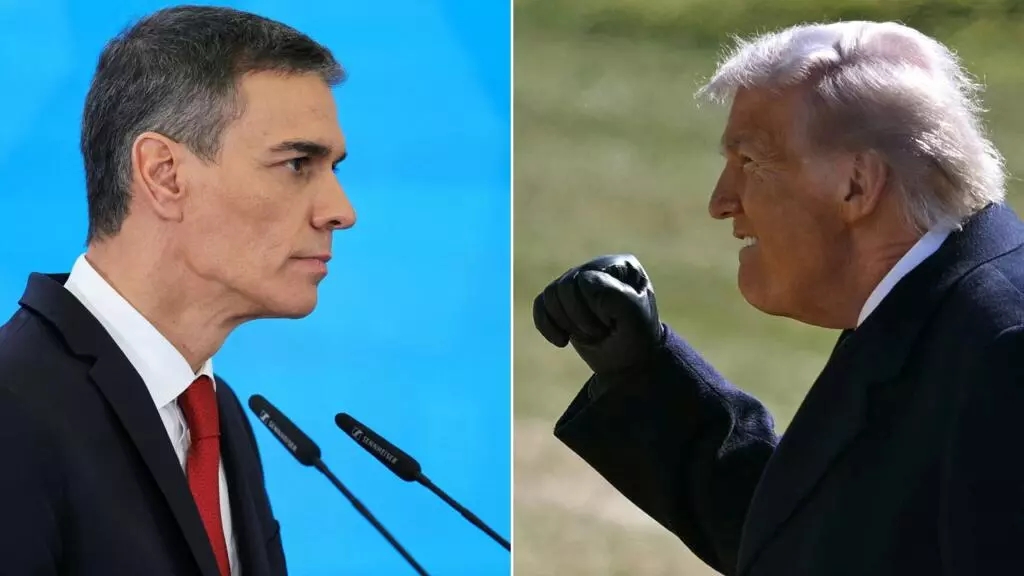

Gambiaj.com – (MADRID, Spain) – Spanish Prime Minister Pedro Sánchez has taken a sharply dissenting stance against the ongoing US-Israeli offensive on Iran, distancing Spain from several European partners and risking economic retaliation from Washington.
On Wednesday, March 4, Sanchez reaffirmed his categorical opposition to the military campaign led by Donald Trump and Israel, declaring that Spain would not endorse what he described as a breach of international law and a dangerous repetition of past strategic errors.
“The position of the Spanish government is clear,” Sanchez said. “No to the rupture of an international order that protects us all. No to the idea that conflicts can only be resolved through bombs. No to repeating the mistakes of the past. In four words: no to war.”
A Lone Voice in a Divided Europe
Sanchez’s posture contrasts with the more cautious or supportive approaches adopted by other European leaders grappling with the widening Middle East conflict, now in its fifth day.
European governments face a complex dilemma. On one hand, there is broad concern about Iran’s destabilizing regional role and fears that Tehran could eventually acquire nuclear weapons.
On the other hand, there remains a deep attachment to the principles of sovereignty and international law, principles many argue the Israeli-American intervention has bypassed.
French President Emmanuel Macron stopped short of endorsing the offensive, citing legal concerns, but has adopted what Paris calls a “defensive posture.”
French air forces stationed in the Gulf have reportedly intercepted Iranian drones targeting the United Arab Emirates, while the aircraft carrier Charles de Gaulle has been deployed to the Mediterranean to reinforce regional security and support European partners such as Cyprus.
Germany, by contrast, has been more circumspect. Chancellor Friedrich Merz, seated alongside Trump at the White House, avoided public criticism of the operation’s legality. Berlin, citing historical ties and longstanding support for Israel’s security, has facilitated the use of US bases on German soil for the campaign.
Spain, however, has drawn a firmer line.
Iraq Precedent and Domestic Pushback
Sanchez invoked the 2003 invasion of Iraq as a cautionary precedent, arguing that the intervention triggered soaring energy prices, strengthened jihadist networks, and deepened poverty, outcomes contrary to its stated objectives.
He described the current offensive as a “disaster” whose goals remain unclear, adding that millions across Europe, North America, and the Middle East do not want “more war or more uncertainty.”
Spain’s conservative opposition has strongly criticized Sanchez’s refusal to align with Washington. Nonetheless, the Socialist leader has so far maintained his position.
US Bases and Trade Threats
Tensions escalated after Trump publicly rebuked Spain for refusing to authorize the use of the US military bases at Rota and Morón, facilities governed by a bilateral defense agreement dating back to 1953.
Trump labeled Spain “very, very uncooperative” and threatened to sever trade relations with the eurozone’s fourth-largest economy. He has also repeatedly criticized Madrid for failing to raise defense spending to 5% of GDP, in line with NATO’s new benchmark.
The European Commission moved quickly to back Spain, stating it was “ready to react” to defend EU interests. The silence of Chancellor Merz during Trump’s remarks reportedly surprised Spanish officials, according to Foreign Minister José Manuel Albares.
Strategic Balancing Act
The crisis underscores Europe’s increasingly precarious balancing act. While reliant on the transatlantic alliance for security, European capitals are wary of being drawn into a widening regional war that could engulf Lebanon, where Hezbollah is already involved, and destabilize the broader Middle East.
Spain’s refusal to grant base access places it at the forefront of a growing debate within Europe: whether strategic alignment with Washington should override legal and multilateral considerations.
For Sanchez, the answer appears unequivocal. But as the conflict intensifies and US pressure mounts, Madrid’s defiant posture may test not only Spain’s bilateral ties with Washington but also Europe’s capacity to present a coherent geopolitical front.