



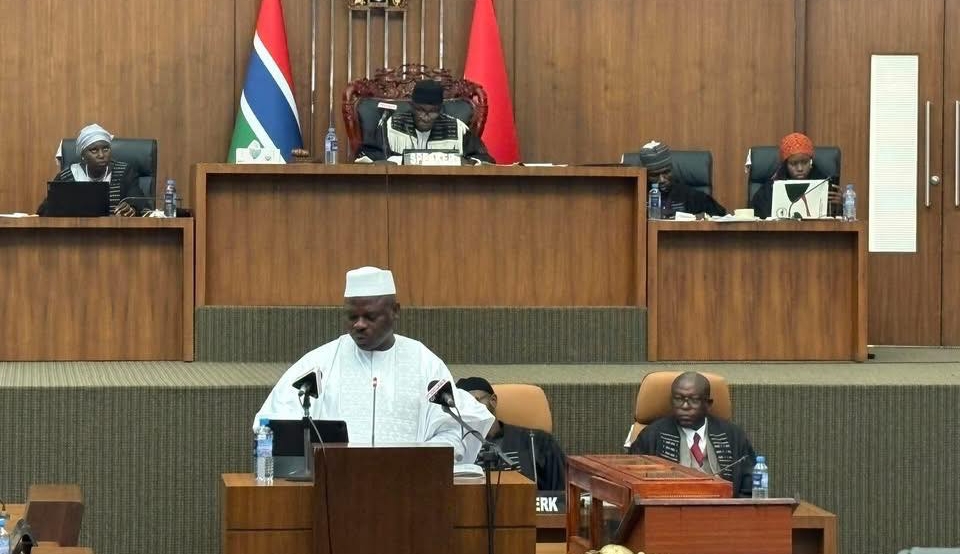
Gambiaj.com – (BANJUL, The Gambia) – The National Assembly has approved the Appropriation Bill, 2026, giving legal effect to a record D43.49 billion national budget that will fund government operations throughout next year.
The vote concludes a six-week scrutiny process that exposed gaps in public services, rising debt pressures, and growing public demands for accountability in the management of state resources.
The 2026 budget is one of the largest in the country’s history, rising sharply from D37.85 billion in 2025 and underscoring a trend in which government expenditure continues to outpace domestic revenue.
While ministries such as Agriculture, Higher Education, and the Independent Electoral Commission recorded substantial increases, the most striking allocation is the D13.45 billion earmarked for debt servicing, the single largest expenditure across all sectors.
This means a significant portion of taxpayers’ money will go toward repaying old loans rather than improving public services.
Education remains one of the highest-funded sectors, with the Ministry of Basic and Secondary Education receiving more than D5.9 billion.
The Ministry of Health has been allocated D3.1 billion for hospitals, medicines, and personnel. Agriculture, which supports the majority of rural households, sees an 87% rise to D1.7 billion, a boost aimed at addressing years of concerns over inadequate farmer support.
However, despite increased allocations, public skepticism remains high. Many Gambians question whether the larger budget will translate into real improvements, as frustrations persist over hospital shortages, overcrowded classrooms, rising transport fares, youth unemployment, and the rising cost of basic commodities.
Citizens argue that a budget of this magnitude must deliver measurable improvements in their daily lives, not just larger figures in government documents.
Government revenue for 2026 is projected at D32 billion, up from D29 billion in 2025, driven mainly by taxes and improved collections in the Ministries of Interior, Health, and Fisheries.
Yet the gap between revenue and expenditure remains wide, and continued reliance on borrowing has raised concerns about long-term sustainability, especially with debt repayment now consuming such a large share of national income.
The budget was first presented on 31 October 2025 by the Minister of Finance and Economic Affairs and formally tabled as the Appropriation Bill, 2026, on 5 December, in line with Section 152(3) of the Constitution and Assembly Standing Orders.
During six weeks of debate, lawmakers scrutinized ministry allocations, questioned the justification behind expenditure increases, and warned of waste, mismanagement, and duplication across government institutions.
Government maintains that the budget is designed to strengthen human capital, expand public services, and support national development. But with the cost of living rising and debt pressures mounting, many Gambians are watching closely to see whether this record spending plan will bring tangible relief to homes, farms, classrooms, and hospital wards.
As the new fiscal year approaches, the central question is no longer how much government plans to spend, but whether the funds will be used efficiently and transparently, and in ways that truly serve the public interest. The 2026 budget sets the stage; the coming year will determine whether it delivers.