

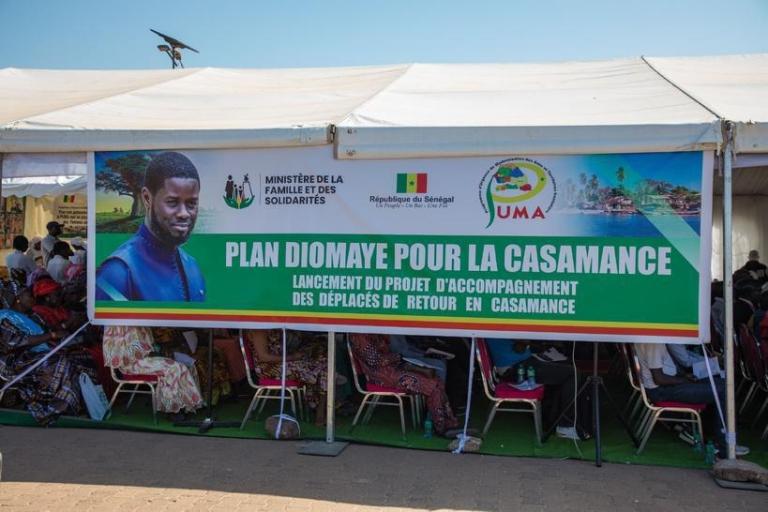
Gambiaj.com – (ZIGUINCHOR, Senegal) – A diagnosis of the implementation of the Diomaye Plan for Casamance (PDC) has uncovered significant delays, institutional weaknesses, and unfulfilled commitments, raising concerns over the effectiveness of the emergency program designed to support displaced returnees in southern Senegal.
The findings were presented on Tuesday in Ziguinchor during a regional planning workshop organized by the National Agency for the Revival of Economic and Social Activities in Casamance (ANRAC), with technical support from the Agricultural and Rural Prospective Initiative (IPAR). Similar workshops are scheduled to take place in Sédhiou and Kolda.
According to the report prepared by IPAR at ANRAC’s request, the PDC continues to face serious structural and operational challenges, including weak coordination, poor communication, and the failure of sectoral ministries to honor key commitments.
These shortcomings, the report notes, have slowed the effective operationalisation of the plan, which was conceived as an emergency response for displaced populations returning to Casamance.
ANRAC was tasked with coordinating and monitoring the PDC following an Interministerial Council held on October 8, 2024, with the aim of ensuring coherent implementation in collaboration with Regional Steering Committees.
However, the national diagnosis, based on interviews with sectoral ministries, technical departments, public agencies, non-governmental organizations, and development projects operating in the region, reveals the absence of a consolidated operational planning document, persistent delays in execution, and management gaps that limit the visibility and measurement of results.
Weak Implementation, Unmet Sectoral Commitments, and Poor Coordination
Among the key weaknesses identified are the poor ownership of Interministerial Council decisions by public institutions, the late appointment of national focal points, and the non-implementation of several critical resolutions.
Notably, public financing mechanisms such as ADEPME, FONGIP, DER/FJ, and BNDE have yet to deploy formal interventions with dedicated funding to support very small enterprises, small and medium-sized enterprises, and artisans targeted by the plan.
In several cases, no field-level activities were recorded, largely due to insufficient information on displaced returnees and limited engagement with ANRAC.
The report further highlights that the lack of a concerted planning framework has constrained ANRAC’s ability to effectively coordinate interventions, generate reliable data, and facilitate information-sharing among stakeholders.
Inadequate communication around the PDC has also contributed to widespread confusion, with many potential partners viewing it as a conventional regional development initiative rather than an emergency mechanism focused on the reintegration of displaced populations.
Territorial coordination gaps were also flagged, particularly in the regions of Sédhiou and Kolda, where some public entities have reportedly carried out interventions without informing regional steering committees or local authorities, despite the latter holding critical data on targeted beneficiaries.
Speaking at the workshop, ANRAC Director General Ibra Sané described the meeting as “highly important” and timely. He acknowledged that the PDC, as initially launched, was largely based on sectoral intentions and costed projects, without a coherent framework aligned with Senegal’s 2050 Agenda.
Sané admitted that several commitments made since October 2024 had not been fulfilled by sectoral ministries, underscoring the importance of the diagnostic and updating exercise conducted by IPAR.
Also addressing participants, Cheikhou Oumar Ba, Minister Advisor to the Presidency of the Republic, acknowledged the shortcomings identified in the implementation of the PDC while welcoming the proposed corrective measures.
He called for the establishment of a harmonization mechanism to better align interventions with ongoing government initiatives, including the South Agropole project and the development of agricultural cooperatives, in order to strengthen the plan’s economic impact.
Ba noted that the participation of the military command of the southern zone in the workshop reflected the state’s commitment to peace consolidation and stability in Casamance.