


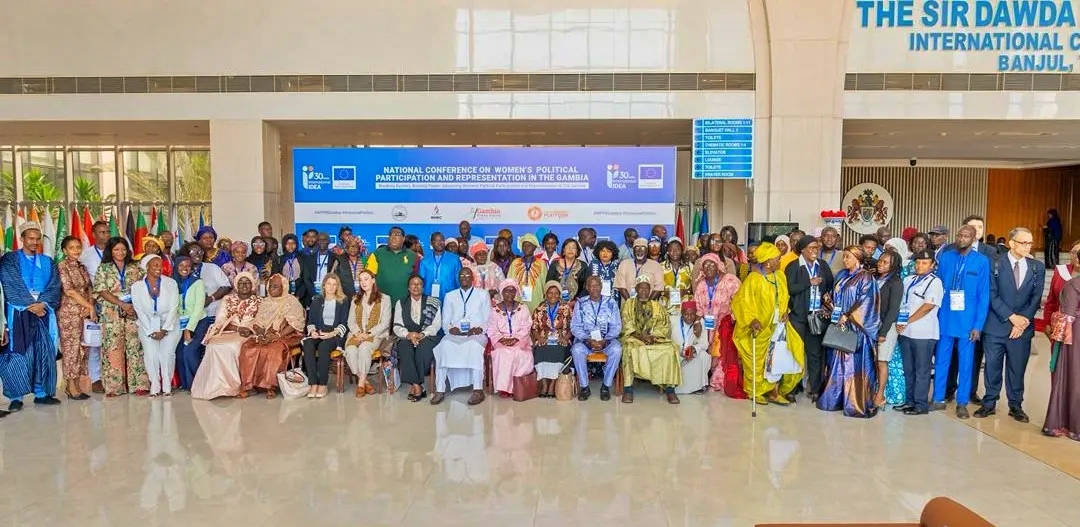
Gambiaj.com – (BANJUL, The Gambia) – Eighteen of The Gambia’s twenty-two registered political parties have signed a landmark communiqué pledging concrete measures to advance women’s political participation and representation, following the successful conclusion of a two-day National Conference on Women’s Political Participation and Representation.
Held from 15–16 December at the Sir Dawda Kairaba Jawara International Conference Center, the conference was convened by the International Institute for Democracy and Electoral Assistance (International IDEA) under the EU-CODE-funded project, in partnership with the National Assembly, National Human Rights Commission, Gambia Press Union, and the CSO Gender Platform.
Historic Communiqué Adopted
Under the theme “Breaking Barriers, Building Power: Advancing Women’s Political Participation and Representation in The Gambia,” the conference brought together a wide array of national stakeholders to assess the state of women’s political engagement and agree on actionable reforms ahead of the country’s next electoral cycle.
Delegates acknowledged that, despite notable strides in democratic reform, women remain underrepresented in political decision-making. Currently, women occupy only 8.6% of National Assembly seats and 14.2% of Cabinet positions and hold similarly low representation in local governance, despite constituting more than half of the population and the majority of registered voters.
The conference reaffirmed The Gambia’s commitments under national, regional, and international frameworks, including the Women’s Act, National Gender Policy, CEDAW, the Maputo Protocol, ECOWAS Gender Policy, and the Sustainable Development Goals (SDGs 5 and 16).
Addressing Barriers and Creating Inclusive Political Spaces
Participants highlighted several challenges hindering women’s political participation. These included entrenched patriarchal norms, economic and campaign finance barriers, the absence of enforceable gender quotas, limited political literacy and leadership training, and the prevalence of political violence and harassment, including digital abuse.
Delegates also pointed to gender-biased media narratives, weak party support structures, and insufficient family and community backing for women aspirants.
The communiqué adopted at the conference outlined a comprehensive framework to address these barriers.
Political parties and other stakeholders committed to strengthening women’s participation through gender-sensitive electoral reforms, including lowering nomination fees, introducing gender quotas in electoral laws, and enabling civil servants, particularly women, to take paid leave to contest elections without reproach.
Efforts will also focus on enhancing women’s representation within party leadership structures and candidate nomination processes, alongside mentorship and leadership pipelines, while promoting safe and inclusive political environments through the enforcement of laws against gender-based and political violence, provision of candidate security, and establishment of independent reporting mechanisms.
In addition, the communiqué called for mobilization of resources and partnerships, including advocacy for a national women’s political empowerment fund, dedicated party budgets for women candidates, and strengthened collaboration with civil society, the private sector, and development partners.
It further emphasized the need to amplify women’s voices and shift public perceptions through fair media coverage, national awareness campaigns, engagement with traditional and religious leaders, and expanded use of local languages and digital platforms.
The communiqué was formally adopted through motions moved and seconded by representatives across political parties, independent members, youth and women’s organizations, local government, and national institutions.
The final adoption was moved by H.E. Fatoumatta Jallow Tambajang, Former Vice President of The Gambia, and seconded by Mr. Joseph Colley, Chairman of the Independent Electoral Commission (IEC).
By signing the communiqué, the 18 political parties joined civil society, state institutions, and development partners in affirming that women’s equal participation in politics is a democratic imperative, not a privilege.
The conference concluded with a collective call for all stakeholders, including the government, political parties, civil society, the private sector, traditional authorities, development partners, and the Gambian public, to translate these commitments into tangible action ahead of the next elections.