

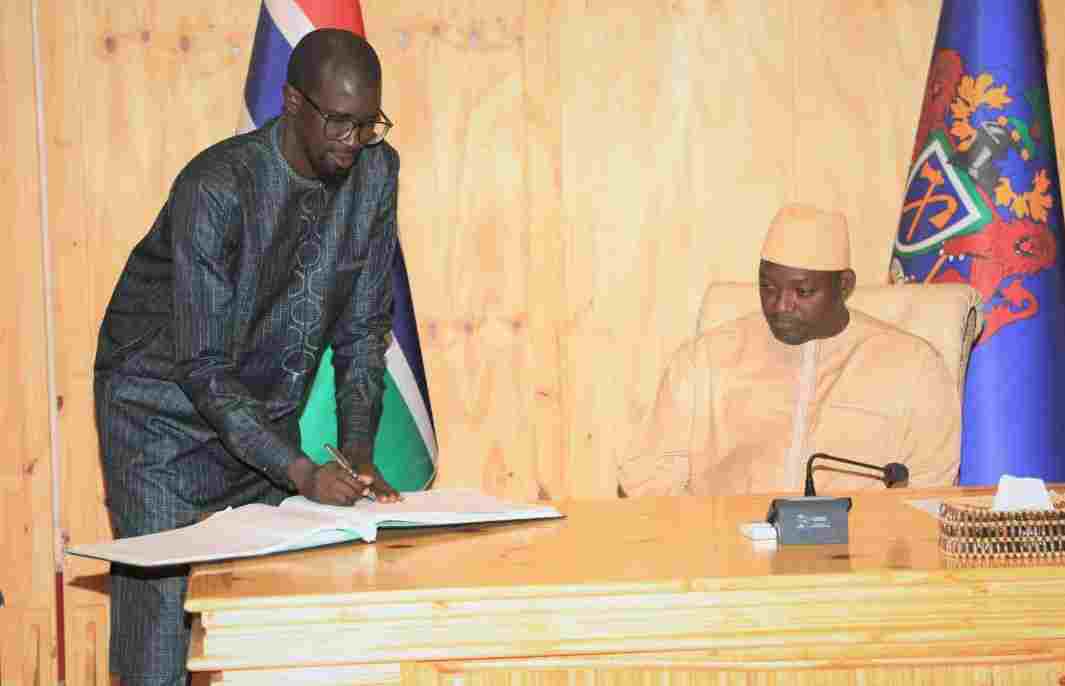
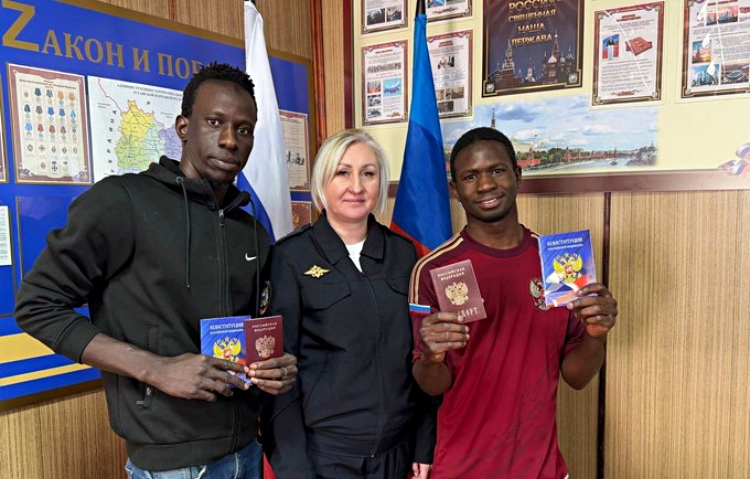
Gambiaj.com – (BANJUL, The Gambia) – Two young men from the Republic of The Gambia, Jallow Malik and Dibba Modou, were on Wednesday showcased on the “News of Donbass” Telegram and X (formerly Twitter) channels after receiving Russian citizenship following their service with the Russian Armed Forces in Ukraine’s Luhansk People’s Republic (LPR).
These men are just a few examples of the growing number of African recruits who have been entangled in Russia’s military operations, often lured by promises of citizenship, financial incentives, and the opportunity to fight in conflicts far from their homeland.
Gambian Fighters Spotlighted on Pro-Russian Propaganda Channels
According to the announcement on the “News of Donbass” Telegram and X (formerly Twitter) channels, the two Gambians served on Russian-controlled territory in eastern Ukraine before applying for citizenship under Russia’s simplified procedure for foreign contract servicemen.
During a ceremonial event at the Slavyanoserbsk department of the Ministry of Internal Affairs, they reportedly took an oath of allegiance and were issued Russian passports.
The post framed their story as one of honor, opportunity, and reward, a narrative that mirrors hundreds of similar propaganda messages circulating across social media platforms in English, French, and African languages, designed to attract foreign recruits into Russia’s war effort.
Fast-Track Citizenship: Incentive or Trap?
Under Russian policy introduced and expanded during the Ukraine war, foreign nationals who sign a minimum one-year contract with the Russian Armed Forces can apply for citizenship after serving as little as six months.
The fast-track process waives requirements for prior temporary or permanent residency and, in some cases, extends eligibility to immediate family members.
By late 2025, these measures had become a central pillar of Moscow’s foreign recruitment strategy, promoted aggressively across Africa, Asia, and Latin America.
However, rights groups and investigators warn that the same policies are frequently used to bind migrants’ legal status to continued military service, limiting their ability to leave even after contracts expire.
Propaganda vs. Reality on the Battlefield
While images of Gambian, Nigerian, or Ghanaian men receiving Russian passports are portrayed as success stories, a growing body of testimony suggests a far darker reality behind the scenes.
A CNN investigation has uncovered extensive evidence that African men are being lured to Russia with promises of civilian employment — only to be coerced into military service and deployed to some of the deadliest front-line positions in Ukraine.
CNN reviewed hundreds of chat messages, contracts, visas, flight records, and hotel bookings and interviewed African fighters both still trapped in Ukraine and those who managed to escape.
Anne Ndarua: “They Lied to Them About Real Jobs”
Anne Ndarua, a Kenyan mother, says her only son, Francis Ndung’u Ndarua, traveled to Russia believing he had secured work as an electrical engineer. Six months later, she no longer knows if he is alive.
In December, Anne received a video of her son warning Africans not to accept job offers linked to Russia. “You’ll end up being taken to the military… and sent to the frontline battle,” Francis said. “Many friends have died in the name of money.”
Soon after, another video went viral showing Francis in uniform with a land mine strapped to his chest, as a Russian speaker hurled racist slurs and said he would be used to breach Ukrainian positions. Anne said she could not bring herself to watch it.
“They lied to them about real jobs, and now they’re in war with their lives in danger,” she told CNN, appealing to Kenyan and Russian authorities to intervene.
From Job Seekers to Disposable Fighters
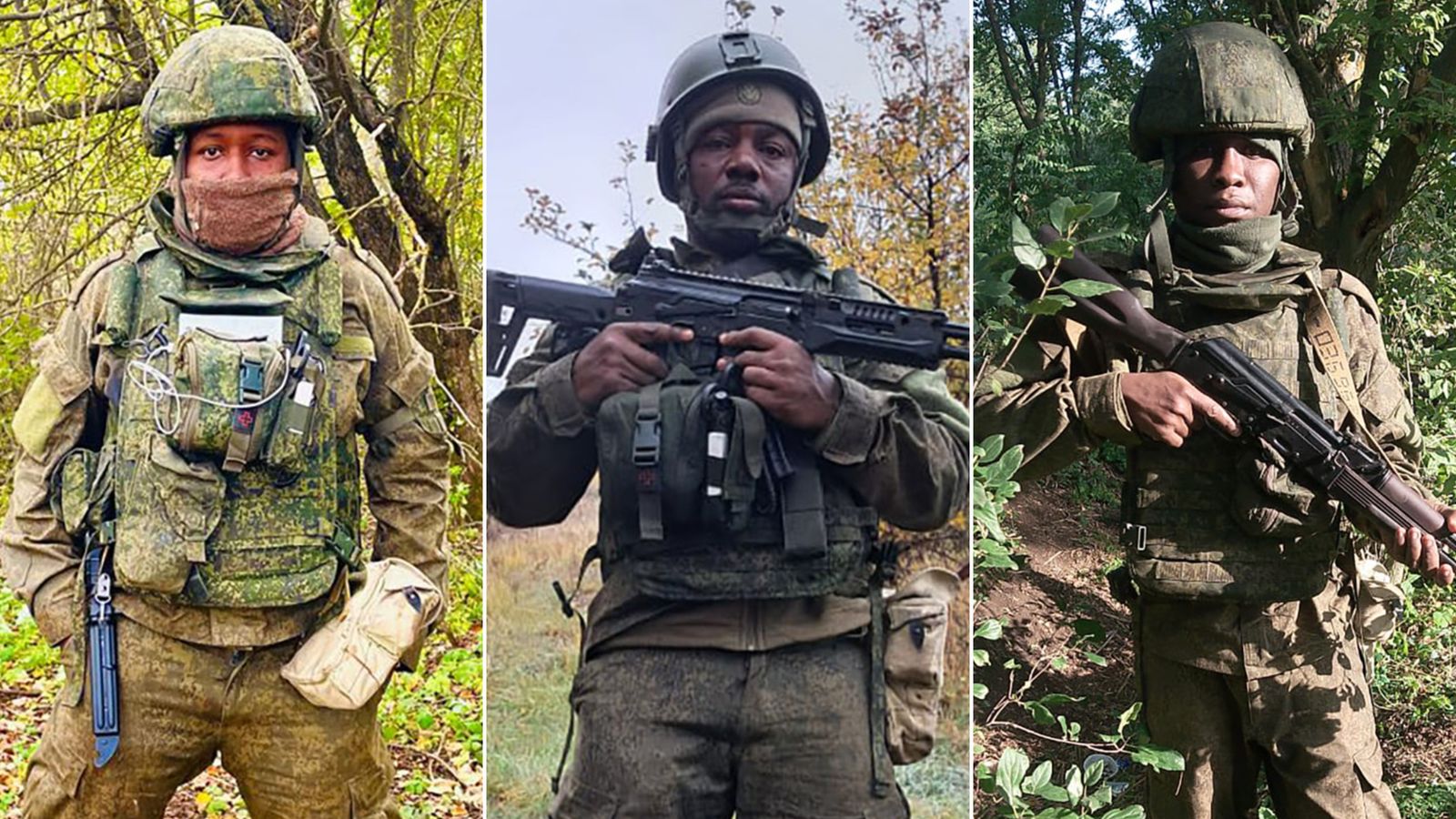
Francis, 35, had been unemployed and living with his mother near Nairobi when he paid about $620 to a recruitment agent. According to his family, he was forced into military training upon arrival in Russia and deployed to Ukraine after just three weeks.
CNN spoke with 12 African fighters still in Ukraine—from Kenya, Ghana, Nigeria, and Uganda—who said they were promised civilian roles such as drivers, technicians, or security guards. Many were offered signing bonuses of up to $13,000, monthly salaries as high as $3,500, and eventual Russian citizenship.
Instead, they described being forced to sign military contracts written in Russian, without legal advice or translation, and having their passports confiscated. None of the Africans interviewed said they spoke Russian, despite Russian law requiring language proficiency for foreign soldiers.
Patrick Kwoba: “You Escape or You Die”
Patrick Kwoba, a 39-year-old Kenyan carpenter, said he was promised a non-combat role and a $23,000 signing bonus after paying a recruiter about $620. Instead, he received three weeks of training before being sent into combat.
After being wounded in a drone and grenade attack, Kwoba said a Russian partner refused to help him and fired shots to drive him away. He later escaped to Kenya with assistance from the Kenyan embassy in Moscow.
“So long as you’ve stepped in the Russian military, you escape or you die,” he said.
Charles Njoki: “They’re Lying to People”
Kenyan photographer Charles Njoki applied directly through a Russian recruitment portal for a drone operator role, selling his car to finance the trip. His phone was confiscated during training, and he later learned his wife had miscarried.
He was deployed to the front without ever flying drones and was injured in a Ukrainian drone strike, leaving him with lasting injuries. He later fled Russia with embassy assistance.
“They’re lying to people,” he said. “The money they promise is not real.”
Governments React as Ukraine Warns Africa
Several African governments, including Kenya, Uganda, Botswana, and South Africa, have acknowledged the scale of the problem and warned citizens against recruitment schemes tied to Russia’s war.
Ukraine has urged African nations to halt the flow of recruits. “If they’re on the front lines, they’re our enemies, and Ukraine defends itself,” Ukraine’s ambassador to Kenya, Yurii Tokar, told CNN. “This pipeline should be stopped.”
Behind the Passports
For families like Anne Ndarua’s, glossy images of African men receiving Russian passports—such as those of the two Gambians celebrated on News of Donbass—offer little reassurance.
“What they show online is not the truth,” Anne said. “Our children are paying with their lives.”
As Russia’s war grinds on and manpower pressures mount, the contrast between propaganda triumphs and the testimonies of African fighters underscores a widening gap between promise and reality—one measured not in passports, but in blood.