





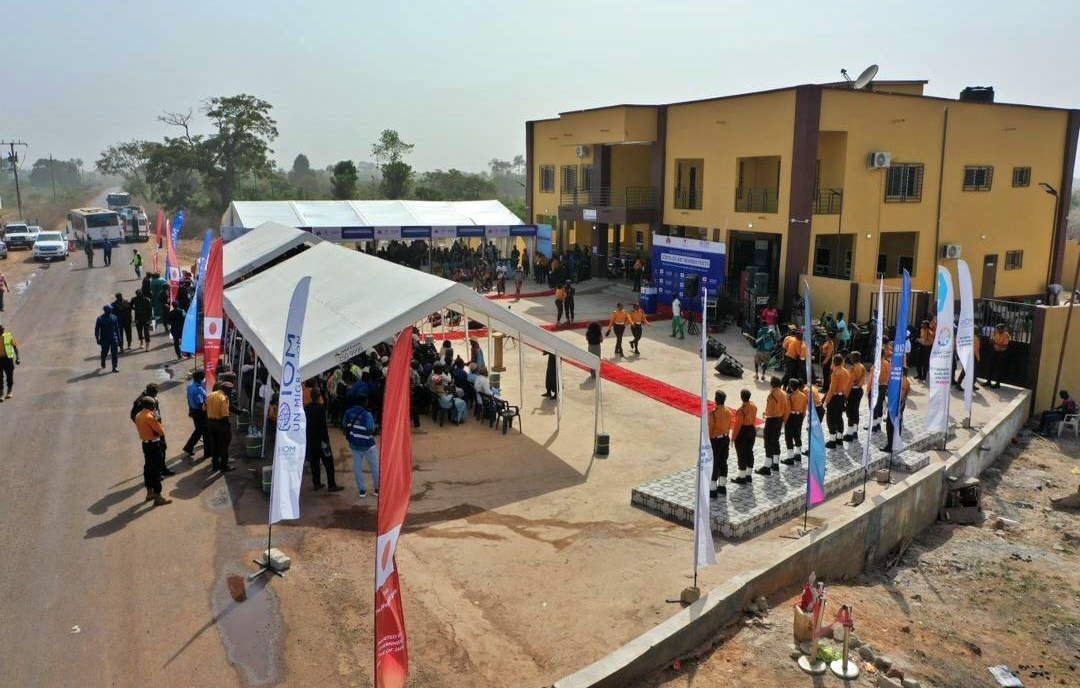
Gambiaj.com – (GIBORO, The Gambia) – The Government of The Gambia on Monday inaugurated three newly constructed immigration border posts at Giboro, Amdallai, and Kerr Ali (Farafenni), marking a significant upgrade in the country’s border management infrastructure.
The facilities were built under the project Enhancing Border Management Capacities of the Government of The Gambia to Promote Peace, Stability, and Security, funded by the Government of Japan and implemented by the International Organization for Migration (IOM).
Speaking at the inauguration ceremony in Giboro, IOM’s Chief of Mission for Senegal, with coordination functions for The Gambia, Sierra Leone, Cape Verde, and Guinea-Bissau, Ms. Aisata Kane, said the new border posts represented more than just physical infrastructure.
“Today’s ceremony represents far more than the completion of new buildings. It symbolizes a shared commitment to safe mobility, regional cooperation, and peace and stability,” Kane said.
She noted that the facilities support The Gambia’s national development priorities by improving border security, strengthening the rule of law, and combating migrant smuggling and human trafficking.
According to her, the project aligns with the Recovery-Focused National Development Plan (2023–2027), ECOWAS Free Movement Protocols, the African Union’s Agenda 2063, and the Global Compact for Migration.
The three border posts are equipped with secure office spaces, surveillance and fire safety systems, solar-powered energy, boreholes, gender-inclusive sanitation facilities and ten Migration Information and Data Analysis System (MIDAS) workstations at each site.
In addition, a document examination and MIDAS training laboratory has been established at Tanji.
IOM disclosed that 52 law enforcement officers were trained under the project on border procedures, document security, the ECOWAS Free Movement Protocol and the protection of vulnerable migrants.
Director General of the Gambia Immigration Department (GID), Mr. Ebrima Mboob, described the project as the outcome of years of planning and close cooperation between the government, IOM, and the Government of Japan.
“This journey started years ago following a joint border assessment that identified the need to better equip our borders,” Mboob said, adding that the facilities were constructed at some of the country’s most strategic entry points.
Japan’s Ambassador to Senegal, accredited to The Gambia, Guinea-Bissau, and Cape Verde, Mr. Takeshi Akamatsu, said the Japanese government supported the project with a contribution of about US$2.2 million.
“One distinctive aspect of this project is how it combines Japanese innovation with the practical needs of Gambian communities,” Akamatsu said, citing the installation of solar power systems, Wi-Fi connectivity, and solar-powered water boreholes capable of serving surrounding communities throughout the year.
He added that more than 1,300 border officials had benefited from specialized training under the initiative, stressing that effective border management enhances security while facilitating legitimate cross-border movement.
For his part, Interior Minister Abdoulie Sanyang said the facilities marked a new phase in The Gambia’s border governance.
“These structures represent progress in strengthening border management systems, promoting inter-agency cooperation, and supporting integrated border management practices,” Sanyang said.
He also highlighted the installation of the MIDAS system at the border posts, describing it as “a new era in border management” that would enhance security, data collection, and overall migration governance.
The government and its partners said the new facilities are expected to improve border security, support legal migration, boost cross-border trade, and contribute to peace and stability along the Gambia–Senegal border.