




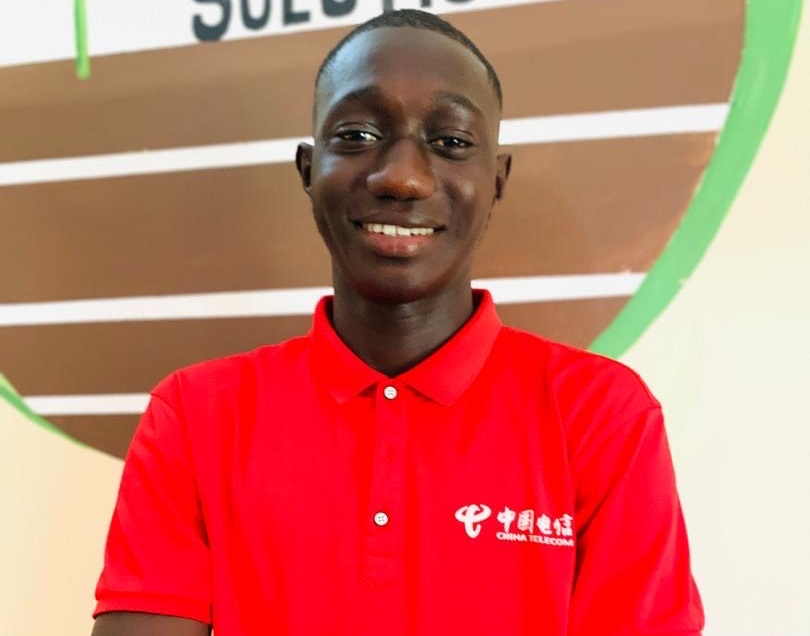
Gambiaj.com – (BANJUL, The Gambia) – For most Gambian children, receiving a scholarship is a moment of pure joy. For young Babou Secka, it was also the moment his voice publicly failed him.
Secka, who grew up in the provinces, recalls the day scholarship officials visited his home to announce that he would be featured on national television. He expressed his gratitude, but when the camera lights came on, the words would not.
His hands trembled, his body stiffened, and every sentence emerged in fragments. What was meant to be a joyful recording became one of the most painful memories of his childhood.
“There was no speech therapist, no guidance, and no awareness,” he later wrote, describing the challenges of navigating life as a child who stutters in a society that often misunderstands the condition.
Across rural Gambia, stuttering remains rarely discussed and poorly understood. Children who stutter are frequently labeled shy, stubborn, or unwilling to speak.
In many communities, families have no access to speech therapy or professional support. For Secka, this meant growing up in a world where silence often felt safer than ridicule.
He remembers going hours, sometimes an entire day, without speaking just to avoid being mocked. The loneliness, he said, was heavier than the speech difficulty itself.
Yet amid the isolation, Secka made a quiet but life-changing decision: he refused to let silence define him.
As he grew older, he began confronting the fear that had shaped his early years. He forced himself to speak even when the words stuck; he spoke even when people laughed. And with every broken sentence, he reconstructed his confidence.
Today, Secka speaks openly about stuttering. His voice may not always be fluent, but it is steady in purpose.
“I have learned that courage is not about speaking perfectly,” he wrote. “It is about speaking anyway.”
Now a student at the University of The Gambia (UTG), majoring in agriculture, Secka is working to establish an association for people who stutter. Advocate Lamin Sey says Babou’s story underscores the urgent need for awareness around speech disorders in The Gambia, an issue rarely addressed in public health, education, or policy spaces.
Without proper support, many children who stutter are left to navigate the condition alone, risking long-term emotional and academic consequences.
For Secka, sharing his story is more than personal healing; it is a mission. He hopes his voice, once a source of pain, can now inspire parents, teachers, and communities to better understand stuttering and support those who live with it.
His journey is a reminder that sometimes the strongest voices are the ones that once struggled to be heard.


One Response
Superb