


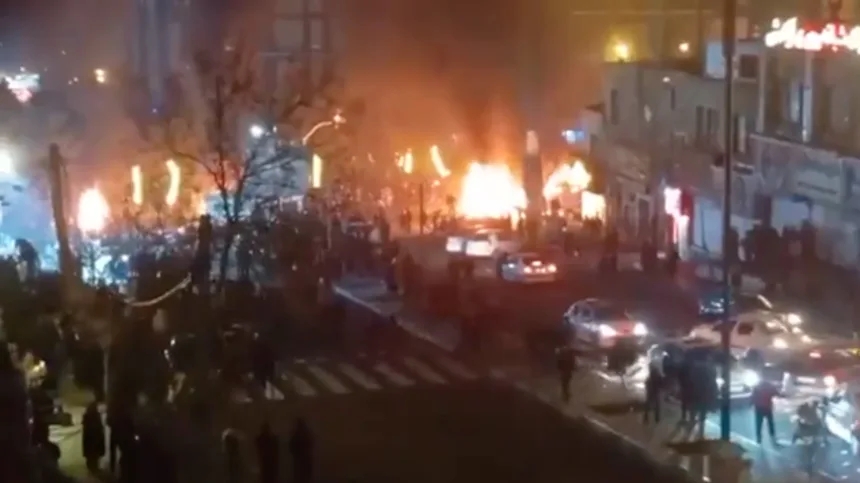
Gambiaj.com – (TEHRAN, Iran) – Anti-government protests erupted across Iran on Thursday, with thousands of demonstrators taking to the streets of Tehran and other major cities to vent anger over a collapsing economy, soaring prices, and the state’s heavy-handed security response. Protesters chanted slogans targeting the ruling theocratic system, signaling a growing and increasingly direct challenge to the authority of the Islamic Republic.
Iranian authorities swiftly cut internet access and telephone lines shortly after demonstrations began, a move widely seen as a precursor to a violent crackdown. Internet watchdog NetBlocks warned that nationwide blackouts are often imposed when deadly force is imminent, although videos of protests continued to circulate online despite the restrictions.
Footage verified by international media showed crowds blocking roads, setting fires, and rallying in cities across the country, including Tehran, Mashhad, Ilam, Lorestan, Mazandaran and Golestan provinces. In the capital, some demonstrators chanted, “This is the last battle, Pahlavi will return,” echoing calls by exiled Crown Prince Reza Pahlavi, who urged Iranians to unite and “take to the streets” in a message posted on X.
As unrest spread, President Donald Trump renewed his warning to Tehran, threatening military action if Iranian security forces kill protesters. “If they start killing people, which they tend to do during their riots, we’re going to hit them very hard,” Trump said in a radio interview on Thursday.
Economic Anger Fuels Nationwide Unrest
The protests have been driven primarily by severe economic hardship. Iran is grappling with rampant inflation, a rapidly depreciating currency, and shortages of basic goods, leaving millions struggling to meet daily needs. What began last month as localized demonstrations in Tehran’s bazaars and universities has steadily evolved into nationwide unrest, with economic grievances increasingly merging with political demands.
“This feels different because it’s about people’s buying power,” said a 30-year-old Tehran resident, speaking anonymously. “Prices keep going up almost hour by hour. People really can’t afford anything.”
The Grand Bazaar in Tehran, long considered a pillar of support for the Islamic Republic, emerged as a flashpoint last week after shopkeepers shut their businesses in protest of government policies. Tensions escalated further after the central bank ended a preferential dollar scheme for some importers, triggering overnight spikes in the prices of staples such as cooking oil and chicken and causing some goods to disappear from shelves.
In response, the reformist-led government announced modest cash handouts of nearly seven dollars per month, a move widely criticized as inadequate. President Masoud Pezeshkian acknowledged the scale of the crisis in a televised address, saying the government could not resolve the situation alone.
Deadly Crackdowns, Rising Defiance and Regional Fallout
Human rights groups say the state’s response has been increasingly violent. The Norway-based Iran Human Rights NGO reported that at least 45 protesters, including eight children, have been killed since demonstrations began on December 28, 2025. More than 2,000 people have reportedly been detained, with hundreds injured. The group accused security forces of using live ammunition and carrying out mass arrests.
Iranian state-affiliated Fars News Agency, however, said 950 police officers and 60 members of the Basij paramilitary force have been injured, describing protesters as “rioters” armed with weapons. Iranian media have also reported the deaths of at least five security personnel, including two members of the Islamic Revolutionary Guard Corps. Independent verification of casualty figures remains difficult due to media restrictions and the communications blackout.
Anger has been particularly intense in western and northern provinces, where protesters have openly called for the removal of Supreme Leader Ayatollah Ali Khamenei. Videos geolocated to Mazandaran showed crowds chanting, “This is the year of blood… Seyyed Ali is going to fall,” while other footage captured damage to government buildings and the tearing down of Iranian flags in Mashhad, Khamenei’s hometown.
The unrest has drawn comparisons to the 2022 protests sparked by the death of Mahsa Amini in police custody, but analysts say the current wave is distinct because of the central role played by bazaar merchants and the depth of economic despair. Iranian-American journalist and activist Masih Alinejad said the demonstrations have moved beyond calls for reform. “They’re saying this regime can no longer be reformed. They want an end to the Islamic Republic,” she said.
Despite the scale of the protests, experts caution that the absence of unified leadership or a clear political alternative makes regime change unlikely in the short term. Still, they warn that the unrest underscores a deep legitimacy crisis confronting Iran’s leadership.
“The only tool the Islamic Republic truly has left is coercion and force,” said Arang Keshavarzian, an associate professor at New York University. “Large segments of the population have lost trust in the regime and don’t believe it is willing or able to address their grievances.”
With sanctions biting, corruption entrenched, and the prospect of renewed conflict with the United States and Israel looming, Iran’s leadership faces mounting pressure as protests enter their second week, marking the most serious challenge to the regime since the 2022 uprising and last year’s brief war with Israel.