


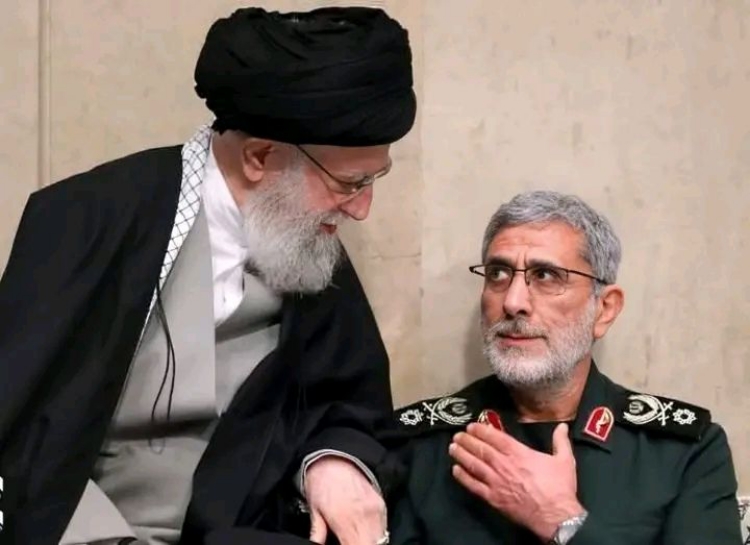
Gambiaj.com – (TEHRAN, Iran) – On 3 January 2020, Esmail Qaani assumed command of the Quds Force of the Islamic Revolutionary Guard Corps (IRGC), within hours of Qasem Soleimani’s death in a U.S. drone strike ordered by then-President Donald Trump near Baghdad International Airport.
As head of the external operations arm of the IRGC, Esmail Qaani inherited one of the most sensitive portfolios in the Islamic Republic: oversight of Iran’s foreign paramilitary networks and strategic alliances across the Middle East.
Unlike Soleimani, whose battlefield visibility elevated him to near-mythic status, Qaani has maintained a lower public profile.
Yet structurally, his authority has been no less significant. As Quds Force commander, he reports directly to the Supreme Leader and exercises influence over Iran’s proxy coordination, intelligence channels, and expeditionary military planning.
A Pattern of Survival
In recent months, Qaani’s name has surfaced not for operational achievements, but for what critics describe as a pattern of improbable survival.
Following the reported death of Supreme Leader Ali Khamenei in joint U.S.–Israeli strikes on February 28, attention quickly turned to Qaani.
Unofficial accounts circulating in regional media claim he was present at a high-level meeting shortly before the strike but departed minutes before the attack. He survived. Many other senior figures did not.
This was not an isolated episode.
On September 27, 2024, Israeli airstrikes in Lebanon killed Hezbollah leader Hassan Nasrallah. Reports indicated Qaani had been in Lebanon and in proximity to senior leadership before the strike. Again, he emerged unharmed.
During the recent Iran–Israel escalation referred to in regional commentary as the “12-day wars,” several high-ranking Iranian officials were killed or wounded in precision strikes targeting command infrastructure. Qaani was reportedly not far from the impact zones.
Individually, each incident could be explained by operational timing, security protocols, or simple chance. Collectively, however, they have generated suspicion within segments of Iran’s political and security ecosystem.
Espionage Allegations Gain Traction
Over the past 48 hours, social media narratives have escalated dramatically. Hardline commentators have ironically labeled Qaani “the luckiest man in Iran.” More severe accusations allege he may be linked to foreign intelligence services, including Israel’s Mossad or even U.S. agencies.
There is no verified evidence supporting these claims. Iranian authorities have not issued any official statement confirming investigations, charges, or internal disciplinary measures. Independent corroboration is absent.
Yet the structure of the allegations reveals deeper systemic anxiety. Precision strikes that repeatedly eliminate top-tier leadership suggest either exceptional adversarial intelligence capabilities or possible internal leakage.
In highly securitized institutions such as the IRGC, recurring decapitation strikes almost inevitably trigger counterintelligence paranoia.
Institutional Stakes
The Quds Force operates through compartmentalized networks spanning Iraq, Syria, Lebanon, Yemen, and beyond. Trust, loyalty, and operational secrecy are foundational. Any erosion of confidence in its commander carries strategic risk.
Three potential implications stand out. Even unproven allegations could prompt quiet internal investigations within IRGC ranks. Such probes can disrupt operational tempo and strain elite cohesion.
Iran’s power structure contains competing ideological and institutional factions. In moments of leadership transition or crisis, accusations of foreign collaboration can function as political weapons.
Psychological warfare or not, narratives portraying infiltration at the highest levels serve adversarial objectives. Information warfare amplifies suspicion faster than official rebuttals can contain it.
The Optics Problem
In authoritarian security systems, survival amid repeated high-level assassinations can paradoxically become a liability. Visibility at critical junctures, combined with absence at moments of impact, creates perception challenges.
For Qaani, the issue may be less about proof and more about optics. In environments where regime survival hinges on deterrence credibility, the appearance of intelligence penetration can be destabilizing.
As of now, Qaani remains in command of the Quds Force. There has been no formal confirmation of misconduct, no public inquiry, and no documented disciplinary action.
But in the wake of leadership decapitations and intensifying external pressure, the commander once viewed as a continuity figure has become a focal point of suspicion.
Whether these allegations reflect internal power struggles, external disinformation campaigns, or deeper structural breaches remains unclear.
What is evident is that Esmail Qaani now stands at the center of Iran’s most sensitive security debate, no longer simply as Soleimani’s successor but as a figure whose survival has become politically consequential.