

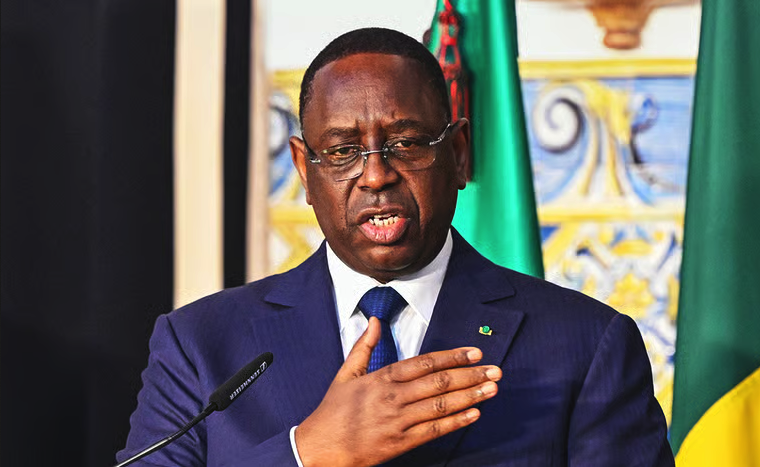


Gambiaj.com – (DAKAR, Senegal) – Former Senegalese president Macky Sall has formally set out why he believes he is the best candidate to lead the United Nations, arguing in a six-page vision document that the world body faces “growing distrust” and an “unprecedented risk of weakening” that demands experienced and pragmatic leadership.
In his note titled “My Vision as a Candidate for the Post of Secretary-General of the United Nations”, transmitted on March 2 to Annalena Baerbock, President of the 80th session of the General Assembly, and Michael G. Waltz, President of the Security Council for March 2026, Sall presents himself as a reformer capable of restoring credibility and effectiveness to a strained multilateral system.
“The UN Must Be Reformed, Rationalised and Modernised”
According to details published by Jeune Afrique, Sall does not soften his assessment of the global order. “The world is today undergoing a profound crisis,” he writes, warning that the UN itself is suffering from declining confidence among member states and operational inefficiencies.
His central argument is that the organisation’s immense potential is being undermined by institutional inertia and geopolitical fragmentation. To address this, he structures his programme around three strategic pillars.
Firts, it is about forging an integrated vision of peace, security, development and shared prosperity. The second pillar is the renovating and revitalising of multilateralism. And finally, it is about strengthening UN governance structures.
Sall pledges to transform the UN into a “revitalised strategic platform” rooted in its founding mandate but adapted to contemporary and future realities.
He emphasises rebuilding trust among member states, preventing crises, resolving conflicts, promoting development, and protecting vulnerable populations.
A key plank of his platform is long-debated reform of the Security Council, alongside revitalising the General Assembly and deepening collaboration with regional organisations, particularly in conflict prevention and resolution, areas where he argues costs have become unsustainably high for the organisation.
Experience as His Core Argument
To justify his candidacy, Sall points to what he describes as four decades of public service in Senegal and significant international exposure, including his tenure as Chair of the African Union and leadership roles in continental and global partnerships.
He frames his leadership style as grounded in experience and pragmatism, anchored in respect for state sovereignty and guided by predictable, disciplined, results-oriented governance.
His promise: a UN that ensures peace and security, uses resources wisely, and delivers outcomes governments can defend before their citizens.
His candidacy, accompanied by a two-page curriculum vitae, was officially transmitted by Zéphyrin Maniratanga, Burundi’s Permanent Representative to the UN. Burundi, which currently holds the rotating presidency of the African Union, formally presented Sall as a candidate to succeed António Guterres, whose term ends on December 31.
What Are His Chances?
Sall joins two other declared contenders: former Chilean president Michelle Bachelet and Rafael Grossi, Director General of the International Atomic Energy Agency.
Both Bachelet and Grossi come from Latin America, a region lobbying strongly for the post under an informal regional rotation principle.
Additionally, many UN member states have advocated for the appointment of a woman for the first time in the organisation’s history, criteria Sall does not meet.
However, his supporters argue that geopolitical realities may outweigh symbolic considerations. The decisive factor will be the Security Council, particularly its five permanent members, China, the United States, Russia, France and the United Kingdom, each wielding veto power.
Sall’s camp stresses that he has no major diplomatic disputes with any of the so-called P5. Chinese President Xi Jinping co-chaired the Forum on China-Africa Cooperation with him, while Russian President Vladimir Putin reportedly appreciated his neutrality and abstentions during contentious votes at the Human Rights Council concerning Russia.
Moreover, the current composition of the Security Council could be advantageous. Three African states are serving as non-permanent members this year, while Bahrain and Pakistan, both members of the Organisation of Islamic Cooperation, sit on the Council, an institution Sall is familiar with from his time engaging Islamic multilateral forums.
A Bid for Consensus in a Polarised Era
Despite facing criticism at home from Senegal’s new leadership, Sall appears determined to present himself internationally as a consensus candidate at a time when consensus has been elusive within the UN system.
His immediate strategic objective is to secure unified endorsement from the African Union, a move that would significantly strengthen his legitimacy and bargaining power ahead of the opaque Security Council straw polls that traditionally determine the Secretary-General.
In a race shaped less by campaign rhetoric than by diplomatic arithmetic, Sall’s argument rests on institutional experience, geopolitical acceptability, and reformist ambition.
Whether that combination is sufficient to overcome regional rotation demands and gender expectations will ultimately depend on the calculations of the world’s most powerful capitals.