





Gambiaj.com – (BANJUL, The Gambia) – Myanmar’s military regime has warned its nationalist supporters to exercise restraint during protests against ongoing genocide hearings at the International Court of Justice (ICJ), cautioning that anti-Rohingya hate speech or other provocative actions could weaken the junta’s legal defense.
The warning comes as a junta delegation, led by ministers Ko Ko Hlaing and Thida Oo, attends hearings at The Hague from January 12 to 29 in a case brought by The Gambia, which accuses Myanmar of committing genocide against the Rohingya Muslim minority in Rakhine State.
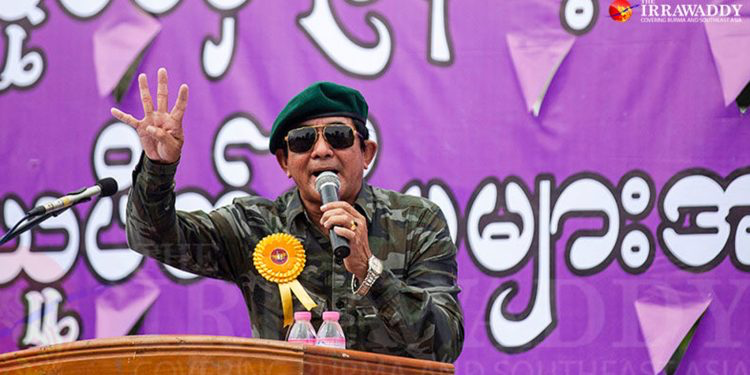
In a four-point directive, the military urged supporters—particularly members of the ultranationalist Association for the Protection of Race and Religion (Ma Ba Tha)—to avoid racially charged language, inflammatory placards, or derogatory references to the Rohingya during rallies planned in Yangon and Mandalay.
Protesters were also told not to criticize or pressure the ICJ or its judges, and instead emphasize the junta’s claimed adherence to international law.
The regime’s warning appears aimed at distancing itself from a long history of anti-Rohingya and anti-Muslim rhetoric by nationalist monks and groups aligned with the military. This includes incendiary sermons delivered during the 2017 Rakhine crackdown by Sitagu Sayadaw, a prominent monk and former Ma Ba Tha vice chair with close ties to the junta’s leadership.
During the hearings, The Gambia’s legal team presented extensive evidence of hate speech by senior monks, nationalist organizations, and pro-military figures—including Sitagu Sayadaw and ultranationalist monk Wirathu—arguing that such rhetoric demonstrated genocidal intent.
International law expert Daw Zar Li Aye said evidence of hate speech forms a central pillar of The Gambia’s case, which alleges a systematic effort to eradicate the Rohingya as a group. She said the junta’s attempt to rein in its supporters reflects concern that new incidents of hate speech could further strengthen the case before the ICJ.
“From a legal perspective, failure to curb hate speech can be interpreted as tacit approval of persecution,” she said. “It is clear that The Gambia is framing such rhetoric as evidence of genocidal intent. The regime is warning against hate speech not out of respect for human rights, but because fresh statements could be used against it at the ICJ.”
In its defense, the junta has argued before the court that hate speech by monks, political groups, or nationalist figures cannot be attributed to the state. “Even if those who spread hate speech have genocidal intent, this does not mean the state shares that intent,” the defense team was quoted as saying by junta-controlled media.
At the same time, state-run outlets have continued to highlight statements of support from religious associations, business groups, and political parties—an effort analysts say is intended to project an image of broad public backing for the regime.
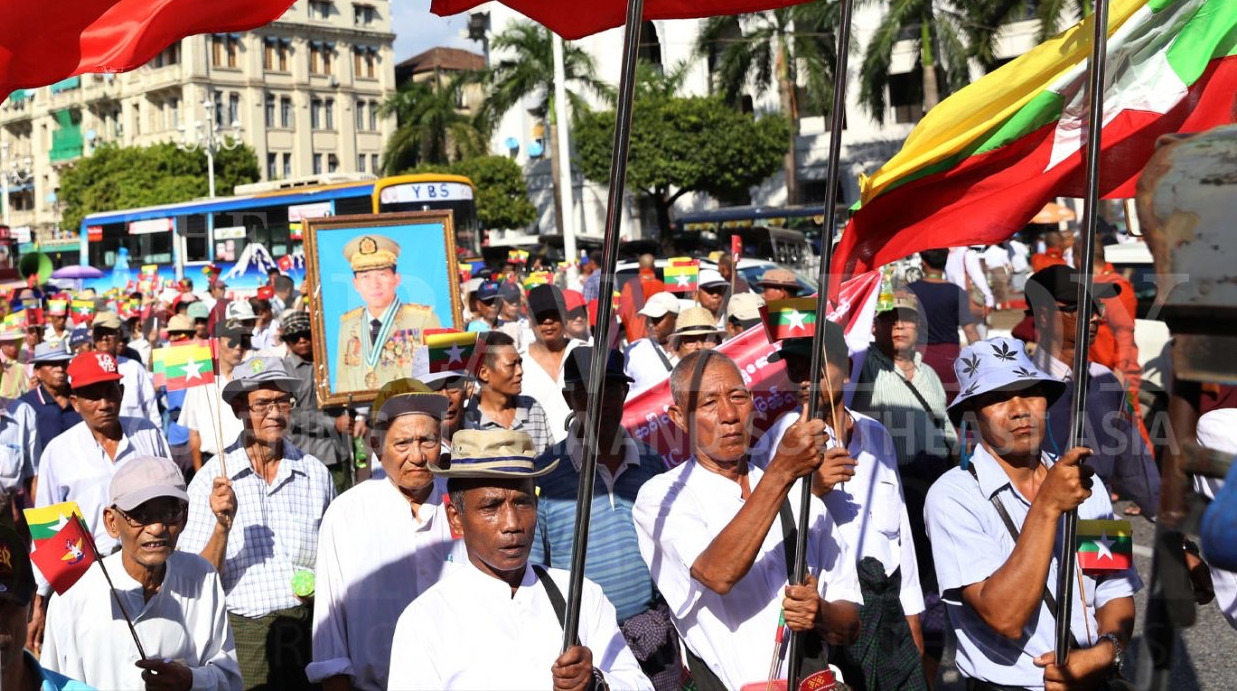
Nationalist groups, former Ma Ba Tha members, and pro-military networks are planning rallies in Yangon and Mandalay on January 27, one day after the conclusion of the junta’s three-phase election.
Held under heavy security five years after the military ousted the elected government and imprisoned its leaders, the vote is widely dismissed by critics as a sham designed to entrench military rule.
The ICJ case stems from the military’s 2016–2017 operations in northern Rakhine State following attacks by the Arakan Rohingya Salvation Army. Those operations saw widespread killings, village burnings, and mass displacement of Rohingya civilians.
More than 700,000 Rohingya fled to neighboring Bangladesh, where over one million now live in overcrowded and impoverished refugee camps. The Gambia filed the genocide case against Myanmar in 2019.
Myanmar’s junta leader, Min Aung Hlaing—who oversaw the Rakhine operations as army chief—also faces an international arrest warrant in a separate genocide case filed in Argentina.