

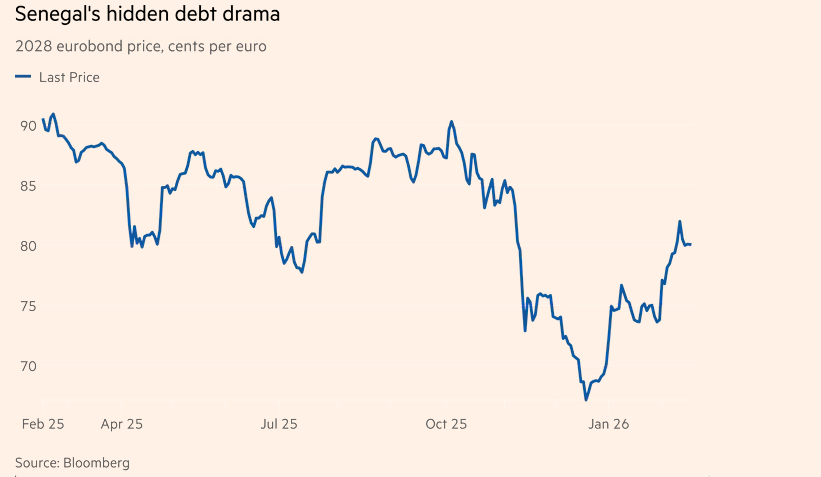
Gambiaj.com – (DAKAR, Senegal) – As Senegal edges closer to default, an unexpected lifeline has emerged on the regional debt market, the Financial Times reported this Wednesday, February 18, 2026.
Cut off from international markets following the “hidden debt” scandal and facing uncertainty over a possible IMF bailout, Dakar has heavily shifted its financing needs toward the WAEMU regional market in 2026. However, the identity of a major buyer based in Togo is raising many questions, according to the British newspaper.
Data analyzed by the Financial Times reveal a striking statistical anomaly. Of the 510 billion CFA francs (about $900 million) in securities issued by Senegal since the start of the year, one-third has been purchased by Togolese investors.
Yet, during the first auction of the year on January 16, Togolese participation was negligible, the newspaper noted.
The turning point came the same day, during a second issuance, when a Togolese financial “whale” secured its entire bid worth nearly 51 billion CFA francs.
The same scenario was repeated on January 30 (60 billion CFA francs, fully allocated) and again on February 6 (60 billion CFA francs, fully allocated on six-month securities), according to the article by Joseph Cotterill.
“There are not many Togolese banks that have the capacity to deploy the equivalent of $300 million into Senegalese bonds within a few weeks,” the Financial Times journalist observed.
Who is behind these purchases?
Attention has turned to major financial institutions based in Lomé. Ecobank, whose headquarters is in Togo, formally denied any direct involvement by its local subsidiary, telling the Financial Times, “Our subsidiary, Ecobank Togo, did not participate in the acquisition of this specific issuance.”
Another possibility mentioned by the newspaper is the West African Development Bank (BOAD), also based in Lomé. When questioned, the institution remained evasive, stating that its role is to finance development and referring inquiries to the UMOA-Titres agency for auction details.
These liquidity injections are critical for Senegal, which must meet a repayment of €330 million next month.
Abdoulaye Ndiaye and Martin Kessler of the Finance for Development Lab, quoted by the Financial Times, warned that this strategy of relying on the domestic market carries risks: “The Senegal episode is not just a national issue; it is testing the resilience of WAEMU’s integrated sovereign banking system.”
The mystery remains unresolved as Senegal prepares its next bond issuance on February 20. Will the Togolese investor once again step in?