


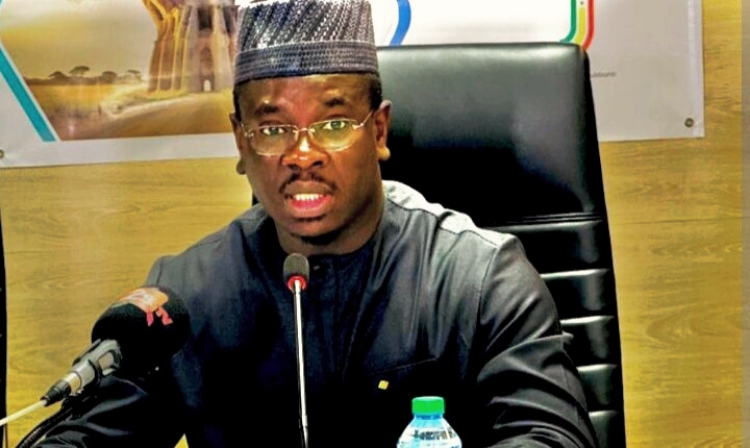
Gambiaj.com – (DAKAR, Senegal) – Senegal’s Energy Minister Birame Souleye Diop is facing mounting scrutiny after issuing conflicting statements this week over the possible nationalization of the strategic Yakaar-Teranga gas field—raising concerns about policy coherence and investor confidence at a critical juncture for the country’s energy ambitions.
On Tuesday, Minister Diop publicly declared that the government intended to nationalize the field, where state-owned Petrosen holds 10 percent and US-based Kosmos Energy the remaining 90 percent.
His remarks immediately triggered alarm within the industry, casting doubt on Senegal’s commitment to legal predictability as the country seeks to attract large-scale investment into its emerging oil and gas sector.
Kosmos Energy’s stock price fell 6.1% by 4:37 PM GMT on Wednesday in New York, a sharp decline that pushed the share to its lowest level in five years and underscored mounting investor concerns over the future of the company’s assets in Senegal.
Yet two days later, Kosmos Energy said it had received assurances from the very same ministry that directly contradicted the minister’s earlier position.
In a statement shared with Reuters and reported on December 11, 2025, the company said the Senegalese Ministry of Energy had “confirmed it has no plans to nationalize” the Yakaar-Teranga field.
The whiplash effect of these opposing messages, delivered within 48 hours and to different interlocutors, has deepened uncertainty among investors already wary of delays and governance risks in Senegal’s hydrocarbons rollout.
Analysts note that such mixed signals complicate the country’s efforts to present itself as a reliable destination for long-term, capital-intensive energy investments.
The timing is especially sensitive. Yakaar-Teranga is central to Senegal’s long-term gas strategy, expected to supply domestic power generation and future liquefied natural gas export projects. Kosmos became the operator in 2023 after BP’s exit, making the Texas-based firm the principal driver of the field’s development.
But progress has stagnated. Both Kosmos and Petrosen have spent months searching for a new technical and financial partner, with the American company acknowledging that no “decisive progress” has been made. Without such a partner, the project risks further delays.
Adding to the pressure, Kosmos’s operating license expires in July 2026. The company warned that if a partner is not secured, it will work with Petrosen to transfer the license back to the Senegalese state by the deadline.
The prospect of a handover, combined with the minister’s inconsistent messaging, has amplified questions about Senegal’s management of its flagship gas resources.
For potential investors, the contradiction between the minister’s public declaration of nationalization and the ministry’s private assurances to Kosmos underscores an uncomfortable ambiguity.
The episode suggests a lack of coordination within the government and highlights the political sensitivities surrounding the gas sector, where expectations are high but financing and technical hurdles remain significant.
As Senegal positions itself to accelerate hydrocarbon development, the government’s ability to project clarity and consistency is emerging as a decisive factor. For now, the minister’s flip-flopping has injected fresh doubt into an already fragile investment climate, just as the clock ticks toward the 2026 license expiry and the need for urgent progress on Yakaar-Teranga intensifies.