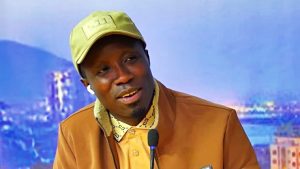
Gambiaj.com – (DAKAR, Senegal) – The trial of Senegalese commentator Abdou Nguer, initially scheduled for Friday before Dakar’s flagrante delicto court, has been postponed to March 20, 2026, in a decision that has drawn sharp criticism from his lawyers and legal rights advocates.
The postponement was ordered by the presiding judge without allowing the defence team—comprising Me El Hadji Diouf, Me Aboubacry Barro and Me Alioune Badara Fall—to submit a bail application that would enable Abdou Nguer to return home until the trial.
Nguer was arrested and remanded in custody on charges of “dissemination of false news” after he publicly criticized a statement issued by the public prosecutor concerning the death of student Abdoulaye Ba at Cheikh Anta Diop University (UCAD).
“Detaining a news commentator for his remarks on legal proceedings of public interest sends an intimidating message to the entire press in Senegal,” said Moussa Ngom, the Committee to Protect Journalists’ Francophone Africa representative. “Senegalese authorities must release Abdou Nguer and stop using false news charges to deprive journalists of their right to freely comment on public affairs.”
The decision to delay the trial has also been challenged by Babacar Ba, president of the Forum du Justiciable, who argued that such a lengthy adjournment contradicts the very principles governing flagrante delicto proceedings.
In a post on social media platform X, Ba cited Article 385 of Senegal’s Code of Criminal Procedure, which stipulates that if a case is not ready for trial, it must be adjourned to one of the nearest available hearings for further investigation.
The provision also allows the court, where appropriate, to grant provisional release or place the accused under electronic surveillance.
According to Ba, the spirit of the flagrante delicto procedure is based on speed and efficiency and cannot justify postponing a case to such a distant date.
He warned that fixing the trial nearly a month later without granting provisional release effectively amounts to imposing a custodial punishment before any final judgment has been delivered, undermining the presumption of innocence.
“If the court considers the case incomplete, it must schedule it for the next available hearing,” Ba argued, stressing that procedural rules are fundamental to upholding the rule of law.
He added that the legitimacy of judicial decisions depends first and foremost on strict adherence to legal safeguards, noting, “The law is first about form before substance.”
Nguer remains in detention pending the rescheduled trial.
In 2025, Nguer was detained for seven months on multiple charges related to his criticism of the Sonko-Diomaye regime. He was released in November after serving a three-month sentence for causing offense to the head of state.



Senegal: Trial of Commentator Abdou Nguer Postponed to March 20 Amid Legal Controversy
Categories
Recent Posts
Cameroon: Three Soldiers Jailed Over Ngarbuh Massacre, Victims’ Lawyers Call Sentences ‘Insignificant’.
Senegal: Trial of Commentator Abdou Nguer Postponed to March 20 Amid Legal Controversy
DR Congo Offers Rebel-Held Tantalum Mine to US in Strategic Minerals Partnership
Moroccan Court Jails 18 Senegalese Fans Over AFCON Final Violence
Government Confirms Nine Gambian Citizens Killed in Russia-Ukraine War, Awaits Conclusive Report
Gambiaj.com – (DAKAR, Senegal) – The trial of Senegalese commentator Abdou Nguer, initially scheduled for Friday before Dakar’s flagrante delicto court, has been postponed to March 20, 2026, in a decision that has drawn sharp criticism from his lawyers and legal rights advocates.
The postponement was ordered by the presiding judge without allowing the defence team—comprising Me El Hadji Diouf, Me Aboubacry Barro and Me Alioune Badara Fall—to submit a bail application that would enable Abdou Nguer to return home until the trial.
Nguer was arrested and remanded in custody on charges of “dissemination of false news” after he publicly criticized a statement issued by the public prosecutor concerning the death of student Abdoulaye Ba at Cheikh Anta Diop University (UCAD).
“Detaining a news commentator for his remarks on legal proceedings of public interest sends an intimidating message to the entire press in Senegal,” said Moussa Ngom, the Committee to Protect Journalists’ Francophone Africa representative. “Senegalese authorities must release Abdou Nguer and stop using false news charges to deprive journalists of their right to freely comment on public affairs.”
The decision to delay the trial has also been challenged by Babacar Ba, president of the Forum du Justiciable, who argued that such a lengthy adjournment contradicts the very principles governing flagrante delicto proceedings.
In a post on social media platform X, Ba cited Article 385 of Senegal’s Code of Criminal Procedure, which stipulates that if a case is not ready for trial, it must be adjourned to one of the nearest available hearings for further investigation.
The provision also allows the court, where appropriate, to grant provisional release or place the accused under electronic surveillance.
According to Ba, the spirit of the flagrante delicto procedure is based on speed and efficiency and cannot justify postponing a case to such a distant date.
He warned that fixing the trial nearly a month later without granting provisional release effectively amounts to imposing a custodial punishment before any final judgment has been delivered, undermining the presumption of innocence.
“If the court considers the case incomplete, it must schedule it for the next available hearing,” Ba argued, stressing that procedural rules are fundamental to upholding the rule of law.
He added that the legitimacy of judicial decisions depends first and foremost on strict adherence to legal safeguards, noting, “The law is first about form before substance.”
Nguer remains in detention pending the rescheduled trial.
In 2025, Nguer was detained for seven months on multiple charges related to his criticism of the Sonko-Diomaye regime. He was released in November after serving a three-month sentence for causing offense to the head of state.