



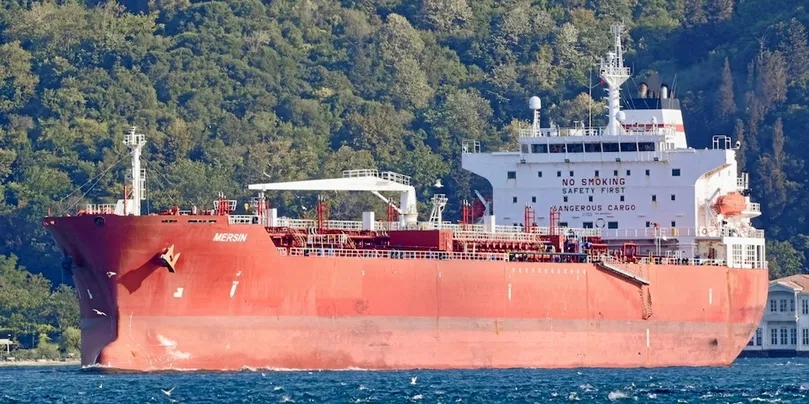
Gambiaj.com – (DAKAR, Senegal) – Senegalese authorities have still not issued any statement regarding the violent attack on a Turkish-owned oil tanker carrying 50,000 tonnes of Russian petroleum products off the coast of Dakar on November 27, a silence that is drawing mounting scrutiny given the gravity of the incident, the geopolitical speculation surrounding it, and the potential environmental risks.
The tanker, Mersin, was anchored near Dakar when four external explosions struck it late on November 27, flooding its engine room with seawater. No injuries or pollution were reported, according to Besiktas Shipping, the Istanbul-based management firm.
The cause of the blasts remains unclear, and the incident triggered a distress call that prompted Senegal’s navy and maritime authority to deploy tugboats and specialized teams to prevent a possible oil spill.
Despite the scale of the emergency response and the risk posed by the 50,000 tonnes of fuel aboard the vessel, Senegal’s government, including the presidency, armed forces, and foreign ministry, has offered no public comment. Analysts say such silence is unusual for an incident that touches on national security, maritime safety, and potential environmental disaster.
Growing Questions Over Possible Ukrainian Link
While Mersin is not listed among ships sanctioned by the United Nations, United Kingdom, or European Union, two other vessels owned by Besiktas Shipping are under Ukrainian sanctions. Maritime analyst Martin Kelly of EOS Marine noted in a LinkedIn post that the Mersin has “repeatedly transported Russian crude oil and petroleum products,” calling at Taman, Novorossiysk, Tuapse, and Ust-Luga throughout 2025.
Speculation has intensified following Ukraine’s recent attacks on Russian-linked tankers in the Black Sea. Some media outlets, including in Senegal, have questioned whether Kyiv could be extending its drone operations as far as West Africa.
For Dirk Siebels, an analyst with Denmark-based Risk Intelligence, the nature of the blasts is telling. “We can reasonably conclude that this stems from the Ukrainian government or the Ukrainian army,” he said, citing the external detonation pattern as evidence that the incident was unlikely to be accidental.
However, not all experts are convinced. Igor Delanoë, deputy director of the Franco-Russian Observatory, cautioned that it is far from certain that Ukraine was responsible, even if such a strike, if proven, would be the first in this geographical zone.
He also noted that only some vessels in Russia’s so-called “ghost fleet” appear on European or Ukrainian sanctions lists, describing it as “a bit of a cat-and-mouse game.”
Dakar’s position as a major Atlantic port serving trade routes between Africa, Europe, and the Americas makes any security incident off its coast particularly sensitive, raising broader concerns about the spillover of global conflicts into West African waters.
Moscow Condemns; Dakar Says Nothing
Russia has reacted sharply. Foreign Ministry spokeswoman Maria Zakharova denounced the attack as an act of “international terrorism” and a violation of Senegalese sovereignty, accusing unnamed actors of seeking to disrupt international peace efforts.
Yet in Dakar, silence prevails. With no statement from Senegalese officials, unanswered questions about responsibility, motive, and the country’s preparedness to safeguard its maritime domain continue to loom.
Environmental advocates and maritime analysts warn that, despite the vessel remaining stable, any shift in conditions could still risk a major spill with serious consequences for marine ecosystems, coastal populations, and Senegal’s vital fishing sector.
As investigations proceed quietly between insurers, technical teams, and Senegalese authorities, the government’s refusal to communicate publicly has become the focal point of growing frustration, leaving the public, regional partners, and the maritime community searching for clarity amid an incident that carries both global implications and local risks.