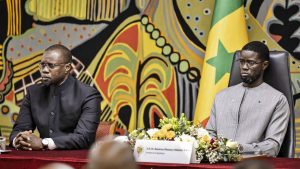


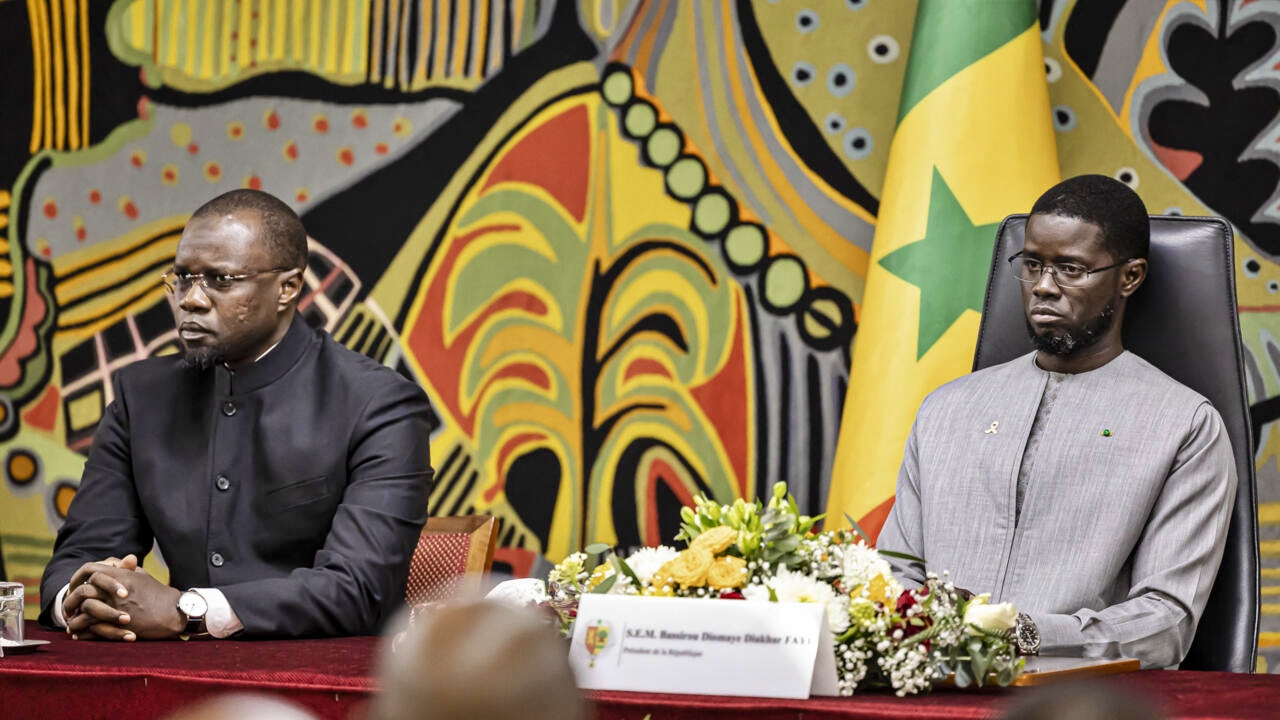
Gambiaj.com – (DAKAR, Senegal) – Ousmane Sonko on Sunday sharply escalated political tensions within Senegal’s ruling camp, openly preparing his militants for a possible confrontation with President Bassirou Diomaye Faye and even a return to the opposition if what he described as PASTEF’s governing principles are undermined.
Speaking during a face-to-face meeting with party supporters, Sonko delivered one of his most combative addresses since assuming office, framing PASTEF as the true engine behind the coalition’s rise to power and warning that governance without the party is “an illusion.”
“PASTEF Conquered the Presidency”
Sonko forcefully rejected narratives suggesting that the Diomaye Coalition won power independently of PASTEF. Despite the party’s legal ban at the time of the presidential election, he argued, its militants formed the backbone of the electoral victory.
“If you count 100 voters, 90 were PASTEF militants,” he declared, portraying the party as the dominant political force in the country.
He pointed to the current balance of power, with the majority of ministers and roughly 80 percent of National Assembly deputies affiliated with PASTEF, as proof that the party remains central to state authority.
“Anyone who believes it is possible to rule without PASTEF is deceiving himself,” Sonko said, in remarks widely interpreted as directed at elements within the presidency and the broader coalition.
Drawing Red Lines
More significantly, Sonko laid down clear red lines regarding the conduct of government business. He vowed to block or reject any policy initiative that departs from what he called the “struggle and principles” of PASTEF.
“As long as I remain Prime Minister, government action will reflect PASTEF,” he told supporters. “If I can block it, I will block it.”
The declaration signals a hardening posture amid growing speculation of divergences between the Prime Minister and the President.
While reaffirming his “full respect” for President Diomaye, Sonko emphasized that constitutional authority is shared, not subordinate. He stressed that the Prime Minister is head of government and chief of public administration, responsible for implementing public policy.
At the same time, he sought to dispel claims that he wields excessive institutional power, arguing that his formal prerogatives are weaker than those of predecessors such as Abdallah Boune Dione (late), due to powers transferred to the presidency when the post was previously abolished and later restored.
Preparing Militants for “Cohabitation” or the Opposition
In what may prove the most consequential part of his address, Sonko openly contemplated scenarios of political rupture.
He introduced the concept of a “soft cohabitation” should the President and the party cease to share the same governing vision, a reference to institutional friction within the executive. If disagreements became irreconcilable, he warned of a shift toward “hard confrontational cohabitation.”
“And if necessary,” he added, “PASTEF will return to the opposition. We have no fear of accountability.”
The remark marks a significant rhetorical shift. Rather than presenting internal tensions as manageable disagreements, Sonko framed them as a potential structural divergence that could redefine the governing arrangement.
Reform, Power, and Parliamentary Leverage
On the issue of reforms, Sonko insisted that no individual, not even the President, can unilaterally impose constitutional changes. He reminded militants that reforms must pass through Parliament, where PASTEF holds a commanding majority, or be approved by referendum.
“The President may propose,” he said, “but Parliament decides.”
The message appeared aimed at reinforcing the party’s institutional leverage and reminding supporters that legislative power ultimately rests with PASTEF lawmakers.
“Not Obsessed With Office”
In a bid to preempt accusations of personal ambition, Sonko repeatedly stated he is not attached to the premiership and would return to private life if dismissed.
“The day the President tells me he no longer wants me in government, I will leave,” he said.
However, he warned that his departure could remove what he described as a “barrier” preventing a return to past governance practices, a veiled suggestion that forces resistant to reform remain active within the system.
A Defining Political Moment
Sunday’s address signals a defining moment in Senegal’s post-election political configuration. While stopping short of declaring an outright break with President Diomaye, Sonko unmistakably positioned himself, and PASTEF, as an autonomous center of power prepared to confront, resist, or even withdraw from government if necessary.
For militants gathered before him, the message was clear: loyalty lies first with the party and its “struggle,” not with institutional arrangements.
Whether this posture leads to negotiated alignment or open confrontation within the executive now appears to be the central question shaping Senegal’s political trajectory.