

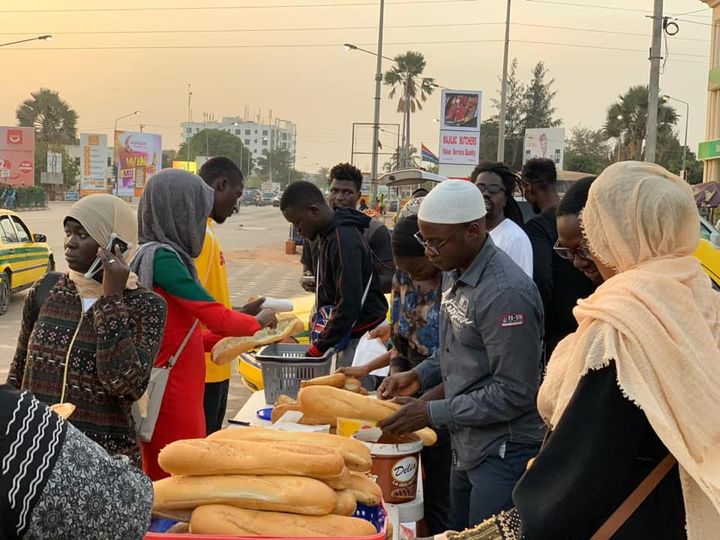


Gambiaj.com – (BANJUL, The Gambia) – A long-overlooked crisis has re-emerged in national debate as residents of Ghana Town, many of whom were born and raised in The Gambia, continue to live in legal limbo—stateless in the only country they have ever known.
The issue returned to the spotlight in the National Assembly after Hon. Alhagie Babou Ceesay, Member for Sabach Sanjal, tabled a motion urging the government to resolve the longstanding challenges facing hundreds in the coastal community.
A joint assessment conducted by the Gambian Commission for Refugees (GCR), the Gambia Food and Nutrition Association (GAFNA), and the UNHCR Senegal Multi-Country Office found that 87 percent of Ghana Town residents surveyed do not possess documentation from any country.
The study further revealed that 98.9 percent consider The Gambia their sole home, even though they lack legal proof of nationality.
For affected residents, statelessness extends far beyond paperwork. Without national identification, many struggle to access healthcare, enroll in public schools, secure formal employment, or travel abroad for education or medical treatment.
Several individuals also reported harassment from immigration officers who regard them as foreigners, even though most have never lived anywhere else.
One young resident, born in Brufut in 1998, told assessors that he has spent his entire life in The Gambia yet remains legally unrecognized. “Where do they expect me to go?” he asked. “I was born here, grew up here, and this is the only country I know. But legally, I don’t exist.”
Ghana Town dates back to the late 1950s, when Ghanaian fishermen settled in Brufut in search of better opportunities.
The community has since grown, with generations born on Gambian soil. Despite this deep-rooted presence, many remain undocumented due to constitutional limitations. The 1997 Constitution presumes a child born in The Gambia to be Gambian only if at least one parent is a Gambian citizen, a provision that excludes many descendants of the original settlers.
Hon. Ceesay informed lawmakers that this constitutional gap has created a cycle of exclusion for an entire community. He described the issue as a human rights concern that undermines the country’s commitment to dignity, inclusion, and equality.
“These individuals have contributed to our society, yet their status remains unresolved,” he said, calling the situation “an injustice we must urgently address.”
Although The Gambia has ratified key United Nations conventions aimed at reducing statelessness, the country has yet to establish a national framework to identify, protect, or naturalize stateless individuals. The absence of such mechanisms, compounded by rigid citizenship rules, has left generations trapped in bureaucratic uncertainty.
Hon. Ceesay’s motion calls for the government to regularize the status of individuals born and raised in Ghana Town, simplify the naturalization process, introduce legal reforms to prevent statelessness, and create a clear pathway for long-term residents to acquire Gambian nationality.
The motion also recommends a coordinated assessment and policy roadmap to guide immediate government action.
As Parliament deliberates, the human cost of the crisis remains evident in Ghana Town. Families continue to live without the basic security that legal identity provides. Children risk inheriting their parents’ statelessness, while adults remain unable to fully participate in national life despite their deep roots in the country.
For many in the community, the question is no longer whether they deserve citizenship; it is whether the Gambian state will finally recognize them after more than six decades.
Whether this renewed attention will result in meaningful reform remains uncertain. But for the families of Ghana Town, whose lives have long been defined by uncertainty, the hope is that this time, the country they call home will take action.