


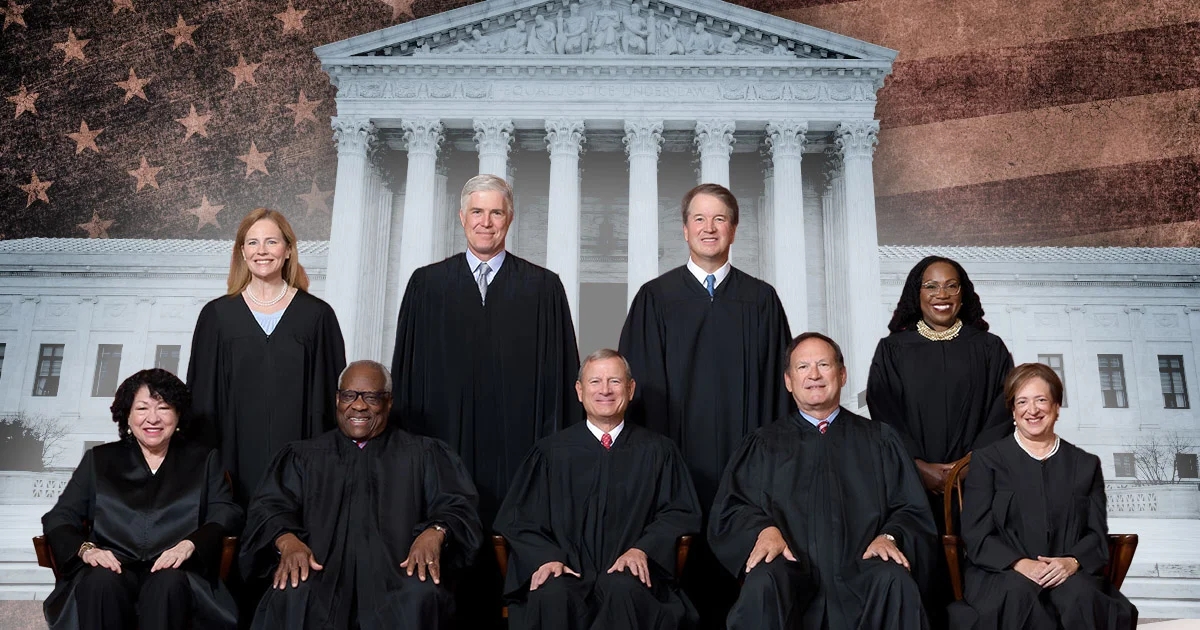



Gambiaj.com – (WASHINGTON, DC) – The Supreme Court of the United States on Friday struck down the bulk of President Donald Trump’s sweeping tariff regime, ruling that he unlawfully relied on emergency powers to reshape global trade, in a landmark decision that dismantles a cornerstone of his second-term economic agenda.
The ruling invalidates tariffs imposed on nearly every country under the International Emergency Economic Powers Act (IEEPA), a 1970s-era statute that allows the president to regulate imports in response to “unusual and extraordinary” national emergencies.
Chief Justice John Roberts, writing for the majority, stressed that the court’s role was limited to interpreting the law.
“We claim no special competence in matters of economics or foreign affairs,” Roberts wrote. “Fulfilling that role, we hold that IEEPA does not authorize the President to impose tariffs.”
Trump is the first president in the law’s nearly 50-year history to invoke IEEPA to justify tariffs.
Economic Stakes and Legal Fallout
The decision leaves unresolved how businesses will recover billions of dollars in tariffs already paid, setting up further litigation in lower courts.
According to the Bipartisan Policy Center, the United States collected about $289 billion in tariff revenue under Trump’s policy as of January 2026.
Companies including Costco, parts of the Toyota Group, and Revlon had already filed lawsuits seeking to recover tariff payments, though none of those cases were directly part of the Supreme Court proceedings.
The court’s ruling does not affect sector-specific tariffs imposed under separate laws, including levies on steel, aluminum, and copper, which remain in force.
Emergency Powers Argument Rejected
The decision follows Trump’s repeated declarations of national emergencies to justify tariffs, including citing fentanyl trafficking to impose levies on Canada, China, and Mexico, and later invoking trade deficits to apply so-called reciprocal tariffs on dozens of countries.
Lower courts had allowed the tariffs to remain in place pending the Supreme Court’s final decision.
Though the administration had won numerous emergency appeals before the conservative-majority court in recent months, this marks the first time the justices issued a definitive ruling on the legality of one of Trump’s central policies.
Legal experts say the ruling represents a significant rebuke but does not completely foreclose Trump’s tariff ambitions. Congress retains authority to impose tariffs, and the president could attempt to use other statutory powers.
Conservative Justices Dissent
Three conservative justices dissented, arguing the president acted within his authority.
Justice Brett Kavanaugh, joined by Justices Clarence Thomas and Samuel Alito, wrote that tariffs are a traditional tool to regulate imports.
“The sole legal question here is whether, under IEEPA, tariffs are a means to ‘regulate … importation,’” Kavanaugh wrote. “Statutory text, history, and precedent demonstrate that the answer is clearly yes.”
He added that the court’s ruling essentially concluded Trump relied on the wrong statute rather than lacking authority altogether.
President Trump Slams Justices, Including His Own Nominees
President Trump reacted angrily, singling out two justices he nominated during his first term, Amy Coney Barrett and Neil Gorsuch, who joined the majority.
“I think it’s an embarrassment to their families,” Trump told reporters at the White House.
He accused the majority of acting out of political motivations and claimed the court had been influenced by foreign interests.
Trump also dismissed the justices’ invitations to his upcoming State of the Union address.
“They are barely invited. To be honest, I could care less if they come or not,” he said.
The decision marks one of the most consequential legal defeats of Trump’s presidency and strikes at the heart of a policy he has called essential to protecting American industry.
However, analysts say the president still has alternative legal and legislative pathways to pursue tariffs, ensuring the broader battle over U.S. trade policy is far from over.