


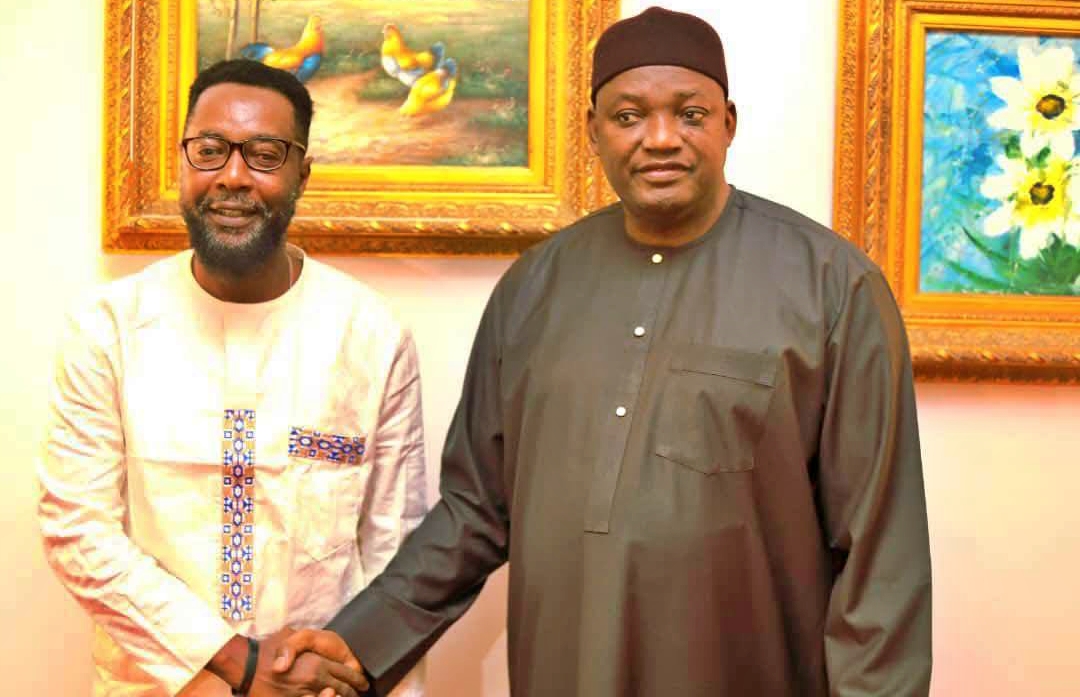
Gambiaj.com – (BANJUL, The Gambia) – Her Excellency Fatoumatta Jahumpa-Ceesay, representing President Adama Barrow, declared that peace must be treated not as an abstract ideal but as a deliberate political and diplomatic choice grounded in justice, dialogue, and inclusive governance. The Gambia’s envoy to South Africa made this statement after being formally mandated by the Gambian leader to represent him at the February 13–14 meeting in South Africa.
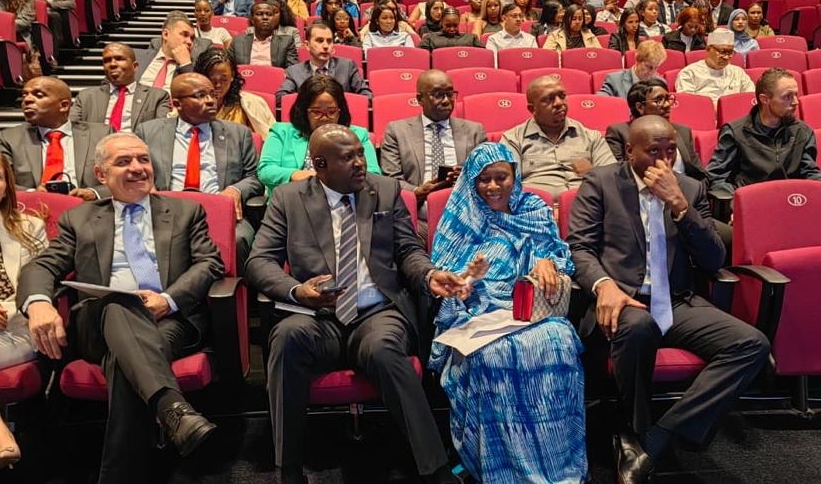
Delivering President Barrow’s message at the 4th Council Meeting of the Global Council for Political Renewal (GCPR) in Cape Town, South Africa, Ambassador Jahumpa-Ceesay emphasized that diplomacy remains the “architecture of peace” in a world increasingly shaped by political instability, violent extremism, inequality, and declining trust between nations.
“Peace is not merely the absence of war. Peace is the presence of justice. Peace is the protection of human dignity,” she told delegates, stressing that leaders must build bridges, foster understanding, and defend dialogue even in difficult circumstances.
Drawing on The Gambia’s own experience, she pointed to the country’s democratic transition as evidence that reconciliation and institution-building can heal fragile societies.
“Our democratic transition reaffirmed an important truth: that reconciliation is stronger than revenge, and that institutions grounded in justice and accountability can heal even the most fragile societies,” she said, adding that peace is an ongoing process requiring patience, courage, humility, and leadership.
She further urged African nations to adopt a collective approach to peace and security, warning that instability in one country inevitably affects the wider continent through its impact on migration, economic growth, and social cohesion.
Ambassador Jahumpa-Ceesay reaffirmed The Gambia’s commitment to the African Union’s peace and security mechanisms, including preventive diplomacy, mediation, and post-conflict reconstruction, while also calling for greater inclusion of youth and women in peacebuilding processes.
She stressed that diplomacy must evolve to address emerging drivers of conflict such as climate change, resource competition, digital misinformation, transnational crime, and economic exclusion.
“The true realism of our time is understanding that there is no security without peace and no peace without diplomacy,” she said, concluding that The Gambia stands ready to work with other nations to promote dialogue, inclusive governance, and collective security.
Global Leaders Call For Inclusive Governance And Ethical Politics
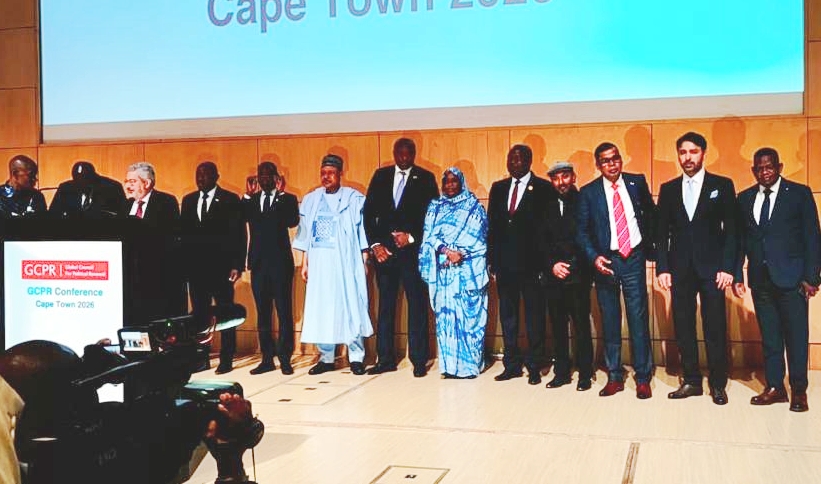
The Global Council for Political Renewal, a platform bringing together political leaders from around the world to promote cooperation, ethical governance, and civic discourse, officially opened its two-day meeting on Friday.
Prime Minister Russell Mmiso Dlamini of Eswatini, who serves as President of the Council, used his address to advocate for diversity in governance systems, arguing that democracy must reflect local histories, cultures, and social realities.
“For too long, global governance frameworks have insisted on uniformity in a world that has never been uniform,” he said, warning that imposing external political models has sometimes weakened states rather than strengthened them.
Nigeria was represented by Information Minister Mohammed Idris, speaking on behalf of President Bola Ahmed Tinubu, who highlighted the urgent need for ethical political conduct amid rising global polarization and misinformation.
“We are living in a time of deep political and ideological polarization, where misinformation spreads faster than truth,” Idris said, stressing the need to balance free expression with responsibility and civility.
The Global Council for Political Renewal is led by senior international figures, including Jordan Senate President and former Prime Minister Faisal Al-Fayez and Italian academic and former mayor Prof. Furio Honsell, and aims to promote ethical leadership, political cooperation, and global peace.
The Cape Town meeting brings together political leaders and diplomats from multiple regions to discuss governance, diplomacy, and strategies for strengthening peace and democratic institutions worldwide.