






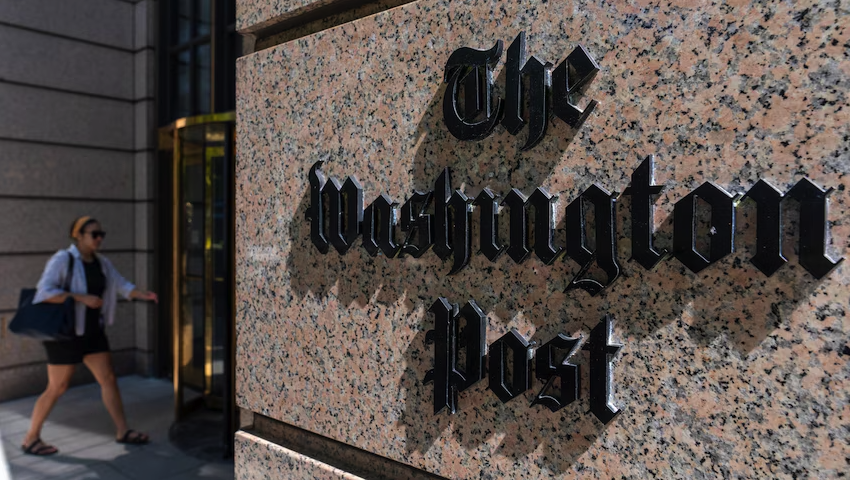
Gambiaj.com – (WASHINGTON, DC) – The Washington Post has laid off more than 300 journalists in a sweeping round of job cuts that has dramatically reduced the newspaper’s sports, local, and international coverage, marking one of the darkest moments in its modern history.
The layoffs, carried out on Wednesday, affected about 30 percent of the company’s workforce, including more than 300 of the roughly 800 journalists in the newsroom, according to people familiar with the decision. Business-side employees were also impacted.
In a call with newsroom staff, Executive Editor Matt Murray said the company had been losing money for too long and was no longer meeting readers’ needs.
He said all sections were affected and that the restructuring would result in a publication more heavily focused on national news, politics, business, and health, with significantly reduced coverage in other areas.
“If anything, today is about positioning ourselves to become more essential to people’s lives in what is becoming a more crowded, competitive, and complicated media landscape,” Murray told staff, acknowledging that the paper had faced years of struggle.
In a follow-up email, Murray said The Post had remained “too rooted in a different era,” when it was primarily a dominant local print newspaper.
He revealed that online search traffic had fallen by nearly half over the past three years, a decline he partly attributed to the rise of generative artificial intelligence, while the paper’s daily story output had also dropped substantially over the past five years.
Despite the scale of the cuts, Murray said the current newsroom size may not be permanent. In an interview later on Wednesday, he said he did not expect this to be “the final end-all-be-all footprint” of the newsroom and insisted collaboration across departments would continue.
Among the hardest-hit sections was sports, which will be shut down entirely, though some reporters will be reassigned to the features department to cover sports culture. The metro section will be significantly reduced, while the books section and the daily news podcast Post Reports will be closed.
International coverage was also scaled back. Reporters and editors in the Middle East, India, and Australia were laid off, though Murray said the paper would retain reporters in nearly a dozen overseas locations. The cuts included journalists working in active conflict zones, and all staff photographers were eliminated.
As layoff notices landed in inboxes, journalists began alerting colleagues with brief messages reading: “Eliminated.” The departures stunned the newsroom, including the dismissal of a Ukraine correspondent reporting from a war zone and a sports reporter in Italy covering the Winter Olympics, who said he would continue filing stories despite being laid off.
Peter Finn, editor of the international section, asked to be laid off rather than take part in planning the cuts after learning their scope, according to people familiar with his decision.
The layoffs come amid continued efforts by owner Jeff Bezos to return the paper to profitability. Bezos appointed Will Lewis as publisher in late 2023 to steer the organization through declining audiences and subscriptions.
Lewis has pushed changes, including the use of artificial intelligence in comments, podcasts, and news aggregation, but his tenure has been marked by internal upheaval and public controversy.
Ahead of the 2024 U.S. presidential election, Lewis announced a new policy, backed by Bezos, ending presidential endorsements by The Post’s editorial board.
The decision blocked a drafted endorsement of Democratic candidate Vice President Kamala Harris and triggered the cancellation of hundreds of thousands of subscriptions.
In a 2024 staff meeting, Lewis warned that the paper was in serious financial trouble, telling employees that audiences had halved in recent years. Bezos later acknowledged the crisis, saying in late 2024, “We saved The Washington Post once, and we’re going to save it a second time.”
Reaction to the layoffs has been fierce. Jeff Stein, The Post’s chief economics correspondent, called it “a tragic day for American journalism,” while former executive editor Marty Baron described it as one of the darkest days in the paper’s history, warning that the public would be denied vital fact-based reporting.
Don Graham, whose family owned the paper for more than five decades, said he would “have to learn a new way to read the paper,” lamenting the closure of the sports section he had followed since the 1940s.
The Washington Post’s crisis mirrors a broader struggle across the global media industry, where declining print circulation, fragmented digital audiences, and the disruptive impact of artificial intelligence have forced publishers to cut costs and search for new revenue models to survive.