

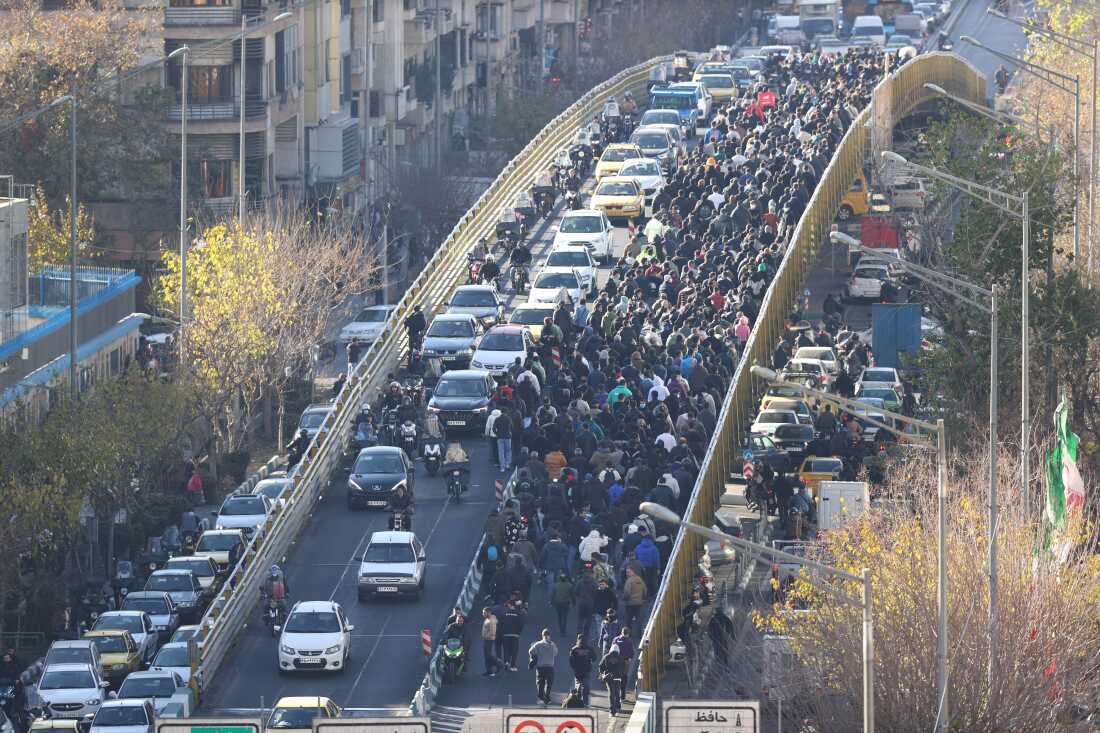
Gambiaj.com – (TEHRAN, Iran) – Galloping inflation and a currency crisis have provoked demonstrations across the country. Protests fueled by deepening economic hardship have swept Iran for more than a week, as soaring inflation has driven frustrated traders and university students into the streets of major cities, including the capital, Tehran.
The demonstrations are the biggest in Iran since 2022, when the death of 22-year-old Mahsa Amini in police custody set off fierce anti-government protests, observers and human rights groups say.
The current protests, however, have not reached the same scale or intensity as those that followed the death of Ms. Amini, who was detained for violating the country’s hijab rules.
But the protests are drawing scrutiny abroad. On Friday, President Trump said the United States would come to the aid of protesters in Iran if the government used lethal force against them.
His comments came a day after reports from Iranian state media that at least one person had been killed in clashes between protesters and security forces. Iranian officials swiftly responded, saying they will act on any interference from the United States, including potentially targeting American bases and forces in the region.
On Saturday, Iran’s supreme leader, Ayatollah Ali Khamenei, called the protesters’ grievances “valid” but accused external forces of trying to exploit them to destabilize the country.
Why are people protesting?
Iran’s economy has been under sustained pressure for years, largely as a result of U.S. and European sanctions tied to its nuclear ambitions. That strain has been compounded by regional tensions, including a 12-day war with Israel last June, which further drained the country’s financial resources.
A steep decline in Iran’s currency has battered import-dependent businesses, angering shopkeepers and straining household budgets. Iran’s currency has lost roughly half its value against the dollar in 2025, and official figures show inflation exceeding 42 percent in December alone.
In response, merchants, traders, and university students in several cities have staged days of protests, shuttering major marketplaces and holding demonstrations on campuses.
On Wednesday, the authorities effectively shut down much of the country as they grappled with mounting public frustration over their handling of the economy.
How intense are the protests?
Demonstrations have spread to more than 100 locations in 22 of Iran’s 31 provinces, according to Human Rights Activists News Agency, an Iranian nonprofit registered in the U.S. that monitors the protests. Across social media and television stations, demonstrators have been shown chanting slogans including “Death to the dictator” and “Iranians, raise your voice; shout out for your rights.”
The government identified the man killed in the protest late Wednesday as a 21-year-old member of a militia that works alongside the security forces. A rights group countered that, saying that he had been among the protesters.
Semiofficial news outlets and a human rights organization reported clashes and fatalities during protests in the western city of Lordegan on Thursday, though the accounts could not be independently confirmed.
Late on Friday and early Saturday, demonstrators gathered in several cities and towns, including in Alborz Province, which is west of the capital, and in Fars Province in the southwest. Asal, a 20-year-old shopkeeper in Alborz, said she has continued to attend the protests for days despite security forces firing tear gas and paintball pellets at her and other demonstrators.
“It doesn’t matter to me if I die,” said Ms. Asal, who would be identified only by her first name for fear of reprisals. “If my country is set right by my death, I am content.”
How have officials reacted so far?
In previous rounds of unrest, Iranian authorities have often responded with force, using mass arrests and violence to suppress demonstrations. While security forces have similarly tried to put down the protests this time, the authorities have also signaled a willingness to engage with protesters and listen to their demands.
Iran’s government is dealing with several other crises, including water shortages, growing air pollution, and the gnawing fear among many Iranians of another round of U.S. or Israeli military strikes.
President Masoud Pezeshkian has acknowledged what he called the public’s “legitimate” grievances and said the government must act quickly to address them.
On Tuesday, he met with leaders of guilds, unions, and chambers of commerce to discuss the country’s economic challenges, according to Iran’s state news agency, IRNA.
Amid the turmoil, the head of the central bank stepped down, and on Wednesday, Mr. Pezeshkian named a replacement, appointing the former economy minister, Abdolnaser Hemmati, to the post.
On Saturday, Mr. Khamenei, Iran’s supreme leader, said the traders’ complaints about the country’s difficult economic situation were “valid” and said he was aware that senior officials were working to address the problem.
But he also blamed the economic crisis on outside forces, who he claimed were seeking to take advantage of the protests to undermine the country’s stability.
“This is the work of the enemy,” Mr. Khamenei said. “Protest is legitimate, but protest is different from riot. We can speak with a protester, but speaking with a rioter is pointless. A rioter must be put in their place.”