


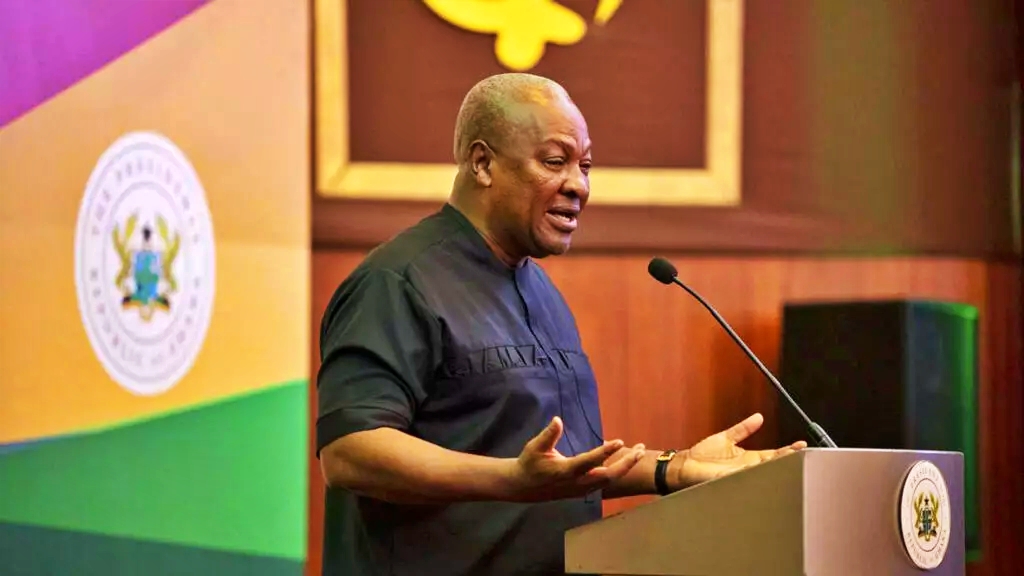
Gambiaj.com – (NEW YORK, United States) – John Dramani Mahama, President of Ghana, is set to present a resolution at the United Nations on Wednesday calling for the transatlantic slave trade to be formally recognized as the gravest crime against humanity and opening the door to discussions on reparations.
The vote, scheduled for March 25 at the United Nations General Assembly, comes amid growing momentum among countries of the Global South seeking acknowledgment and concrete measures to address the legacy of slavery. The initiative has the backing of several states and the African Union.
Speaking on March 24 at a high-level forum on reparatory justice at the U.N., Mahama said the effort was not meant to divide nations but to recognize historical facts and advance justice.
“This resolution allows us, as an international community, to collectively bear witness to the fate of more than 12.5 million men, women, and children who, over the past four centuries, were stripped of their homes, families, futures, and lives,” he said. “It is a path toward healing and reparatory justice and a safeguard against forgetting.”
Mahama said the proposed resolution aims to move the international community beyond symbolic recognition of the transatlantic slave trade toward tangible forms of restitution.
Calls for Concrete Reparations
Under the initiative, Ghana is advocating practical measures, including the restitution of looted cultural artifacts and greater investments in education and development across Africa and the African diaspora.
Accra argues that present-day global inequalities are closely linked to the historical exploitation of enslaved Africans and should be addressed through compensation and long-term development support.
Samuel Okudzeto Ablakwa, Ghana’s foreign minister, emphasized the scale of the historical injustice.
“More than 12.5 million Africans were torn from the continent, treated as commodities without rights, tortured, and dehumanized. More than three million lost their lives,” he said. “Other crimes against humanity have led to reparations, but the transatlantic slave trade has never been fully recognized in that way.”
Mahama also pushed back against arguments that slavery should be judged within the context of historical norms.
“Some people try to minimize slavery by saying today’s standards should not be used to judge the past,” he said. “But just because everyone did something does not make it right. Slavery is an injustice today, and it was an injustice then.”
Ghana’s Historical Role
Ghana says it has a particular responsibility to lead the push for recognition and reparations, noting that the country hosts numerous historical sites from which millions of enslaved Africans were deported during the centuries-long trade.
The initiative also aligns with broader continental efforts. The African Union has designated the period from 2026 to 2035 as a decade of action focused on reparations and the preservation of African heritage.
If adopted, the resolution would mark a significant step in the international debate over historical accountability and compensation for the transatlantic slave trade.




Leave a Reply