


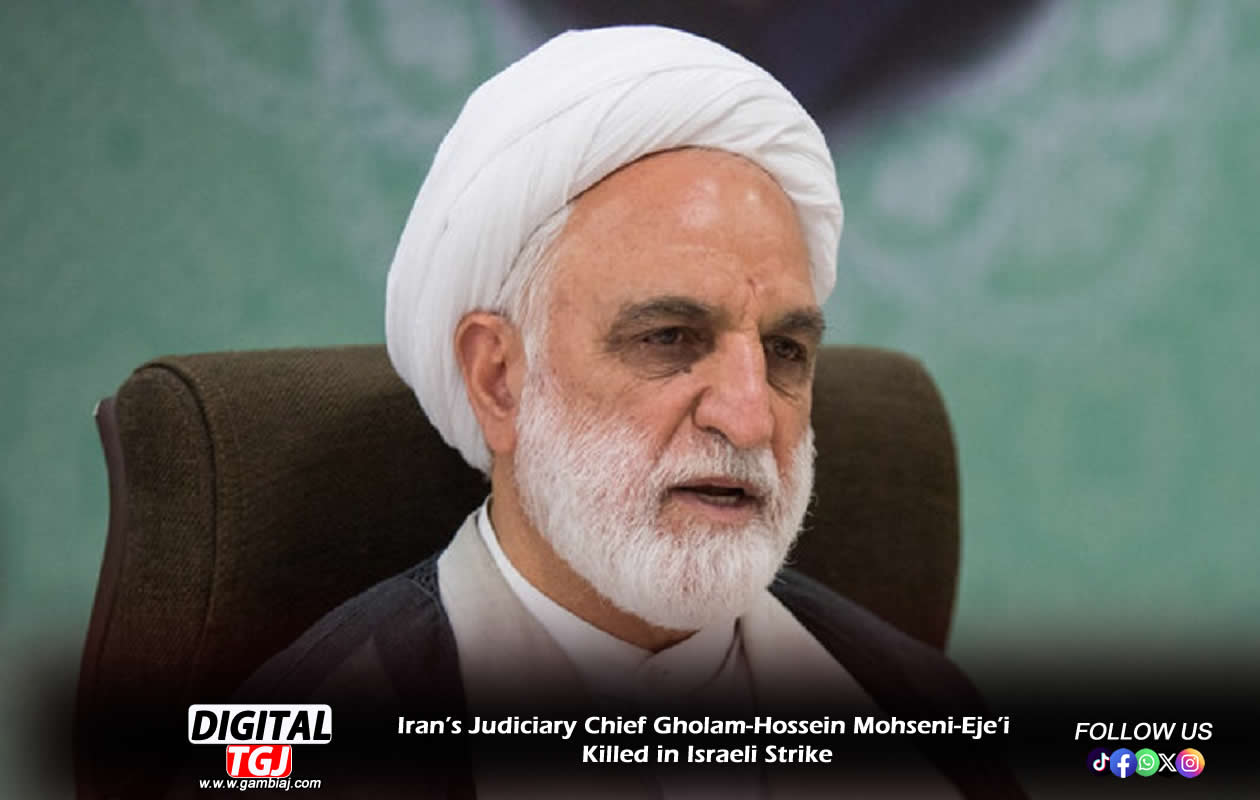
Gambiaj.com – (RIYADH, Saudi Arabia) – Gholam-Hossein Mohseni-Eje’i, the head of Iran’s judiciary and a central figure in the country’s crackdown on anti-government protests, has reportedly been killed in an Israeli strike, according to the Saudi-owned television network Al Hadath.
Mohseni-Eje’i, 79, was widely regarded as one of the most powerful figures in Iran’s legal and political establishment and a key architect of the judicial response to recent nationwide protests against the Islamic Republic.
He had served as Iran’s Chief Justice since July 2021, after being appointed by Supreme Leader Ali Khamenei to replace Ebrahim Raisi, who left the judiciary to assume the presidency following the 2021 election.
Before leading the judiciary, Mohseni-Eje’i held several senior roles within Iran’s security and judicial apparatus. Notably, he served as Minister of Intelligence and National Security from 2005 to 2009 under then-president Mahmoud Ahmadinejad.
Born in Ejieh near Isfahan, Mohseni-Eje’i rose to prominence after the Iranian Revolution that overthrew the Shah. Over the decades, he built a reputation as a hardline cleric-jurist aligned with conservative factions within the Islamic Republic.
He was considered a follower of the late cleric Mohammad-Taqi Mesbah Yazdi, known for his radical ideological influence on Iran’s conservative political movement.
During his tenure as Chief Justice, Mohseni-Eje’i became closely associated with the government’s harsh judicial crackdown on the nationwide protests that swept Iran in 2025 and 2026, sparked by economic hardship and wider political grievances.
The demonstrations spread across dozens of cities and posed one of the most significant challenges to the Iranian leadership in recent years.
Mohseni-Eje’i publicly instructed prosecutors to act with “resolve” and show “no leniency” toward demonstrators, many of whom he described as rioters or instigators. Under his leadership, courts accelerated prosecutions related to the protests, handing down death sentences to dozens of detainees.
Iran’s so-called Revolutionary Courts and lower courts issued capital punishments within days of arrest in some cases, often on charges such as Moharebeh—meaning “waging war against God”—and “corruption on earth,” both of which carry the death penalty under Iranian law.
Critics of the judiciary said many defendants were denied independent legal counsel and were convicted based on confessions allegedly obtained under duress, raising concerns about due process violations.
During Mohseni-Eje’i’s time in office, Iran ranked among the countries carrying out the highest number of executions worldwide, with dozens of protesters and detainees executed following the unrest.
Further details about the reported Israeli strike and official confirmation from Iranian authorities were not immediately available.









Leave a Reply