


Gambiaj.com – (BANJUL, The Gambia) – A new government proposal to introduce accreditation and regulatory controls over journalists, broadcasters, and online content creators has sparked a sharp backlash from prominent media figures, unionists, and academics, who warn the measures could fundamentally alter journalism practice in The Gambia and risk reversing hard-won gains in press freedom.
At the center of the debate are two draft instruments prepared by the Ministry of Information: the National Press Accreditation Policy for The Gambia and the Broadcasting and Online Content Regulations, 2025.
Together, the proposals seek to introduce a formal system requiring journalists and certain content creators to undergo registration, accreditation, and evaluation before practicing their profession.
While the government has not yet formally adopted the policies, their contents have ignited alarm among sections of the media community who say the framework would significantly expand the state’s role in determining who qualifies to practice journalism and produce public information.
Proposed shift in how journalism is regulated
Under the proposed system, journalists could be required to obtain official accreditation before operating, a process that may involve professional assessment and administrative approval. Critics say the framework also allows for executive discretion in determining eligibility, potentially including security vetting.
If implemented, the measures would mark a structural change in how journalism and media activity are regulated in the country. Traditionally, Gambian journalism has relied on professional self-regulation, with the Media Council of The Gambia (MCG) serving as the industry’s primary oversight body.
The proposed policies appear to shift part of that oversight authority toward state institutions, introducing a formal government-managed accreditation structure for practitioners and potentially extending regulatory oversight to digital media and online content creators.
Supporters of the proposal have framed accreditation as a mechanism to promote professionalism, accountability, and responsible media practice in a rapidly evolving information environment shaped by digital platforms and citizen journalism.
But critics argue that the same framework could easily evolve into a licensing regime where the state effectively determines who may practice journalism or disseminate news.
Former GPU leaders warn of “permission-based journalism.”
The most forceful opposition has come from a group of former presidents of the Gambia Press Union (GPU), who issued a strongly worded open letter condemning the proposals as a dangerous step toward renewed state control over the media.
The statement, signed by prominent media figures including Demba A. Jawo, Ndey Tapha Sosseh, Hon. Madi M. K. Ceesay, Sheriff Bojang Jr., and Muhammed S. Bah, warns that the policies could reintroduce what they describe as “permission-based journalism.”
In the letter titled “We Refuse a Return to Permission-Based Journalism in The Gambia,” the former GPU leaders argue that allowing the state to determine who qualifies as a journalist undermines the core principle of an independent press.
“What problem exactly is the Ministry of Information seeking to solve?” the signatories ask, questioning the necessity of state accreditation when the profession already maintains a self-regulatory structure through the Media Council.
They contend that creating parallel state-driven regulatory mechanisms risks politicizing the profession and weakening the independence of the press.
Memories of the Jammeh era resurface.
Opponents of the proposal have also framed the debate through the country’s recent political history.
During the 22-year rule of former president Yahya Jammeh, journalists faced arrests, harassment, intimidation, and exile. The period remains one of the most difficult chapters in the country’s media history.
Media advocates frequently cite the 2004 assassination of veteran journalist Deyda Hydara, then president of the GPU, as a stark reminder of the dangers faced by journalists during that era.
The former GPU leaders say Hydara had repeatedly warned that once the state begins deciding who qualifies as a journalist, press freedom effectively disappears.
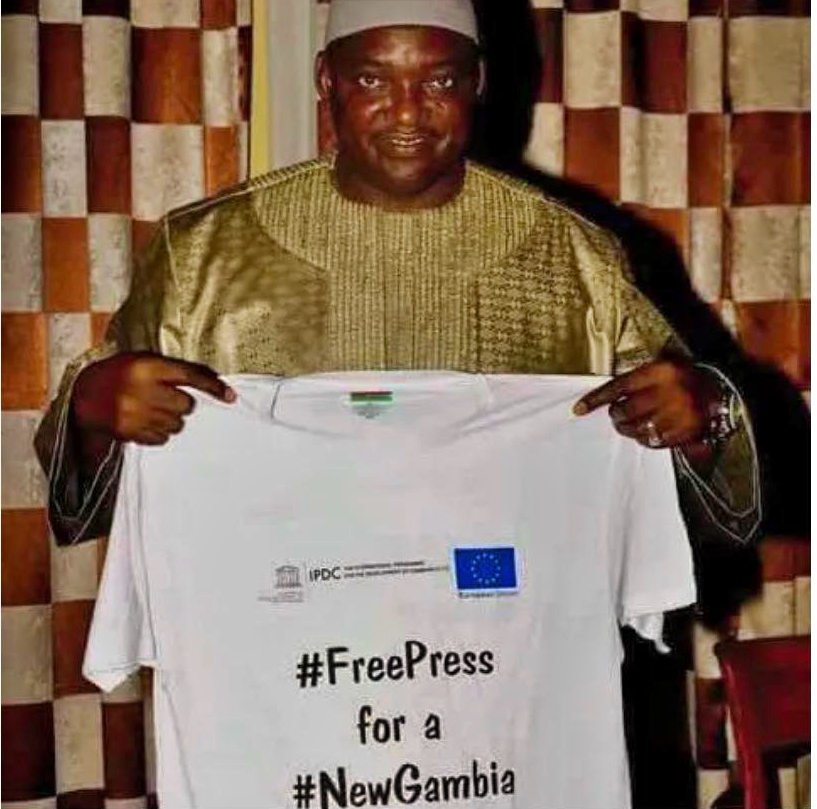
Since Jammeh’s departure from power in 2017, The Gambia has experienced a dramatic expansion of media freedom under the administration of Adama Barrow, with new media houses emerging and critical reporting becoming more common.
Critics argue that introducing accreditation requirements now risks gradually eroding those gains.
Academics and media professionals join the criticism.
Media academics and industry professionals have also expressed strong reservations.
Sang Mendy, Managing Director of the Media Academy for Journalism and Communication (MAJAC), described the proposal as a “backflip” for press freedom and questioned the rationale behind introducing accreditation at a time when the government itself frequently highlights improvements in the country’s media environment.
According to Mendy, requiring journalists and content creators to obtain official approval before practicing could create a system in which authorities have the power to exclude critics of the government.
“Accreditation or screening policies could be used to exclude journalists deemed critical of government because the state will have the right to decide who can hold it accountable,” he warned.
He added that such a framework could undermine the very democratic progress the government has often cited as a hallmark of the post-authoritarian era.
Debate over professionalism versus control
The controversy also reflects a broader debate over how governments should respond to the changing media landscape.
Advocates of stronger regulation argue that the rise of digital platforms and unregulated online content has created new challenges around misinformation, ethics, and accountability.
However, critics insist that targeting journalists through accreditation requirements is not the appropriate response.
Mendy and other media figures argue that professionalism can be strengthened through existing industry institutions rather than state oversight.
They point to the Media Council of The Gambia, which already handles complaints against journalists, mediates disputes, and promotes ethical standards across the media sector.
Strengthening this self-regulatory framework, they say, would improve accountability without undermining editorial independence.
Constitutional and international concerns
Opponents of the proposed policies also raise legal concerns.
They argue that requiring government accreditation for journalists could conflict with constitutional protections for freedom of expression and press freedom, which do not grant the executive authority to license journalists.
The critics further cite The Gambia’s obligations under international frameworks such as Article 19 of the International Covenant on Civil and Political Rights and Article 9 of the African Charter on Human and Peoples’ Rights, both of which protect freedom of expression and access to information.
Calls for vigilance
The former GPU presidents have called on journalists, media owners, civil society organizations, and international press freedom groups to closely monitor developments around the proposed policies.
They also urged younger journalists to remain vigilant in defending freedoms that were achieved through decades of struggle.
“A free press is the lifeblood of accountability,” the statement concludes. “Any regression, however technical in appearance, must be confronted collectively and decisively.”
Although the government has yet to finalize or adopt the accreditation policy, the controversy surrounding the proposal has already triggered a broader national debate over the future direction of journalism, media regulation, and democratic accountability in The Gambia.













Leave a Reply