


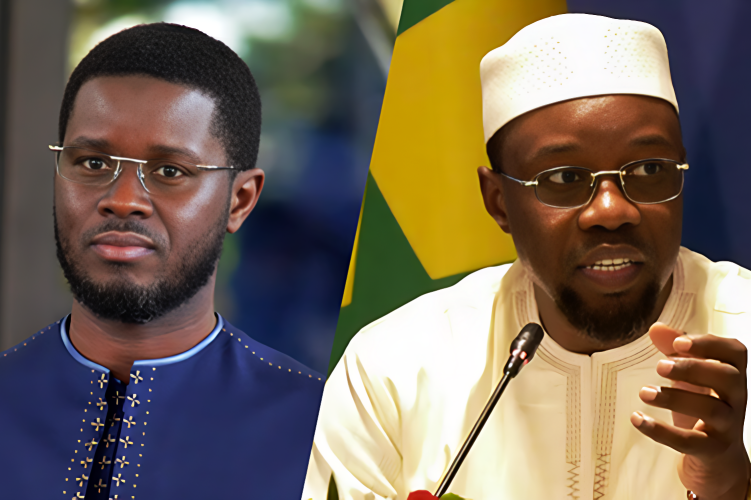
Gambiaj.com – (DAKAR, Senegal) – A mounting institutional standoff in Senegal has exposed growing tensions between President Bassirou Diomaye Faye and Prime Minister Ousmane Sonko, as both men appear to maneuver over who ultimately controls eligibility and participation in the 2029 presidential election.
What was initially expected to be a routine parliamentary process has instead evolved into a high-stakes political confrontation. On April 28, lawmakers aligned with the ruling Pastef party were preparing to adopt an electoral code reform designed to restore Sonko’s eligibility for future elections. However, in a dramatic last-minute move, President Faye unveiled a competing set of draft laws, one of which proposes a comprehensive overhaul of the same electoral framework.
This unexpected intervention has triggered what observers describe as an institutional clash at the heart of the executive, raising questions about coordination within the ruling leadership and, more critically, about competing ambitions for 2029.
At the core of the dispute is control over the legal architecture that determines who can contest elections.
The parliamentary initiative backed by Sonko’s allies seeks targeted amendments to specific provisions of the electoral code, notably revising Article L.29 and scrapping Article L.30. These changes would effectively remove legal barriers stemming from Sonko’s past convictions, which currently render him ineligible for five years.
The proposed reform goes further by introducing retroactive application, meaning that prior ineligibility rulings would be nullified under the new framework. This provision is widely seen as tailored to benefit Sonko directly, positioning him for a presidential bid in 2029.
President Faye’s counterproposal, however, shifts the terrain entirely. By advancing a broader rewrite of the electoral code, he not only challenges the legality and relevance of the parliamentary reform but also reasserts presidential authority over the process.
The timing of his intervention, after remaining silent during the statutory review period, has added to perceptions of a calculated political move to outmaneuver his prime minister’s camp.
The situation places Sonko in a politically delicate position. As head of government, he may be required to defend the president’s draft legislation before parliament, even though it undercuts the initiative driven by his own political base. This dual role underscores the increasingly visible strain between the two leaders.
Public statements and recent political developments have further fueled speculation about a rivalry. Sonko has previously declared his determination to run in future elections, asserting that nothing would prevent his candidacy.
Meanwhile, President Faye’s renewed grip on the coalition that brought him to power has been interpreted by analysts as a signal of his own long-term political calculations.
Beyond the internal power dynamics, the controversy has drawn criticism over the process itself. Figures within the broader ruling coalition and political stakeholders have denounced the use of an expedited legislative procedure without adequate consultation.
They argue that altering electoral laws in such a manner risks undermining democratic norms and could trigger legal challenges.
Opposition voices, while not central to the apparent rift, have also raised concerns about a departure from Senegal’s tradition of consensus-based electoral reforms. The absence of inclusive dialogue, particularly with civil society and opposition groups, has heightened fears that the electoral framework is being reshaped primarily to serve elite political interests.
As the National Assembly moves forward, uncertainty remains over whether Pastef lawmakers will proceed with their initial reform or align with the president’s broader proposal.
What is clear, however, is that the battle over electoral law has become a proxy for a deeper contest between Sonko and Faye, one that could determine not only their political futures but also the rules governing Senegal’s 2029 presidential election.




Leave a Reply