


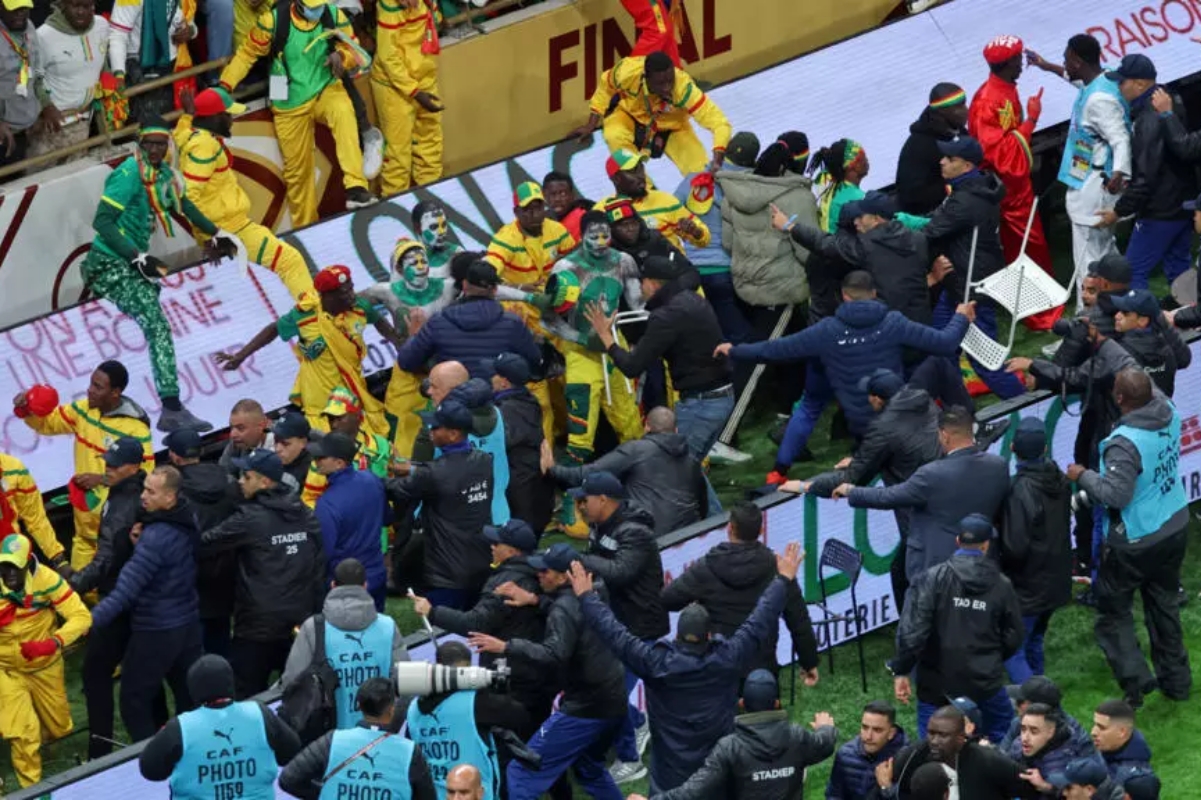
Gambiaj.com – (CASABLANCA, Morocco) – A dramatic courtroom exchange between lead defense counsel Maître Patrick Kabou and the presiding judge has intensified concerns over the fairness of the trial of 18 Senegalese supporters, whose sentences were upheld Monday night in Rabat following their prosecution over violence during the January 18, 2026, Africa Cup of Nations (AFCON) final.
The tense hearing took a confrontational turn when Kabou, addressing the court, launched a scathing critique of the prosecution’s case, describing it as incoherent and lacking evidentiary basis.
“The certainty of the first-instance decision has become a blatant, ridiculous uncertainty. From the lunar, we pass to geomancy,” Kabou argued, in remarks that appeared to question both the logic and integrity of the proceedings.
He further denounced the absence of key evidence, stating that neither videos nor photographs, central to the accusations, had been presented before the appellate court.
Kabou’s remarks quickly drew the ire of the presiding judge, who interrupted and demanded that the lawyer withdraw his statements. The defense counsel refused.
“I do not withdraw a single syllable of what I have just said,” Kabou replied, escalating tensions in the courtroom.
In what observers have described as a pivotal moment reinforcing perceptions of procedural irregularity, the judge then invoked a legal requirement that pleadings be conducted in Arabic—despite Kabou already presenting his argument with translation.
Kabou sharply pushed back, questioning whether the issue lay with the translation or the substance of his arguments. “Is it the translation that displeases you, or the truths that hurt?” he retorted, suggesting that procedural rules were being selectively enforced.
He went further, accusing the court of shifting the “rules of the game” under pressure, and formally requested that his protest be recorded. Kabou also declared that his clients would no longer respond to questions, citing what he described as an unfair trial.
Moments later, the court withdrew briefly before returning with its verdict.
Sentences Delivered Amid Controversy
Of the 18 Senegalese supporters, nine were sentenced to one year in prison, six received six-month terms, and the remaining three are expected to return home after serving three months in detention.
The rapid issuance of the ruling following the heated exchange has further fueled criticism, with many questioning whether due process was adequately observed.
Allegations of ‘Parody of Justice’
The Senegalese Football Federation has strongly condemned both the verdict and the conduct of the trial. Its Secretary General, Abdoulaye Saydou Sow, described the proceedings as a “parody of justice.”
“The 18 supporters have committed only one crime – participating in a final where their team won,” Sow said, arguing that any sanctions should be proportionate to proven wrongdoing.
He also raised concerns over what he termed a “double standard,” noting that only Senegalese nationals were brought before the Rabat Court of Appeal despite reports that the clashes involved both Moroccan and Senegalese supporters.
“What is strange is that only the Senegalese are before the court,” he said, adding that the incident, which could have remained confined to the stadium, had taken on an “extrasportive” dimension.
Broader Perception of Injustice
The courtroom confrontation, marked by Kabou’s defiance and the judge’s insistence on procedural compliance, has become emblematic of wider doubts surrounding the trial’s credibility.
For many observers, the exchange underscored a perception that the proceedings were less about adjudicating evidence and more about delivering a predetermined outcome.
Sow echoed this sentiment in closing remarks that framed the trial in moral and symbolic terms. “Beyond the justice of men, there is the justice of God,” he said, adding that the 18 defendants represent “18 million Senegalese” whose dignity, he insisted, remains at stake.
As reactions continue to mount, the Rabat trial risks becoming a flashpoint not only for legal scrutiny but also for broader debates about fairness, accountability, and the treatment of African supporters on the international stage.





Leave a Reply