


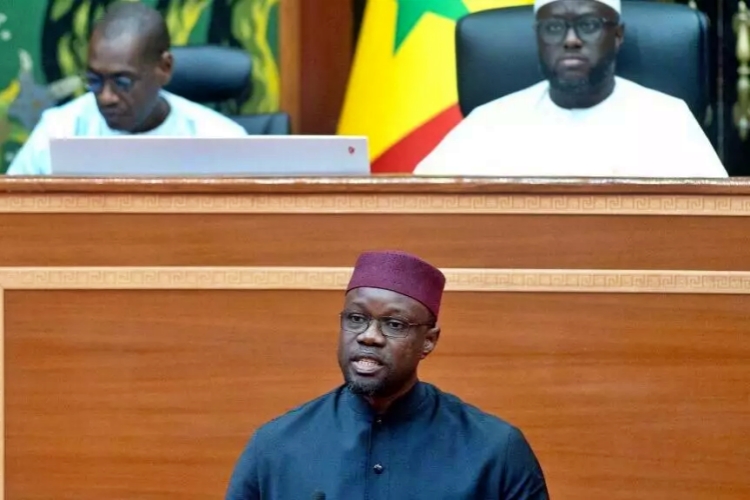
Gambiaj.com – (DAKAR, Senegal) – Senegal’s National Assembly, dominated by the ruling PASTEF party, has adopted a controversial amendment to the country’s electoral code, setting the stage for a likely legal battle before the Constitutional Council of Senegal, an institution with a track record of striking down contentious legislation.
The bill, passed on April 28 with 128 votes in favor, revises key provisions governing voter eligibility and candidacy, in what opposition lawmakers describe as a politically tailored move designed to secure the presidential ambitions of Prime Minister Ousmane Sonko ahead of the 2029 elections.
A Law With a Clear Political Target
At the center of the reform is a complete rewrite of Article L.29 of the electoral code, which previously barred individuals from voter rolls based on relatively minor convictions, including suspended sentences exceeding six months.
The new provision narrows disqualification strictly to individuals convicted of serious offenses such as corruption, embezzlement, fraud, money laundering, and other major financial crimes.
In parallel, Article 30, which imposed ineligibility for candidates fined more than 200,000 CFA francs, has been repealed altogether.
This change is far from abstract. In 2024, Sonko himself was removed from the electoral register and rendered ineligible after receiving a six-month suspended sentence and a hefty fine for defamation, a conviction later upheld by the Supreme Court in July 2025.
Under the revised framework, such a conviction would no longer automatically disqualify him.
Retroactivity Clause Raises Legal Stakes
The most contentious aspect of the legislation lies in its potential retroactive application, a provision that could effectively nullify prior judicial decisions, including those affecting Sonko.
While the Interior Minister defended the bill as a democratic safeguard aimed at preventing politically motivated exclusions, he acknowledged that retroactivity remains a legally sensitive matter, albeit one with recognized exceptions.
Opposition figures, however, argue that the clause directly undermines the principle of res judicata, the finality of judicial decisions.
Lawmaker Cheikh Ahmed Tidiane Youm warned that applying the law retroactively would violate fundamental legal norms by reopening cases that have already exhausted all avenues of appeal.
Anta Babacar Ngom of the opposition ARC bloc went further, accusing the ruling majority of engineering a legal solution to a future political problem.
“This is about 2029, not 2026,” she argued, suggesting that PASTEF is leveraging its parliamentary dominance to preemptively secure Sonko’s eligibility rather than addressing more immediate national concerns.
Constitutional Council in the Crosshairs
The opposition has pledged to challenge the law before the Constitutional Council of Senegal, setting up what could become a defining institutional confrontation.
The Council has, in recent months, demonstrated its willingness to push back against controversial legislation, including the rejection of a Pastef-backed interpretative amnesty bill and a recently proposed media regulatory law, both deemed legally problematic.
This history raises the prospect that the newly adopted electoral amendments, particularly their retroactive dimension, may face similar scrutiny.
A Test of Institutional Balance
Beyond its immediate political implications, the bill underscores deeper tensions within Senegal’s governance architecture, between a dominant legislative majority and an assertive constitutional judiciary.
If upheld, the reform could significantly reshape the legal contours of electoral participation and reopen the political pathway for Sonko. If struck down, it would reinforce the Constitutional Council’s role as a critical check on legislative overreach.
Either way, the coming legal battle is poised to have lasting consequences for Senegal’s democratic trajectory, and for the political future of its most polarizing figure.










Leave a Reply