


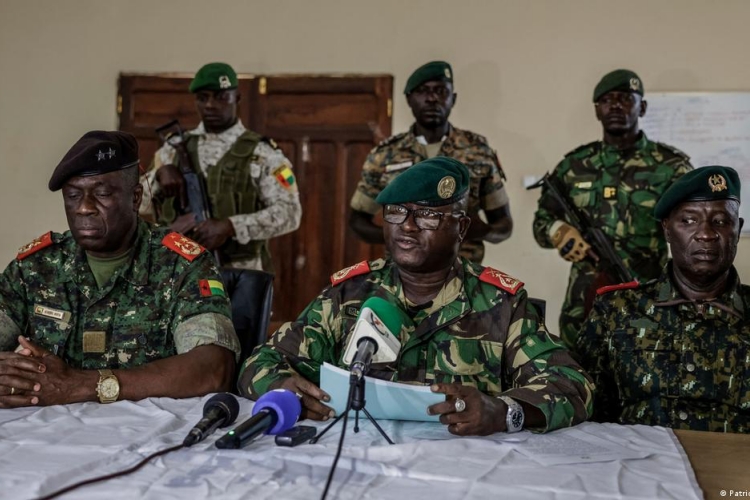
Gambiaj.com – (BISSAU, Guinea-Bissau) – The postponement of Guinea-Bissau’s presidential and legislative elections is becoming more than a question of electoral logistics.
Taken alongside the military government’s restrictions on political activity, its exclusion of former President Umaro Sissoco Embaló, and the constitutional changes approved in August, the latest development is raising questions about whether the transition is gradually being structured around the continued influence of the military leadership.
On Thursday, October 8, Transitional Prime Minister Ilídio Vieira Té said the conditions were not in place to hold the elections scheduled for December 6. The National Electoral Commission reached a similar conclusion, saying the electoral timetable could no longer technically be met. Neither official announced a new date.
The immediate explanation is procedural. Several political parties have not renewed their leadership structures, while the legal deadline for submitting candidacies to the Supreme Court expired on October 6 without candidates being formally registered. The government argues that proceeding under those circumstances would create legal and potentially post-election problems.
But the political significance lies in how those conditions came about.
The same transitional authorities now pointing to the unpreparedness of political parties have operated for months in an environment in which political activity has been severely restricted.
According to the account provided by political analyst Rui Semedo, parties were unable to function normally while their headquarters were closed and political activities prohibited. That raises a fundamental question: how could parties complete congresses, renew their structures, and prepare candidates for an election while operating under such restrictions?
The result is a striking contradiction. The military authorities presented December 6 as the date on which Guinea-Bissau would return to constitutional civilian rule. Yet, as that date approaches, the political system appears less prepared for a civilian election than it was when the date was first announced.
And the delay now comes at a particularly consequential moment.
A transition without a clear exit
The military took control in November 2025, suspending the electoral process and appointing Major-General Horta Inta-A as transitional president. Although elections were intended to restore civilian rule, the transition now faces its first major deadline without an active electoral process.
The focus is shifting from when Guinea-Bissau will vote to the political conditions under which voting might eventually occur, reflecting a trend towards greater military consolidation.
In early October, the military leadership prevented Embaló from returning to Guinea-Bissau, citing national security and public-order concerns. Embaló had announced his intention to return from exile and contest the December election. The junta said the security conditions necessary for his return were not in place.
The decision effectively removed from the country, at least temporarily, a former head of state who intended to participate in the very electoral process that was supposed to end military rule.
It was followed days later by the declaration that the election itself could not proceed.
Neither decision, taken individually, necessarily establishes an intention by the military to remain in power indefinitely. The authorities have offered security and administrative explanations for both. But together with the wider political restrictions and constitutional changes, they have created an environment in which the military leadership retains substantial control over the conditions under which civilian politics can resume.
The constitution adds another layer
The picture becomes more significant when viewed alongside the constitutional referendum held in August.
The transition is not merely determining when elections will occur. It has also been altering the institutional framework within which the next civilian government will operate.
For critics of the transition, that combination is troubling: political parties have struggled to operate; a prominent potential presidential candidate has been prevented from returning; the election timetable has effectively collapsed; and the constitutional order has been revised while the country remains under military supervision.
A postponed election can be a technical necessity. A carefully redesigned political system under military supervision can also be presented as institutional reform. But when the same authorities control the security environment, political space, electoral timetable, and transition process, the line between managing a transition and managing the conditions for retaining influence becomes harder to ignore.
The danger is the open-ended transition
The most immediate concern is not necessarily that the military will formally announce an indefinite extension of its rule. It may not need to.
A transition can become prolonged through successive institutional explanations: parties are not ready, the electoral register needs work, candidates have not been validated, security conditions remain uncertain, constitutional procedures require adjustment, or the electoral commission needs additional time.
Each justification may have some administrative validity. But without a clear and credible new electoral timetable, the cumulative effect can be the same: civilian rule remains postponed.
That is why Thursday’s announcement carries greater political weight than its technical language suggests.
The government says the December 6 election cannot be organized because the legal and organizational requirements have not been met. The electoral commission agrees that the timetable is no longer feasible.
Yet those failures did not emerge in a political vacuum.
For Guinea-Bissau, the central issue is no longer simply the date of the next election. It is whether the transition remains a temporary route back to civilian government—or gradually becomes a political arrangement in its own right.






Leave a Reply