


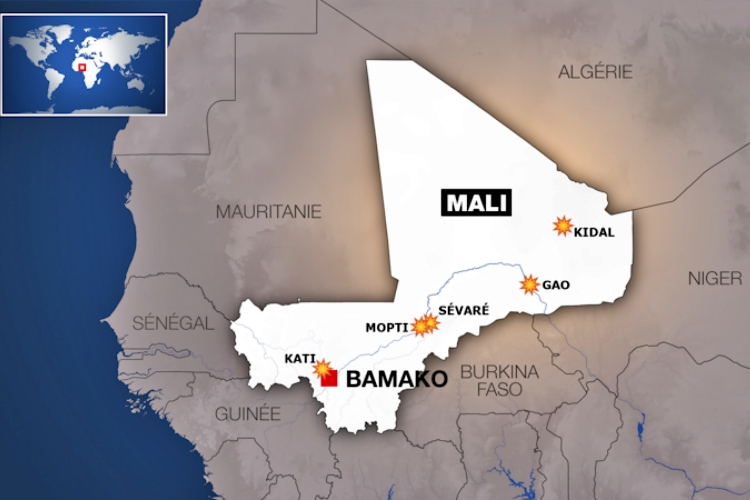
Gambiaj.com – (BAMAKO, Mali) – A wave of coordinated attacks across Mali on Saturday has exposed what analysts describe as a critical deterioration in the country’s security architecture, with jihadist and separatist forces demonstrating an unprecedented level of operational alignment and geographic reach.
From the northern city of Kidal to the capital Bamako and its military nerve center in Kati, simultaneous assaults targeted military installations, senior officers’ residences, and strategic infrastructure, including the international airport.
The Malian army has maintained that the situation is “under control,” but multiple field reports and eyewitness accounts point to fluid, contested conditions across key areas.
A Coordinated Front: JNIM–FLA Tactical Convergence
The most consequential development is the explicit claim by Jama’at Nasr al-Islam wal Muslimin (JNIM) that the attacks were carried out in coordination with the Front de libération de l’Azawad (FLA).
This convergence between jihadist and separatist actors, historically operating with differing ideological objectives, marks a strategic inflection point in the Sahel conflict.
By synchronizing operations across multiple cities, including Gao, Mopti, and Sévaré, the alliance has effectively stretched Malian forces and undermined their ability to respond rapidly. The reported seizure of Kidal, long a symbol of contested sovereignty, if confirmed, would represent both a tactical and symbolic setback for Bamako.
Strategic Depth and Intelligence Failures
The targeting of Kati, home to key military installations and closely associated with junta leader Assimi Goïta, has amplified concerns over intelligence and perimeter security failures. Attacks reportedly extended to the residence of Defence Minister Sadio Camara, suggesting that attackers penetrated zones previously considered secure.
Security analysts, including Jean-Hervé Jézéquel, interpret the scale and coordination of the assaults as evidence that armed groups have resolved prior logistical and operational constraints. He noted that “a new threshold has been crossed,” emphasizing the absence, so far, of a visible reaction from Bamako’s external allies.
Russian Support and the Limits of Military Containment
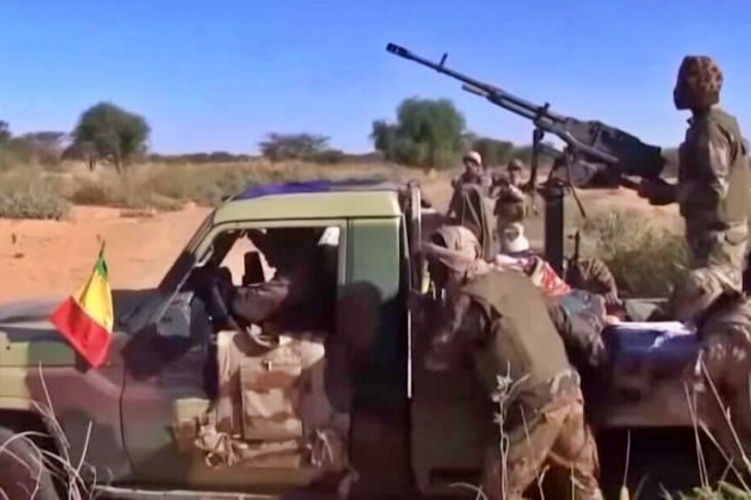
For months, the Malian army, supported by Russian paramilitary elements often referred to as Africa Corps, relied heavily on drone strikes and fortified positions to contain insurgent advances. Saturday’s events suggest that insurgents have adapted to these tactics, either through mobility, dispersal, or improved coordination, thereby reducing the effectiveness of one of the junta’s key military advantages.
Reports from Gao and Kidal indicate that Malian and Russian forces have largely remained entrenched in their bases under sustained fire, raising questions about their operational flexibility and ability to reclaim contested territory in the short term.
Silence at the Top and Signs of Political Strain
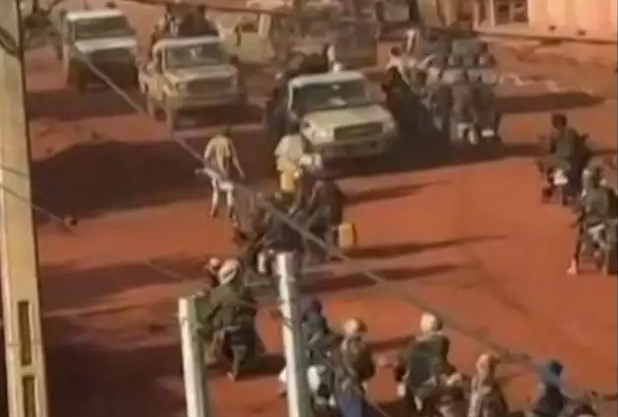
Image taken from a verified video by AFP showing armed jihadists in the streets of Kati, the hometown of General Assimi Goïta in Mali, April 25, 2026. © ANONYMOUS / AFP
Compounding the uncertainty is the conspicuous silence from senior figures within the ruling junta. Neither Goïta nor other prominent officials, including intelligence chief Modibo Koné and junta member Ismaël Wagué, have publicly addressed the nation at the height of the crisis.
This communication vacuum risks deepening public anxiety and may signal internal disarray at a moment requiring decisive leadership.
The suspension of flights at Bamako’s airport and advisories from foreign embassies urging citizens to remain indoors further underscore the gravity of the situation.
A Conflict Entering a New Phase
While Bamako has consistently denied engaging in negotiations with JNIM, the group has repeatedly claimed the existence of backchannel contacts. The scale and timing of Saturday’s offensive strongly suggest that any tacit understanding, if it existed, has collapsed.
More broadly, the attacks indicate a shift from sporadic insurgent operations to coordinated offensives aimed at reshaping control over major urban centers. This evolution challenges the junta’s narrative of restored sovereignty and raises the prospect of a de facto fragmentation of territorial control.
Regional and Geopolitical Implications
The African Union, led by Commission Chair Mahmoud Ali Youssouf, has already expressed concern, but the absence of immediate, tangible external intervention highlights Mali’s increasing strategic isolation.
If the JNIM–FLA axis consolidates its gains, it could redraw the conflict map across the Sahel, emboldening similar alignments elsewhere and complicating counterterrorism frameworks built on clear distinctions between jihadist and separatist threats.
A State Under Pressure
By day’s end, Mali remained in a state of uncertainty, with active fighting continuing in multiple locations and conflicting claims over territorial control. For civilians, many of whom remained confined to their homes amid sustained gunfire, the immediate concern is safety.
For the junta, however, the stakes are existential. Saturday’s coordinated offensive has not only exposed vulnerabilities in military readiness but also challenged the very premise of its rule: that a security-first approach could stabilize the country.
That assumption is now under its most severe strain.






Leave a Reply