


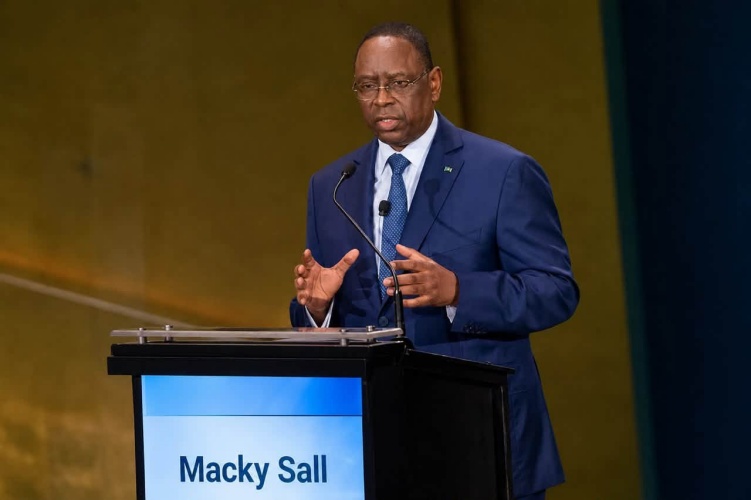
Gambiaj.com – (NEW YORK, United States) – Former Senegalese President Macky Sall has laid out an ambitious vision for the United Nations, promising to restore trust, reform the institution, and strengthen preventive diplomacy if elected the next UN Secretary-General.
Speaking during a two-hour public debate featuring candidates for the UN’s top job on Thursday night, Sall said his decades of leadership at the national, regional, and continental levels have prepared him to lead an organization facing growing geopolitical tensions, financial difficulties, and declining confidence among member states.
The debate, part of the UN’s ongoing selection process for the next Secretary-General, gave candidates an opportunity to present their priorities and answer questions on global peace, development, human rights, and institutional reform.
Experience as his strongest asset
Sall said his greatest contribution would be the experience he gained over nearly four decades in public service, including 12 years as President of Senegal, as former Chairperson of the African Union, former Chair of ECOWAS, and as head of the New Partnership for Africa’s Development (NEPAD).
He said those responsibilities enabled him to manage political crises, build consensus among leaders, and champion Africa’s interests internationally, including helping secure the African Union’s permanent membership in the G20.
According to Sall, those experiences taught him how to listen to differing viewpoints, engage leaders from every region, and build practical solutions to complex international problems.
“If elected, I will be a facilitator of dialogue and a Secretary-General committed to implementation, reform, and restoring trust,” he said.
Calling for a more effective Security Council
Sall argued that many of today’s conflicts remain unresolved because of divisions within the UN Security Council, particularly among its five permanent members, whose veto powers often prevent collective action.
He said global peace and security depend on a Security Council capable of functioning in accordance with the UN Charter, adding that the lack of trust between major powers has left the organization unable to respond effectively to several international crises.
Rather than taking sides, Sall said the Secretary-General must maintain dialogue with all parties, even during periods of intense geopolitical confrontation.
“I will speak to everyone and build bridges of communication,” he said, describing the Secretary-General as an impartial facilitator whose role is to keep diplomatic channels open when others have broken down.
Preventive diplomacy at the center, drawing on Ukraine diplomacy
Sall stressed that the UN Charter gives the Secretary-General important responsibilities beyond administrative leadership.
He said the office should make greater use of early warning systems, preventive diplomacy, and quiet diplomacy to detect and defuse crises before they escalate into conflict.
The Secretary-General, he added, must also have the authority and credibility to engage directly with leaders involved in conflicts, including permanent members of the Security Council.
For Sall, rebuilding confidence among member states is essential if the UN is to continue fulfilling the role it has played since the end of the Second World War.
“The leaders of our countries should strengthen, not weaken, this organization,” he said.
To illustrate his approach, Sall recalled his diplomatic mission in 2022 following Russia’s invasion of Ukraine while serving as Chairperson of the African Union.
Despite criticism at the time, he traveled first to Russia to meet President Vladimir Putin before also engaging Ukrainian leaders.
He said Africa’s dependence on grain exports and fertilizer from the Black Sea region made dialogue essential because the conflict was threatening food security across the continent.
That experience, he said, demonstrated the importance of maintaining communication with all parties regardless of political tensions.
The first 100 days focused on reform
If elected, Sall said his first priority would be assembling a leadership team based on competence, diversity, and balanced geographical representation.
He outlined three immediate priorities.
The first would be strengthening the UN’s peace and security work through preventive diplomacy, mediation, early warning systems, the Secretary-General’s good offices, and closer cooperation with regional organizations during peace operations.
Secondly, he pledged an operational review of the UN’s structures and mandates to improve efficiency while launching consultations with member states on institutional reforms, including the UN80 initiative. He also promised to address the organization’s liquidity crisis while improving transparency and accountability.
His third priority would focus on keeping human rights and sustainable development at the center of the UN’s work. Sall said he would begin consultations on the post-2030 global development agenda with governments, international financial institutions, the private sector, civil society, and philanthropic organizations.
He also called for greater emphasis on investment, trade, and partnerships to finance development while helping developing countries gain fairer access to capital, technology, and innovation.
“My objective in the first 100 days is to restore trust and put the UN on a path to becoming more agile, more effective, and more ready to listen, act, and bring people together,” he said.
Returning to the UN’s core mission
Sall repeatedly argued that the organization must return to what he described as its founding mission: promoting peace, security, development, and human rights.
He said addressing those priorities would help respond to the aspirations of nearly four billion young people worldwide who need education, skills training, and employment opportunities.
He also emphasized protecting the rights of women and ensuring girls have access to education.
According to Sall, renewed cooperation among member states around these priorities would restore the UN’s central role in global affairs through what he described as “renewed multilateralism.”
Tackling the financial crisis
The former Senegalese leader also linked the UN’s current financial difficulties to a wider crisis of confidence among member states.
The United Nations has faced persistent liquidity problems in recent years, largely because some countries have delayed or failed to pay their assessed contributions, forcing the organization to cut spending and postpone activities.
Sall said transparency would be his first response.
He pledged to open the organization’s financial accounts to member states and present reform proposals on budgeting and human resources in a transparent manner.
Once trust is restored, he said, governments would be better placed to fulfill their financial obligations to the organization.
Reforming global finance
Sall also called for reforms to the international financial system, arguing that developing countries continue to pay disproportionately high borrowing costs despite often carrying lower debt burdens than advanced economies.
He blamed the situation partly on international risk assessment mechanisms and called for closer cooperation among governments, international financial institutions, and credit rating agencies to ensure fairer access to finance.
Public funding alone, he argued, is no longer sufficient to meet development needs. Instead, countries should mobilize greater private investment while reducing financial risks through partnerships and better financing mechanisms.
Vision for his legacy
Looking beyond a first term, Sall said he hopes to leave behind a United Nations that is more confident, more efficient, and fully modernized through digital transformation and responsible use of artificial intelligence.
He argued that meaningful reform must involve both the UN Secretariat and its 193 member states, noting that institutional change cannot succeed without governments’ active participation.
Sall also called for a review of the UN’s working methods, saying the organization currently manages around 40,000 active mandates and more than 27,000 meetings annually, making it essential to demonstrate greater impact and reduce inefficiency.
Using the analogy of a pipe organ, he said the UN’s many departments should function like different musical notes brought together by a skilled conductor.
“If the United Nations were an organ,” he concluded, “I believe I have the ability to bring its many voices into harmony in the service of the peoples we represent.”





Leave a Reply