


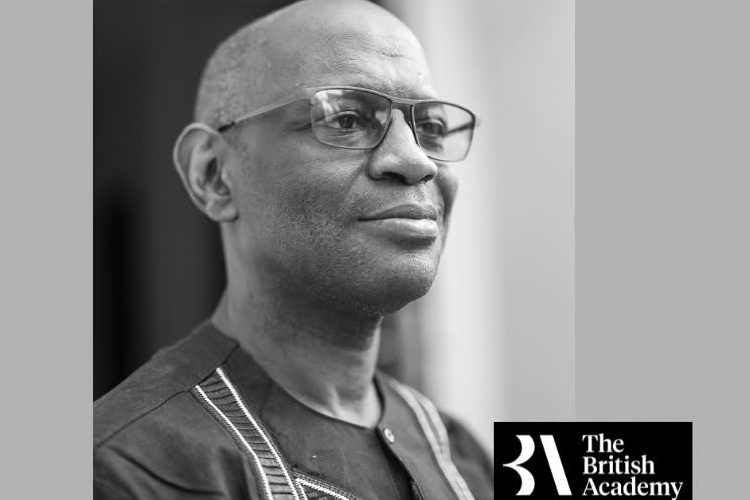
Gambiaj.com – (BANJUL, The Gambia) – Gambian historian and scholar Hassoum Ceesay has been elected as an International Fellow of the British Academy, one of the United Kingdom’s highest scholarly institutions for the humanities and social sciences.
Ceesay, who currently serves as Director General of the National Centre for Arts and Culture (NCAC), is among 92 scholars from around the world elected to the Academy in 2026.
The British Academy said Ceesay has attained a high level of international standing in the fields of history and the arts.
His election places him alongside internationally recognized scholars, including renowned anthropologist Professor Lila Abu-Lughod of Columbia University, Professor John Arnold of Cambridge University, and Lady Chief Justice of Northern Ireland, the Rt. Hon. Dame Keegan, KC.
In a letter informing him of his election, British Academy President Professor Susan J. Smith, FBA, described the Academy’s Fellows as representing “the very best of humanities and social sciences research” in the UK and globally.
“Only one or two scholars a year are elected in most fields, so this is a significant mark of distinction,” Professor Smith said, congratulating Ceesay on his election.
Founded in 1902, the British Academy is the UK’s national academy for the humanities and social sciences. Fellowship is regarded as a major distinction in academic and scholarly circles.
Focus on Gambian and African history
Ceesay’s scholarship has focused extensively on Gambian and African history, with particular attention to the use of biography as a means of bringing overlooked figures and experiences into the mainstream of historical scholarship.
His work has also sought to highlight the contributions of women to Gambian history and examine historical events and personalities that have traditionally remained on the margins of the national narrative.
Reacting to his election, Ceesay described the Fellowship as both an honor and a responsibility.
“The British Academy is the acme of scholarly recognition, and my Fellowship is more than a personal honor for my contribution to the Humanities and Social Sciences,” he said.
He added that the recognition was also “a call to duty” to make use of the Academy’s international network, resources, and intellectual platforms to strengthen the relevance of his research and publications.
Ceesay said he hoped to apply that scholarship to pressing national and international issues, including women’s and children’s empowerment, poverty alleviation, and peaceful coexistence.
From journalism to cultural leadership
Ceesay’s career has spanned journalism, academia, cultural heritage, and public service.
Between 1999 and 2006, he worked at The Daily Observer newspaper in Banjul, where he served as features editor and editorial writer. During the same period, he was curator of the Gambia National Museum, a position he held until 2008 and through which he was involved in curating art and ethnographic exhibitions.
In 2008, Ceesay briefly served as Deputy Permanent Secretary and Director of the Press Office at the Office of the President under former President Yahya Jammeh.
He later strengthened his academic credentials, obtaining a Master’s degree in African History from the University of The Gambia in 2009. The following year, he served as lead researcher on a UNESCO study examining cultural rights in The Gambia.
His work in cultural administration also included serving as Director of the Copyright Office, where he was credited with establishing The Gambia’s Copyright Collecting Society.
Ceesay has also contributed to university governance, serving as a member of the University of The Gambia Governing Council from 2014 to 2017.
He is now Director General of the National Centre for Arts and Culture, where he continues to work on the preservation and promotion of the country’s cultural heritage.
His election to the British Academy marks a significant international recognition of a Gambian scholar whose work has sought to deepen understanding of the country’s history while placing its people, particularly historically overlooked figures, at the center of the national story.


Leave a Reply