


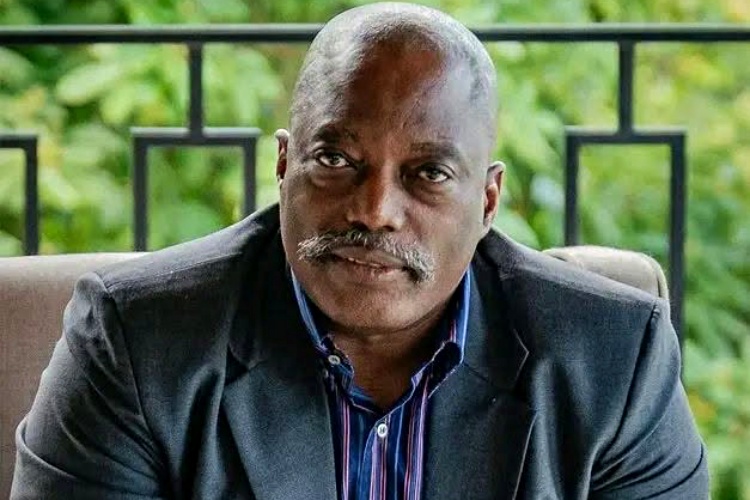
Gambiaj.com – (KINSHASHA, D.R.Congo) – Former Democratic Republic of Congo President Joseph Kabila has taken a decisive step from political opposition into an openly declared politico-military rebellion, launching a new movement that brings him together with the M23 armed group fighting the government of President Felix Tshisekedi.
Kabila unveiled the Front for the Refoundation of the Nation (FRN) on Monday in Goma, the eastern city controlled by M23 since January 2025. The new organization succeeds the Alliance Fleuve Congo (AFC), the political coalition associated with M23, and places the former president at its head.
The move represents a major change in Kabila’s position. While Kinshasa has long accused him of supporting the rebellion, the former president had previously denied being directly involved. His new role formally places him at the head of a structure that combines political and military forces opposed to Tshisekedi’s government.
Kabila Puts Force at The Centre Of His Opposition
Claude Ibalanky, an adviser to the new coalition, said at a news conference at Kabila’s residence in Goma that the FRN would seek to bring together resistance forces to end what it describes as tyranny.
He said the movement would pursue its objectives “by any means necessary, including the use of force,” while calling for the pooling of political, military, and other resources to “liberate” the country.
The leadership structure places several prominent figures from the former AFC/M23 camp alongside Kabila. Corneille Nangaa, the former head of Congo’s electoral commission and former leader of the Congo River Alliance, has been named a vice president, while M23 military commander Sultani Makenga has been designated chief of staff of the movement’s armed wing.
The announcement effectively transforms Kabila from an ex-president challenging Tshisekedi into the political leader of a coalition with an established armed force and territorial control in eastern Congo.
Former President to Rebel Leader
Kabila’s entry into the new movement comes after years of deteriorating relations with Tshisekedi, his successor.
Kabila ruled Congo from 2001 until 2019, taking power after the assassination of his father, Laurent Kabila. His departure followed the December 2018 election, which was won by Tshisekedi after Kabila’s administration had delayed the vote for two years beyond the end of his constitutional mandate.
His return to the center of Congo’s conflict is particularly significant because the former president is already facing severe legal and international pressure over alleged links to the rebellion.
A Congolese military court sentenced Kabila to death in absentia last year after convicting him of treason, war crimes, and crimes against humanity and accusing him of collaborating with Rwanda and M23. Kabila has rejected the accusations as politically motivated.
The United States also imposed sanctions on him earlier this year over alleged funding and political support for armed groups operating in eastern Congo.
A New Threat To The Doha Peace Process
Kabila’s decision also threatens to further complicate international efforts to end the conflict.
Kinshasa and AFC/M23 have been engaged in US-backed and Qatari-mediated negotiations in Doha, but fighting has continued despite the talks.
The creation of the FRN effectively puts the principal rebel leadership inside a new organization headed by Kabila, raising questions about whether the existing negotiating framework can continue.
Yvon Muya, a researcher at the University of Ottawa, described the development as a direct confrontation between Kabila and Tshisekedi and warned that it could lead to an escalation on the military front.
“The AFC/M23 leaders have been integrated into a new formation,” Muya told AP. “So, it is hard to see, even from a purely practical standpoint, how the Doha process will work.”
M23 has seized large areas of mineral-rich eastern Congo, including Goma and other strategic towns. Congo, the United States, and UN experts accuse neighboring Rwanda of backing the group, allegations Kigali denies.
For Tshisekedi’s government, the formation of the FRN therefore presents a different challenge from the armed insurgency it has confronted for years: a former president with national political credentials is now openly assuming leadership of the military rebellion itself.
That shift could redraw both the battlefield and the political calculations surrounding Congo’s long-running eastern conflict.

Leave a Reply