


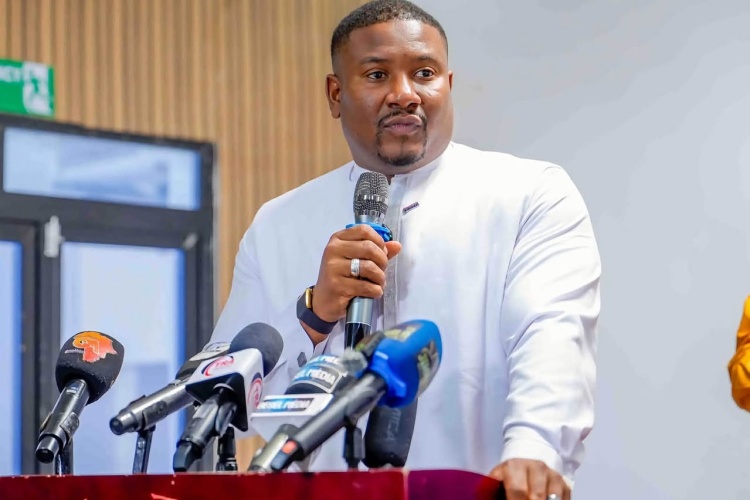
Gambiaj.com – (BANJUL, The Gambia) – The selection of Talib Ahmed Bensouda as the presidential flagbearer of Coalition 2026 may have ended one chapter of the opposition’s long and tortuous search for a common candidate. But it has opened a far more consequential question: what exactly has Talib Bensouda won?
He has secured the coalition’s flag, but the coalition itself has been badly diminished.
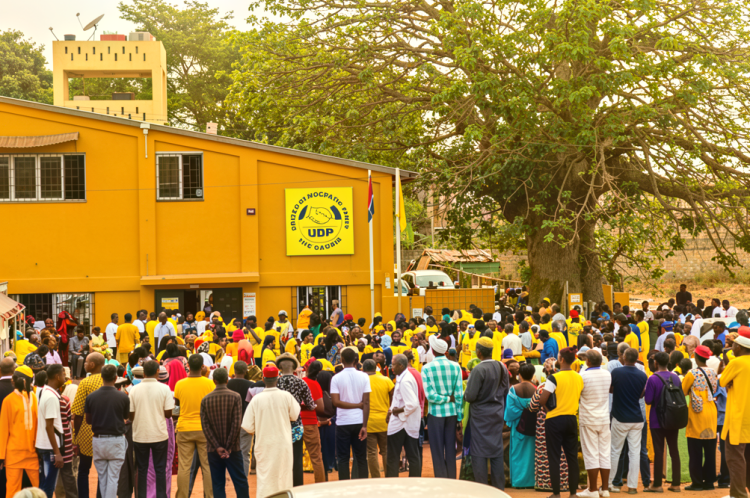
The United Democratic Party (UDP), the most established opposition political machine in the country, has walked away. The All People’s Party (APP-Sobeyaa) has withdrawn. The People’s Progressive Party (PPP) has also abandoned the talks. Former Vice President Fatoumatta Jallow Tambajang withdrew from the flagbearer selection process over concerns about the credibility of the exercise, while Coalition Mediation Committee Chairman Professor Yerro Mballow has subsequently distanced himself from the process.
The Gambia Sustainable Environment Movement (GSEM) has now gone further, saying it never consented to join the formation that selected Bensouda or endorsed his candidacy.
What remains, therefore, is not the broad-based opposition coalition that many Gambians had imagined would confront President Adama Barrow in December.
It is a much narrower political formation centered principally around Bensouda’s UNITE Party and a number of smaller formations whose capacity to mobilize voters nationally remains largely untested.
That reality places an enormous burden on Bensouda.
Winning the flag is not the same as winning the opposition.
For years, Bensouda has positioned himself as a younger, energetic alternative capable of breaking the traditional political mold. His tenure as mayor of Kanifing Municipal Council gave him a visible national platform, while UNITE has invested considerable political capital in building his presidential ambitions.
But presidential politics is a very different proposition from municipal politics.
The December election will not be decided by the political enthusiasm surrounding Bensouda in the Greater Banjul Area alone. It will be a nationwide contest requiring organizational structures, polling-station agents, campaign financing, regional networks, local political brokers, and, above all, a demonstrable ability to convert political popularity into votes.
That is where the real test begins.
Bensouda must now demonstrate that what has been presented as a coalition possesses political weight beyond his own personal campaign.
The central question is therefore no longer whether he can win a coalition primary.
It is whether he can build an electoral machine capable of competing with two formidable political establishments: President Adama Barrow’s ruling National People’s Party (NPP) and Ousainou Darboe’s UDP.
This is precisely where Bensouda’s coalition faces its most uncomfortable question.
How many voters does the coalition actually bring together now that the UDP, APP-Sobeyaa, and PPP are outside it?
Until that question is answered with credible evidence, the declaration of Bensouda as the coalition candidate risks being more symbolic than electoral.
The credibility problem cannot simply be wished away.
The flagbearer selection process has raised significant political credibility issues for Bensouda. Essa Mbye Faal withdrew just before voting, and APP-Sobeyaa exited the Coalition Mediation Committee, raising concerns about fairness and transparency.
Former Vice President Fatoumatta Jallow Tambajang also withdrew, demanding a postponement and an independent review of allegations.
Professor Yerro Mballow, the mediation committee chairman, distanced himself, calling for an investigation into inducement claims.
GSEM announced it did not consider itself part of the coalition that chose Bensouda.
These are not minor disagreements that can simply be buried beneath the excitement of selecting a flagbearer.
They go directly to the legitimacy of the political vehicle Bensouda is expected to drive into the presidential election.
Bensouda may not personally be responsible for every allegation or disagreement that has emerged. But as the newly selected candidate, he inherits the political consequences of the process.
His primary challenge is to establish the UNITE led coalition as a credible alternative to Barrow and Darboe, convincing skeptical Gambians of its national presence.
Bensouda needs to enhance his political standing by demonstrating the coalition’s outreach beyond Greater Banjul, recruiting local organizers, polling agents, and mobilizing resources. He must also cultivate a distinct electoral base separate from UDP and NPP to ensure the coalition transcends mere label status for his candidacy during the presidential election.
Proving political weight under the Barrow-Darboe factor
Bensouda also faces a significant challenge in Gambian politics due to the established presence of Ousainou Darboe, a seasoned figure with extensive influence and a strong political organization, the UDP.
Despite Bensouda’s role as the face of an intended opposition coalition, the UDP’s refusal to join complicates his effort to appeal to voters outside its base. Failure to attract a broader voter demographic undermines his position as a credible alternative to President Barrow.
And there is President Adama Barrow, who has the advantages of incumbency, including government visibility and a strong political network, which pose a challenge for challenger Bensouda.
To have any chance of defeating Barrow, Bensouda must articulate a persuasive economic and governance message that addresses corruption, employment, and public services.
Additionally, he needs to demonstrate political discipline to counter criticisms regarding the failure of coalition talks within the opposition. This strategic approach is crucial for convincing voters to shift their support to him.
The coalition’s biggest asset could still be its biggest weakness.
There is an opportunity for Bensouda in the current political landscape of Gambia. He can present himself as a new generation leader, appealing to voters disillusioned with traditional politics, specifically distancing himself from Barrow and Darboe.
However, his potential success hinges on transcending mere personality politics. The risk lies in the fallout from Coalition 2026, which could position him as just another faction rather than a comprehensive opposition choice, undermining the promise of a united front.
A coalition incorporating significant parties like UDP, APP-Sobeyaa, and PPP would have a clear argument for electoral unity, whereas a coalition lacking these parties must establish such a rationale from the ground up.
Ultimately, the most important measure of Bensouda’s political weight will not be the number of parties standing beside him on a platform.
It will be his vote share.





Leave a Reply