


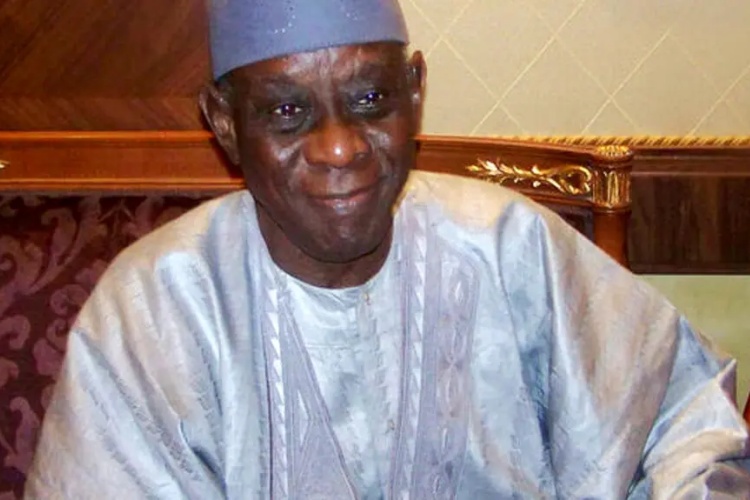
Gambiaj.com – (DAKAR, Senegal) – Senegal is mourning the death of Cheikh Hamidou Kane, the celebrated author of L’Aventure ambiguë and one of the country’s most distinguished public intellectuals, who died in Dakar on Saturday, October 3, 2026, aged 98.
Kane belonged to a generation that stood at the intersection of colonial rule, African independence, and the difficult search for a new national identity. He was at once a novelist, philosopher, senior civil servant, and politician who served as a minister under presidents Léopold Sédar Senghor and Abdou Diouf.
But it was through L’Aventure ambiguë, published in 1961, that his name travelled far beyond Senegal.
The novel, centered on Samba Diallo, tells the story of a young Senegalese Muslim torn between the traditions of his upbringing and the intellectual world of the West.
More than six decades after its publication, it remains one of the most widely studied works of African literature, confronting questions of identity, faith, education, colonialism, and cultural dislocation.
Kane’s own life closely mirrored many of the tensions explored in the novel.
From the Quranic school to Paris
Born on April 2, 1928, in Matam in northern Senegal, Kane came from a prominent Fulani family of traditional leaders and Muslim scholars. His early education was rooted in Islamic learning before his family sent him to French school at the age of nine.
That decision came at a time when Senegalese society was deeply divided over the value and consequences of Western education.
Kane eventually overcame the barriers confronting African students seeking higher education under colonial rule. After obtaining his baccalaureate in philosophy in 1951, he won a scholarship to study in France.
In Paris, he attended the prestigious Lycée Louis-le-Grand before studying law and philosophy at the Sorbonne. He later entered the École nationale de la France d’Outre-mer, the institution that trained administrators for France’s colonial territories.
His years in France transformed his understanding of both Europe and his own intellectual inheritance.
He encountered Western philosophy, including existentialism and Christian thought, while remaining deeply attached to his Muslim faith. At the same time, he became involved in the struggle for African independence and worked alongside figures including future Senegalese president Abdoulaye Wade and Burkinabè historian Joseph Ki-Zerbo.
It was during those years that he began writing what would eventually become L’Aventure ambiguë.
A minister at the birth of independent Senegal
Kane returned to Senegal in 1959, just as the country was preparing for independence.
His administrative career developed rapidly. He became governor of the Thiès region in 1960 and, the following year, commissioner-general for planning before being appointed minister of planning in the government of Prime Minister Mamadou Dia.
Kane had close ties to both Dia and Senghor, but his political trajectory changed dramatically after the rupture between the two men in December 1962.
The confrontation between Senghor, Senegal’s first president, and Dia, his prime minister, culminated in Dia’s arrest after Senghor accused him of plotting a coup. Kane resigned from government in 1963 in protest at Dia’s treatment and left Senegal.
He subsequently joined UNICEF, serving in Africa from offices in Lagos and later Brazzaville.
His return to Senegal came in 1975, after Senghor asked him to rejoin the country’s public service. Kane reportedly made Dia’s release a condition of his return.
He later served as minister of industrial development and handicrafts under Senghor and then as minister of planning and cooperation under Diouf.
In 1988, he left government and devoted increasing attention to development and civil society work, including his involvement in ENDA-Tiers Monde.
The novel that captured a continent’s dilemma
Despite his long public career, Kane’s literary reputation rests principally on two novels.
L’Aventure ambiguë won the Grand Prix littéraire de l’Afrique noire in 1962 and quickly became a landmark of modern African literature.
Its central figure, Samba Diallo, is raised within the Islamic intellectual tradition before being sent to a French school. His journey eventually takes him to Paris, where his encounter with Western modernity deepens rather than resolves his sense of displacement.
The novel’s power lies partly in the fact that its conflict is not presented as a simple choice between Africa and Europe. Instead, Kane explored the painful possibility that an African educated in the intellectual traditions of two worlds might belong completely to neither.
That tension gave the book an influence far beyond the Senegalese or Fulani setting in which it was conceived.
It became a story about a generation confronting the consequences of colonial education and the demands of modernity while trying to preserve a connection to inherited culture and faith.
Kane waited 34 years before publishing his second novel, Les Gardiens du Temple, in 1995. More political in tone, it drew on the political crisis between Senghor and Dia and revisited some of the questions raised in his first book.
He never produced a large body of fiction.
Indeed, Kane often described himself as an “occasional writer,” insisting that writing had never been his principal occupation. His primary task, he said, had been to serve Senegal.
A witness to Senegal’s first decades
In his later years, Kane increasingly assumed the role of elder statesman and witness to Senegal’s modern history.
From his home in Dakar’s Plateau district, he continued to receive students, journalists, politicians, and other visitors seeking his recollections of the country’s early post-independence years and his thoughts on Africa’s future.
He could draw on personal encounters with some of the defining figures of 20th-century African history, from Senghor and Dia to Cheikh Anta Diop, Aimé Césaire, and Félix Houphouët-Boigny.
He remained particularly critical of the 1962 break between Senghor and Dia, describing it as a national “waste” and arguing that the two men had complemented one another.
For Kane, the rupture was not merely a personal or political dispute. It represented a lost opportunity at a formative moment in Senegal’s history.
His own life therefore became inseparable from the historical questions he explored in fiction: how a newly independent African country could reconcile inherited traditions, modern institutions, and the intellectual legacies of colonialism.
Cheikh Hamidou Kane leaves behind a literary legacy far larger than his two novels might suggest. L’Aventure ambiguë gave generations of readers a language with which to confront the contradictions of a world shaped by colonialism, Islam, African tradition, and Western modernity.
In the end, the man who insisted he was primarily a public servant became one of the defining literary voices of postcolonial Africa, a reluctant novelist whose single great book became a mirror for an entire generation.



Leave a Reply