


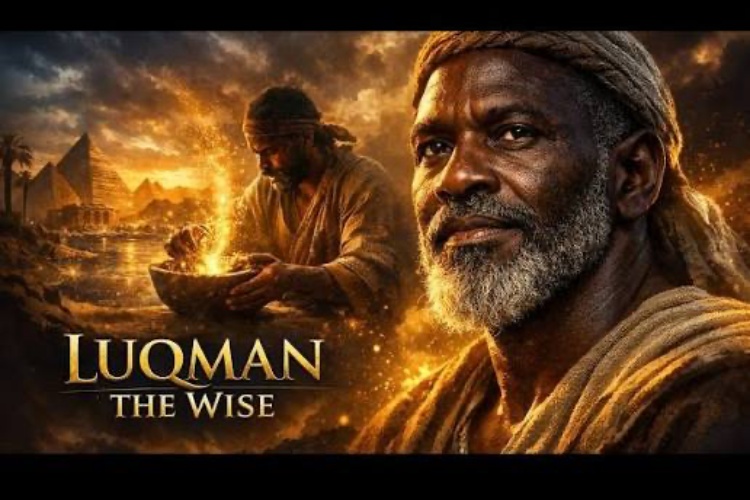
Gambiaj.com – (BANJUL, THE GAMBIA) – History remembers kings, conquerors, rulers and men who commanded great wealth and influence. Yet, among those whose wisdom Allah chose to preserve in the Holy Qur’an was a man traditionally described in Islamic accounts as a Black African. His name was Luqman.
There is something profoundly remarkable about his story. Luqman was not identified in the Qur’an as a king, a prophet or a man of great political authority. The Qur’an does not explicitly establish his ethnicity or nationality, although classical Islamic traditions commonly associate him with Nubia or Ethiopia and describe him as a Black African. What it establishes, however, is that Allah bestowed wisdom upon him and preserved his counsel for generations of believers.
This distinction is important. Luqman’s greatness was not determined by his appearance, ancestry, wealth or social standing. It was his wisdom, humility and understanding that made his counsel worthy of being remembered in the Holy Qur’an.
Allah says:
“And We had certainly given Luqman wisdom…” (Surah Luqman, 31:12).
Perhaps one of the most remarkable aspects of this account is that Allah chose to preserve the words of a man whose advice to his son continues to guide humanity centuries later.
His counsel was not about acquiring wealth, pursuing political influence, seeking public recognition or establishing social superiority. It concerned the foundations of faith, good character and responsible living.
He began with the most fundamental principle of faith: the worship of Allah alone and the rejection of associating partners with Him. He taught his son gratitude, reminding him that gratitude ultimately benefits the person who practises it.
He spoke about accountability, explaining that even the smallest deed, however hidden, is known to Allah.
He also reminded his son of the importance of kindness and respect towards parents, while making clear that obedience to them cannot extend to disobeying Allah. He counselled him to establish prayer, encourage what is right, discourage what is wrong and remain patient in the face of difficulties.
He warned against arrogance, looking down upon others and raising one’s voice unnecessarily. He encouraged humility in both conduct and appearance.
These were not simply instructions from a father to his child. They were lessons in faith, character, personal responsibility and the values upon which a decent society should be built.
What does Luqman’s wisdom say to us as Gambians today?
Our society has much to reflect upon.
The Gambia has long valued hospitality, religious tolerance, extended family relationships and the coexistence of different ethnic and cultural communities. These are qualities we should cherish and protect. Yet, like every society, we face the challenge of preserving our values while navigating changing social attitudes and expectations.
We sometimes place excessive importance on ethnicity, family connections, wealth, political affiliation and social influence. People can be judged by where they come from, the families they belong to, the positions they occupy or the political opinions they hold.
In some instances, appearance, ancestry and perceived social identity become grounds for treating people differently, when none of these should diminish their dignity or worth as human beings.
Luqman’s story challenges such attitudes. His reported African identity gives his story additional significance, particularly in a world where racial prejudice and social discrimination have historically shaped how people are treated.
If Allah chose to preserve the wisdom of a man traditionally described as a Black African in His Holy Book, what justification do we have for diminishing another person because of colour, origin or social background?
There is also a lesson in how we define greatness. Holding public office does not automatically make someone wise. Wealth does not necessarily produce good judgement, and popularity is not proof of good character. Equally, someone who occupies no prominent position in society may possess wisdom that many influential people lack.
This is an important lesson for our political leadership, public institutions, traditional authorities, religious leaders and, indeed, every Gambian.
As we approach the December 2026 presidential election, we should ask ourselves whether our political conversations are strengthening or weakening the values that hold us together. Political competition should be about ideas, policies, competence and the future of our country.
It should never become an excuse for ethnic prejudice, personal insults, arrogance or the humiliation of others.
We can disagree without becoming enemies. We can support different political parties without questioning one another’s patriotism. We can hold leaders accountable without abandoning respect for human dignity. These are not signs of weakness. They are expressions of maturity and responsible citizenship.
Luqman’s counsel about humility is particularly relevant in an age when public recognition and social media visibility can sometimes be mistaken for achievement. The ability to speak loudly does not necessarily mean one has something meaningful to say.
Commanding attention does not establish wisdom. Sometimes, the wisest person in the room is the one who listens, reflects and speaks only when there is something constructive to contribute.
Perhaps the most important lesson for The Gambia concerns our children and young people.
Luqman did not simply tell his son what to believe. He took time to teach him how to live. His advice covered faith, personal conduct, responsibility towards others and the importance of humility.
Today, we speak frequently about unemployment, migration, education, drug abuse, social pressures and the challenges confronting our young people. These are important national concerns. But beyond policies, programmes and economic opportunities, we must also ask what values we are passing on to the next generation.
Are we teaching our children to respect others regardless of their circumstances? Are we encouraging honesty, patience, compassion and responsibility? Are we demonstrating through our own conduct the values we expect them to uphold?
Children learn not only from what we tell them but also from what they see us practise. A parent who teaches humility but demonstrates arrogance, or a leader who preaches unity but encourages division, sends contradictory messages.
Luqman’s example reminds us that raising responsible citizens is not exclusively the responsibility of schools, government institutions or religious establishments. It begins within the family, through the example of parents and the values cultivated in our homes and communities.
We should also reconsider how we recognise greatness in our own society. We should not wait until people occupy important positions, accumulate wealth or receive public honours before appreciating their contributions.
Wisdom can be found among ordinary people in our villages, neighbourhoods, families and communities. Some of our most valuable lessons come from people whose names may never appear in newspapers or history books.
The Gambia needs people who build bridges rather than walls, who value knowledge rather than arrogance, who demonstrate integrity rather than merely speak about it, and who understand that leadership is a responsibility rather than a privilege.
Ultimately, Luqman’s story is much more than the account of a man traditionally associated with African origins whose wisdom was preserved in the Holy Qur’an. It is a reminder of what truly gives a human being dignity and worth. His story challenges us to look beyond appearances, question our assumptions about greatness and recognise that wisdom can come from people and places society sometimes overlooks.
Perhaps this is what we need to rediscover as a nation: that the measure of a person is not the colour of their skin, the family they come from, the wealth they possess or the office they occupy, but the character they demonstrate, the wisdom they exercise and the good they leave behind.
Luqman’s words have survived generations because they speak to truths that do not become outdated. His advice to his son remains as relevant in our homes, communities and public institutions today as it was when it was first given.
May Allah grant us wisdom, humility and the ability to recognise goodness in others. May He guide our parents, leaders and young people, strengthen the bonds that unite our communities and help us build a society in which dignity, compassion, justice and righteousness are not merely spoken about but practised.
Ameen.










Leave a Reply