


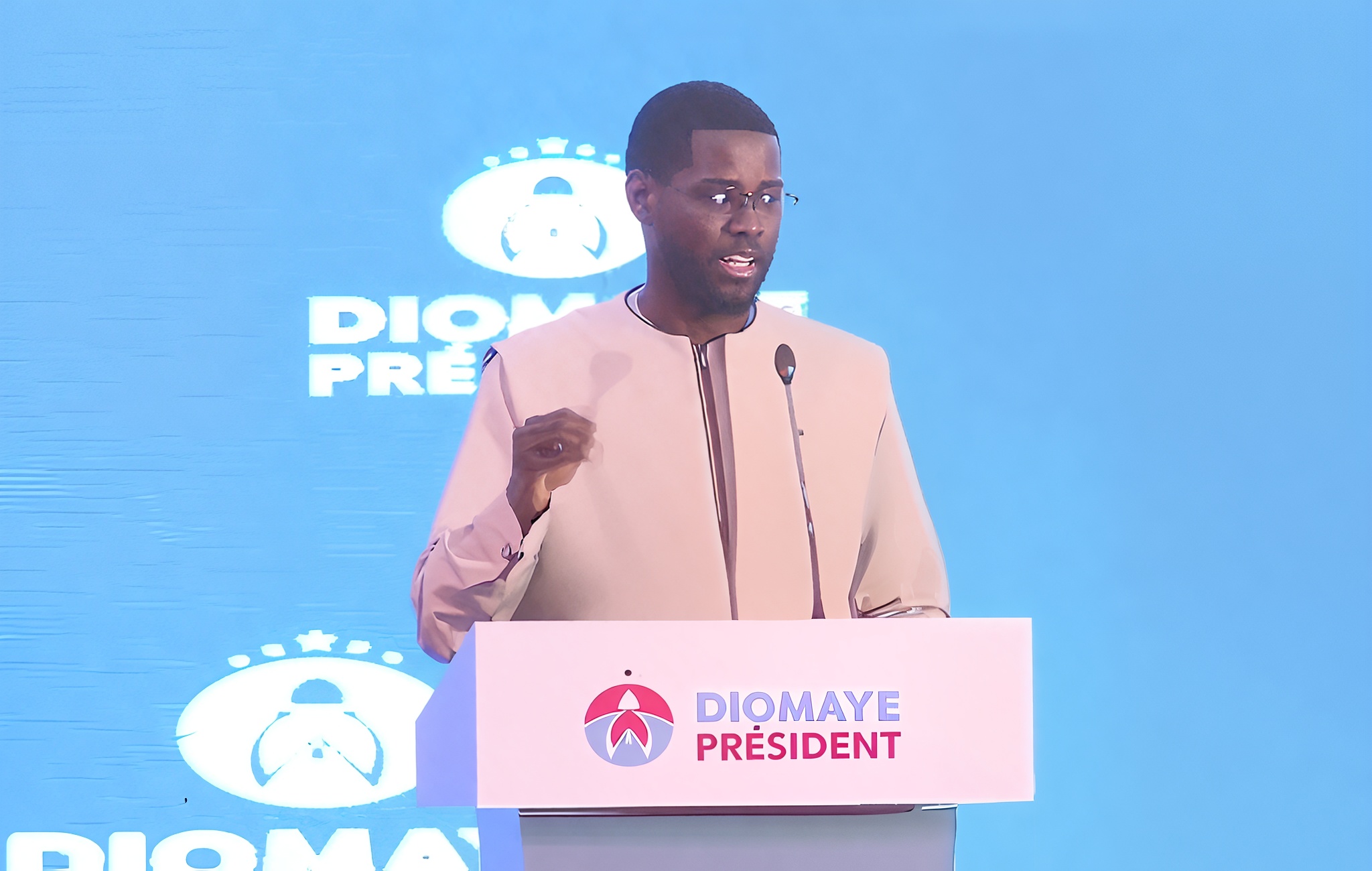
Gambiaj.com – (DAKAR, Senegal) – Saturday’s remarks by Senegalese President Bassirou Diomaye Faye are increasingly being interpreted by political observers as a carefully calibrated response to Prime Minister Ousmane Sonko and a possible indication that the once tightly aligned leadership of the ruling camp may be heading toward a political rupture.
Although the president refrained from naming Sonko directly during his address to the leaders of the Diomaye Président coalition, the themes he emphasized, legitimacy, historical contribution, coalition-building, and political restraint, collectively amount to a subtle but firm counter-narrative to claims that he was simply chosen as a candidate by Sonko and the leadership of PASTEF ahead of the 2024 presidential election.
The intervention is widely seen as the clearest sign yet that the relationship between Senegal’s two most powerful political figures is entering a phase of strategic distancing.
Challenging the “Chosen Candidate” Narrative
At the center of the emerging tension is a narrative advanced by Sonko in recent months suggesting that the political movement, and he personally, selected Faye as its presidential candidate during the political crisis that followed the dissolution of PASTEF in 2023.
Faye’s remarks directly undermine that framing.
“What made me President of the Republic did not start in 2024,” the president stated, implicitly rejecting the idea that his rise to power was merely the product of a last-minute political decision taken by others.
By emphasizing his long-standing role within PASTEF, Faye sought to reaffirm that he was not a substitute candidate but a foundational actor in the party’s development.
“No one can erase my work in PASTEF, and today more than ever I claim my belonging to that PASTEF,” he declared.
This insistence on political ownership is significant because it touches on a fundamental question of authority within the ruling movement: who embodies the legacy and future direction of the political project that brought the opposition to power?
Rewriting the Story of the 2024 Victory
Perhaps the most revealing part of Faye’s speech was his detailed reconstruction of the events that led to the formation of the Diomaye President coalition during the 2024 election.
After the dissolution of PASTEF on July 31, 2023, the movement faced a legal dead end that prevented it from participating in elections under its own banner.
Faye recalled that at the time he was still in detention, yet he continued to orchestrate the political strategy that ultimately led to victory.
“The truth is that PASTEF no longer existed,” he said. “The party had been dissolved by decree… but it was reborn from its ashes after my election.”
According to the president, the coalition that carried him to power was not imposed from above but constructed through alliances with other political parties willing to lend their legal registration to the campaign.
“Men lent us the receipt of their political party and walked alongside us,” he explained.
By recounting these details, Faye effectively positions himself not merely as the beneficiary of a political decision but as the architect of the strategy that made electoral participation possible.
Decisions Taken From Prison
Faye also highlighted a series of strategic decisions he said he personally made while incarcerated, further reinforcing the image of an active political leader rather than a passive candidate.
Among those decisions was the appointment of former prime minister Aminata Touré as supervisor of the coalition.
“I chose Aminata Touré while I was in prison,” he said, explaining that he personally contacted her along with Abdourahmane Diouf to organize the political structure supporting his candidacy.
Other figures who played key roles in the coalition’s organization included Yassine Fall, Amadou Moustapha Ndieck Sarré, Ayib Daffé, and El Malick Ndiaye.
These references serve to underscore that the coalition was the result of collective political engineering, but under his direction.
A Strategy of Silence
Another important element of Faye’s speech was his explicit refusal to engage in direct political confrontation.
Without referring to Sonko, he warned against turning individual statements into public disputes.
“For a dispute to happen there should be a second protagonist,” he said. “Let us not find someone in a monologue in order to allow it to migrate into a dispute.”
This message suggests a deliberate communication strategy: avoiding direct public clashes while quietly consolidating his authority as head of state.
However, such restraint may also reflect a recognition that an open confrontation with Sonko, who remains a powerful political figure within the movement, could destabilize the ruling coalition.
Signs of an Emerging Power Duality
Since the 2024 election, Senegal has effectively been governed by a dual leadership structure: Faye as president and Sonko as prime minister and leader of the political movement that drove the opposition’s rise.
This arrangement initially appeared complementary, with Sonko portrayed as the ideological architect of the “revolution” and Faye as the institutional leader implementing it.
But recent statements suggest that the balance between those roles is becoming increasingly contested.
Sonko’s declaration before Parliament that he is the “guardian of the Revolution” was widely interpreted as an assertion of political primacy within the movement.
Faye’s response, emphasizing his own historical legitimacy and strategic role, can therefore be read as an effort to reassert presidential and political authority.
Why a Separation Appears Increasingly Likely
Taken together, the president’s remarks point to three underlying dynamics that could eventually lead to a separation between the two leaders.
First, there is a growing struggle over narrative legitimacy: whether the political transformation is primarily associated with Sonko’s leadership or with a broader collective movement in which Faye played a decisive role.
Second, there is an emerging institutional divide between the presidency and the political movement. As head of state, Faye must govern within the structures of the state, which often requires moderation and coalition-building. Sonko, by contrast, continues to embody the more militant political base that propelled the movement to power.
Third, Faye’s insistence on governing with the coalition, rather than through a single-party hierarchy, signals an effort to broaden his political base beyond the inner circle of PASTEF.
A Controlled Political Transition?
For now, this is the first time Bassirou Diomaye Faye is openly talking about the deep differences with the leader of PASTEF, Ousmane Sonko, who has long announced and acknowledged the conflict.
Faye concluded his speech by calling for calm political debate, respect for institutions, and dialogue, even with the opposition.
“We can debate in serenity,” he said, insisting that political ambition must be balanced with the interests of the state.
But the very need to deliver such a message suggests that the ruling camp is entering a more complex phase.
The competing narratives about the origins of the 2024 victory as yet another episode of the growing divergence in the political alliance that brought Bassirou Diomaye Faye and Ousmane Sonko to power. Chances are that this may gradually evolve into two distinct centers of authority, raising the possibility that a formal political separation could eventually become unavoidable.





Leave a Reply