


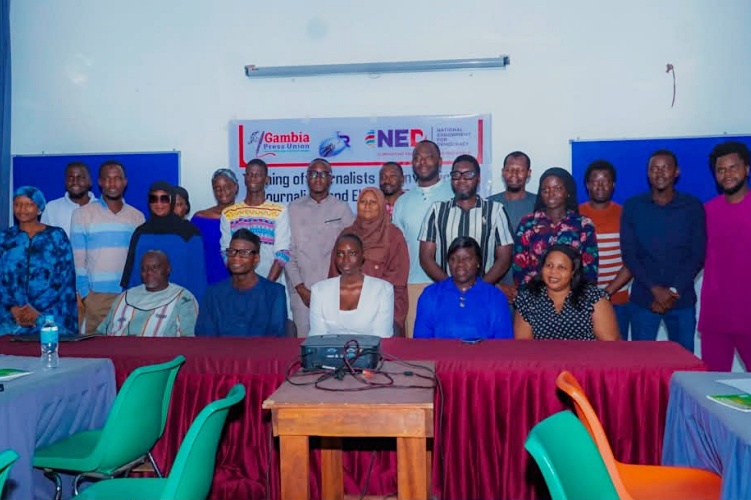
Jobarteh, executive director of the Edward Francis Small Centre for Rights and Justice, said journalists must examine how public institutions manage national resources and independently verify claims made by politicians as voters prepare to make critical electoral decisions.
“If you truly want to know how the Gambia really works, you must understand the audit reports to see the layers of deception and corruption of the state,” Jobarteh told participants at a two-day investigative journalism training organised by the GPU in partnership with The Republic at the National Nutrition Agency (NaNA) on Monday.
He said the National Audit Office had continued to identify weaknesses in public financial controls and instances of unaccounted-for funds, but journalists often lacked the skills to analyse audit findings and translate them into accessible public-interest reporting.
Jobarteh warned that the failure to investigate such findings deprived citizens of vital information about the use of public funds and weakened accountability.
He also cautioned against reporting political claims without independent verification, citing fake coalition agreements and manipulated images of political leaders as examples of misinformation capable of confusing voters and undermining confidence in the electoral process.
“It is not enough to simply report what a politician says but we must also verify it,” he said. “It is not enough to report that a video is circulating online, we must also investigate its authenticity.”
He urged journalists to investigate the financial interests and records of political candidates, scrutinize campaign funding and examine public procurement processes, arguing that reporting without independent scrutiny risked serving the interests of powerful figures.
“Anything less is not journalism; it is stenography for the powerful,” Jobarteh said.
GPU Vice President Sheriff Saidykhan said the training was intended to address gaps in deeply researched reporting and equip journalists to provide voters with credible, evidence-based information throughout the electoral cycle.
He said journalists must prioritise accuracy over speed, verify their sources and produce investigations that help citizens understand issues affecting their electoral choices.
The programme covers public procurement, asset declarations, corporate registries, financial irregularities, source verification and the protection of confidential sources and whistle-blowers.
Jobarteh also called for broader election coverage that reflects the economic and social realities facing voters, including unemployment, rising food prices, unreliable water and electricity supplies, and inadequate healthcare.
He urged journalists to give greater attention to women, young people and persons with disabilities rather than concentrating overwhelmingly on political personalities and campaign events.
He further warned that corruption, abuse of power and disregard for the law remained challenges despite The Gambia’s democratic transition following 22 years of authoritarian rule under former president Yahya Jammeh.
Citing Section 207(3) of the Constitution, which addresses the media’s role in holding government accountable to the people, Jobarteh said media independence must not depend on the goodwill of those in power.
“The independence of the media is not a privilege granted by those in power,” he said.
He also stressed the importance of journalists protecting themselves and their sources when pursuing sensitive investigations, particularly in politically charged environments. Participants were urged to adopt secure communication practices, safeguard whistle-blowers and plan for their physical safety.
The training, which runs from 19 to 20 October, brings together selected journalists for practical sessions led by facilitators including Mustapha K. Darboe, Mustapha Ceesay, Demba Kandeh and Sang Mendy.
It forms part of a wider project titled Empowering Voters Through Investigative Journalism, Fact-checking, and Promoting Transparency and Accountability in The Gambia. The initiative includes three training programs covering investigative journalism, election reporting and fact-checking, as well as plans to develop a media handbook on audit reporting in collaboration with the National Audit Office.
The GPU said the initiative seeks to strengthen the media’s capacity to provide independently verified information and promote transparency and accountability before, during and after the 2026-2027 electoral cycle.




Leave a Reply