


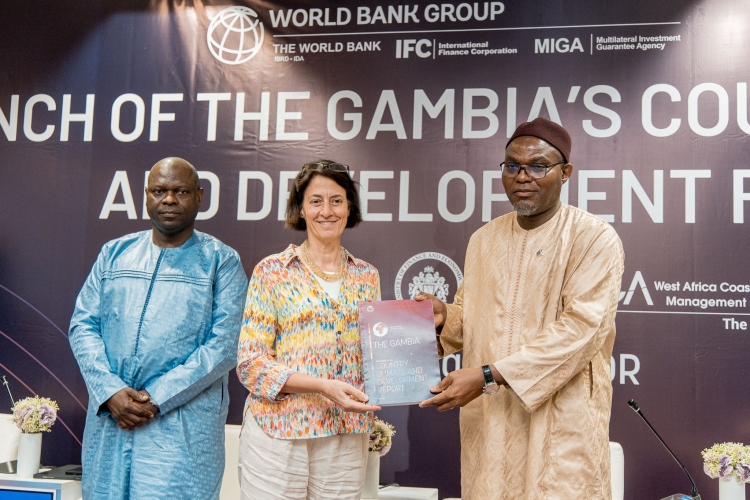
Gambiaj.com – (BANJUL, The Gambia) – The World Bank Group has unveiled a new Country Climate and Development Report (CCDR) for The Gambia, outlining how climate action can be leveraged to protect jobs, strengthen livelihoods, and drive long-term economic growth.
The report serves as a strategic framework that integrates climate risks with development planning, providing the government, private sector, and development partners with data-driven guidance on how to build a more resilient and low-carbon economy.
It identifies priority investments, policy reforms, and financing pathways needed to address environmental threats while expanding economic opportunity.
According to the CCDR, environmental pressures, including flooding, coastal erosion, and rising temperatures, are already undermining productivity in key sectors such as agriculture and infrastructure.
Without intervention, these risks could significantly impact economic output. However, the report argues that an “aspirational growth path” anchored in climate resilience could reduce projected GDP losses from 9.3 percent to as low as 2.6 percent by mid-century.
Speaking on the findings, Franklin Mutahakana said the report demonstrates that targeted investments and sound policies can help the country mitigate future risks while unlocking new economic opportunities.
At the core of the CCDR is a strong emphasis on job creation and livelihoods. Agriculture, which employs about 70 percent of the population, is identified as a critical sector for intervention.
The report highlights that improved farming techniques, expanded irrigation, and better market access could boost agricultural yields by up to 40 percent, significantly increasing rural incomes and employment.
The report also points to the untapped potential of small and medium enterprises (SMEs), which make up roughly 80 percent of businesses in the country but face major financing constraints. Expanding access to affordable credit, lowering energy costs, and supporting value chains, including recycling and composting within a circular economy, are seen as key to enabling business growth and job creation.
Urban resilience is another major pillar of the report, particularly in the capital, Banjul, where economic activity is heavily concentrated.
The CCDR stresses the urgency of protecting infrastructure and assets in the short term, while planning for long-term urban expansion inland to mitigate climate risks and sustain economic stability.
Energy and infrastructure development feature prominently in the report’s recommendations. While electricity access in the country has reached about 90 percent, the CCDR calls for accelerating progress toward universal access and ensuring reliability and affordability.
Strengthening transport networks is also identified as essential to maintaining economic activity and attracting private investment.
Tourism, which contributes around 20 percent of GDP and employs 15 percent of the workforce, is highlighted as another sector with strong potential for inclusive growth. With targeted reforms, the report suggests the industry could generate more stable and higher-quality jobs, particularly for young people and women.
To achieve these ambitions, the report estimates that The Gambia will require approximately $11 billion in long-term investment by 2050. It underscores the importance of increasing private sector participation, potentially up to 35 percent, through blended finance mechanisms and improved governance frameworks.
The CCDR is part of a broader initiative by the World Bank Group to help countries align climate action with development goals. By offering detailed analysis, cost assessments, and prioritized actions, the reports are designed to guide policy decisions, mobilize funding, and support a transition toward resilient, sustainable growth.
For The Gambia, the CCDR positions climate resilience not just as an environmental necessity but as a central pillar for economic transformation, job creation, and poverty reduction in the decades ahead.











Leave a Reply