


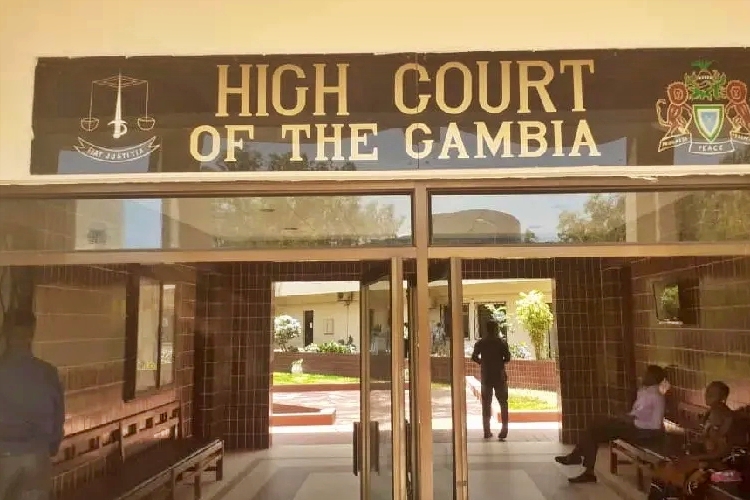
Gambiaj.com – (BANJUL, The Gambia) – A High Court judge has dismissed an application by the defense in a rape case to compel five individuals to appear as witnesses, ruling that counsel failed to establish a sufficient basis that the proposed witnesses could provide evidence material to the case.
Justice Ebrima Jaiteh made the ruling in the ongoing trial of Ass Malick Njie, who is facing a charge of rape contrary to Section 3(1)(a) of the Sexual Offences Act, 2013.
According to the charge sheet, Njie, on or about February 5, 2022, near the Qcell building in the Kanifing Municipality, intentionally and under coercive circumstances had sexual intercourse with a 12-year-old boy through the anus, and thereby committed an offence.
The defense had applied under Section 160 of the Criminal Procedure Code (CPC) 2025, seeking witness summonses for five individuals, Musa Secka, Amadou Kebbeh, Ebrima Drammeh, Muhammed Lamin Jarju, and Ebrima Luke Silver, arguing they were necessary for the accused’s ddefenseand should be compelled to testify.
Delivering the ruling, Justice Jaiteh acknowledged that Section 160 of the CPC 2025 grants courts the power to issue witness summonses but emphasized that the power is not automatic.
The law requires, he explained, that it must be “made to appear” to the court that a proposed witness is capable of giving material evidence or is in possession of documents relevant to the case.
“The phrase ‘made to appear’ imposes an evidential burden on the applicant. The defense must place before the court facts or circumstances from which the court can reasonably conclude that the proposed witness possesses evidence that is material, relevant, and necessary for the just determination of the issues,” Justice Jaiteh stated.
The judge noted that the defense provided only the names of the five individuals without explaining what evidence each was expected to give, which facts in issue their testimony would address, or whether any of them possessed documents, recordings, photographs, or other material evidence.
He further observed that none of the five had given statements to police during investigations, and none were mentioned during the accused’s own testimony.
“Their names emerge for the first time at this late stage of the proceedings without any factual foundation being laid for their involvement,” Justice Jaiteh said.
While affirming that an accused person has both a constitutional and statutory right to call witnesses in their defense, the judge was emphatic that the right is not absolute.
“The court must balance the rights of the accused against the proper administration of justice and the rights of ordinary citizens not to be unnecessarily burdened with compulsory attendance before a court of law,” he ruled.
Justice Jaiteh further stressed the coercive nature of witness summonses, noting that they compel a citizen, on pain of legal consequences, to leave their personal affairs, employment, business, or family obligations to attend court.
“Such coercive power must therefore be exercised judiciously and only where there is a demonstrated basis for believing that the person possesses material evidence relevant to the proceedings,” he said.
The judge warned that compelling citizens to attend court merely because their names were mentioned, without any indication of the evidence they would provide, would amount to a “fishing expedition” and expose members of the public to unnecessary inconvenience, contrary to the spirit and letter of Section 160.
Although the prosecution did not object to the application, Justice Jaiteh emphasized that the court has an independent duty to ensure the statutory requirements of the law are satisfied before exercising its coercive powers, regardless of the parties’ positions.
Concluding, he said he was not satisfied that it had been made to appear that any of the five proposed witnesses were capable of giving material evidence or were in possession of material documents relevant to the case within the meaning of Section 160 of the CPC 2025. The application for witness summonses was accordingly refused.
However, Justice Jaiteh left the door open for the defense, noting that his ruling would not prevent it from renewing the application, provided it could furnish sufficient particulars identifying the material evidence each proposed witness is expected to give or any material documents in their possession.
The trial continues.








Leave a Reply