


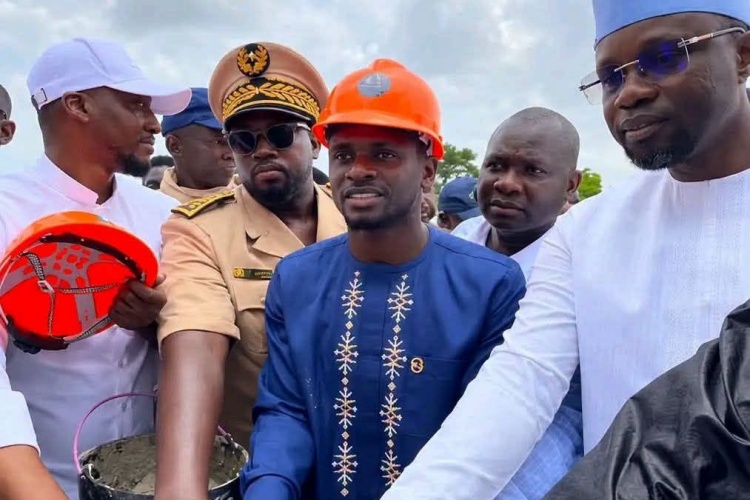
Gambiaj.com – (BAMBALI, Senegal) – The laying of the foundation stone for an agro-industrial park in Bambali, in Senegal’s Sédhiou region, on Saturday, September 19, was overshadowed by controversy over the guest list, particularly the invitation of National Assembly President Ousmane Sonko.
The ceremony, which marked the formal launch of a major agricultural investment promoted by Senegalese international footballer Sadio Mané, attracted attention beyond the economic ambitions of the project.
Despite the government being represented by the minister of Industry and Trade, Serigne Guèye Diop, political analysts and some KIIRAAY party members, led by President Bassirou Diomaye Faye, voiced dissatisfaction over the protocol’s choice to invite and nominate PASTEF leader Ousmane Sonko.
Protocol and the selection of personalities invited to the event have been the main points of contention, with some critics characterizing the circumstances as peculiar and annoying.
The controversy surrounding Sonko’s presence has, in some respects, eclipsed the significance of the investment itself.
Mané: “This project belongs to you.”
Speaking before people from his home region, Mané delivered an emotional message about his ambitions for Bambali and the wider Casamance region.
“I took time to understand what I could bring to the whole of Casamance. Now I want to tell you that your project is finally here. It does not belong to me; it belongs to you. I entrust it to you. I want you to take it as your own project and work on it as your own,” Mané said.
He said local people would be involved in the management and recruitment process, including through the submission of CVs.
“You will manage it yourselves. I will take your CVs, and, depending on the intellectual level and abilities of each person, I will make the choices for recruitment, from the president to the junior staff. So I am giving it to you. Take it. It is for you, for the whole of Casamance,” he said.
For Mané, the laying of the foundation stone represents more than the beginning of a construction project.
“I hope that tomorrow, our children will be able to look at this land and say, ‘Here, something started,'” he said.
The footballer also said he wanted his legacy to extend beyond his achievements on the football pitch.
“I don’t want to be remembered only for the goals I scored or the trophies I won,” he said.
CFA 11.7 billion investment
The SM10 AGRO project is expected to involve an investment of about CFA11.7 billion and create more than 1,000 direct jobs.
The planned agro-industrial park will focus initially on the processing and value addition of mangoes, with the broader objective of reducing agricultural losses and keeping more of the value generated by local production within the region.
According to Abdou Waahab Touré, founder and managing director associate of Groupe Confluence, which is overseeing the project, the complex will include four main processing units.
These will include a unit for processing fruit for export, another for mango purée, a unit producing mango butter, and one dedicated to dried mango.
The park will also include a training center and accommodation for workers, with the aim of combining industrial production with skills development and support for local agricultural actors.
Mané said the project would create more than 1,000 direct jobs, in addition to indirect employment in transportation, supply, and services.
The project also envisages working with farmers and cooperatives to encourage modern agricultural practices and improve their ability to supply the processing facilities.
A factory designed to operate beyond mango season
Engineers involved in the project say extensive technical and market studies were carried out before construction began.
Théodore Monteil, an engineer and associate director of Groupe Confluence, said the preparatory work included nearly three months of documentary analysis, a technical study and a detailed study of the mango market, which informed the business plan approved by Mané and his partners.
He said the project was also being developed in collaboration with Senegal’s investment promotion agency APIX and in accordance with the procedures announced by the promoters.
Monteil said the installations would be progressively certified, beginning with mango pulp and later extending to dried mango and mango butter.
“Mr. Sadio Mané told us, ‘I don’t want poor quality.’ I want the very best,” Monteil said.
The planned facility will include around 2,500 square metres of cold-storage facilities, allowing fruit to be preserved and the factory to continue operating throughout the year despite the seasonal nature of mango production.
The plant is expected to have an initial processing capacity of 10,500 tonnes a year with a single shift. This could rise to 21,000 tonnes with two shifts and eventually reach 31,500 tonnes when operating around the clock with three shifts.
The technology is also designed to allow the factory to process other fruits, including bananas, pineapples and guavas.
“We want a versatile factory that can process not only mangoes,” Monteil said, explaining that diversification would help maintain industrial activity after the mango season ends.
Local families at the center of the project
The promoters have also highlighted the project’s links to the local community.
Monteil said the nine families that previously owned plantations on the site were among the first people recruited to work on the project and continue to be called upon for activities carried out on the land.
The facility is expected to include temperature- and humidity-controlled areas, with some storage spaces maintained between 12 and 14 degrees Celsius, while working areas will be kept at around 22 degrees.
The construction and installation programme is expected to progress gradually, with the entire park projected to become operational in about 18 months.
For Mané, the broader objective is to create jobs, develop agriculture, increase the value of local produce, and provide young people and women with opportunities at home.
“The ambition is also to show that a young person from Casamance can build their future on their own land, without having to leave to look elsewhere for opportunities that are lacking here. We want to create value, support local actors, and contribute to the economic and social development of Bambali and the whole region,” he said.



Leave a Reply