


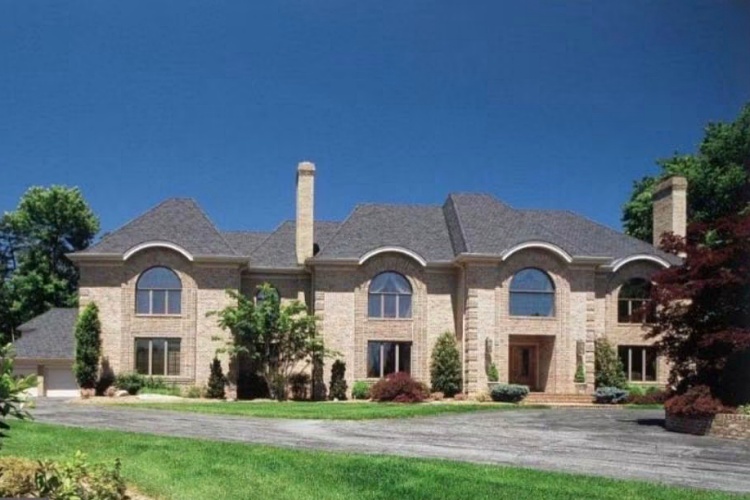
Gambiaj.com – (BANJUL, The Gambia) – The United States and The Gambia have signed an agreement paving the way for the return of more than US$2.5 million recovered from a luxury mansion in Potomac, Maryland, acquired during the rule of former President Yahya Jammeh.
The agreement, signed on Friday, September 18, 2026, provides that US$2,507,911.73 in net proceeds from the sale of the property will be transferred to The Gambia for the compensation of eligible victims of the Jammeh regime.
The funds will be deposited into the Reparations Fund at the Central Bank of The Gambia and independently administered by the Reparations Commission.
The development gives a new dimension to a property that became one of the most striking symbols of the contrast between Jammeh’s public hostility towards the West and his private use of the United States as a destination for family wealth and assets.
The Potomac property and Jammeh’s anti-Western rhetoric
Jammeh acquired the 8,818-square-foot mansion at 9908 Bentcross Drive in Potomac through the MYJ Family Trust established by his wife, Zineb Jammeh. US court documents say the property was purchased in 2010 for about US$3.5 million.
The US Department of Justice later alleged that the money used to acquire the mansion came from illicit proceeds, including misappropriated Gambian public funds and bribes paid by businesses seeking monopoly rights in The Gambia.
The property was therefore not simply another overseas residence associated with a former head of state. It became part of the international trail of assets allegedly accumulated during Jammeh’s 22-year rule.
Its acquisition was also striking given Jammeh’s repeated public attacks on Western governments, including the United States and Britain.
Jammeh frequently accused Western governments of attempting to interfere in The Gambia’s affairs. In 2015, he accused Washington of conducting a campaign against his government after US officials criticized his human rights record. He also repeatedly portrayed Western institutions as seeking to impose their values and political agenda on African countries.
Yet, behind that rhetoric, his family maintained a substantial property in one of the United States’ wealthier suburbs. Reporting at the time established that the Potomac mansion was used by the Jammeh family and their staff.
The US government ultimately turned that contradiction into an asset-recovery case.
From a US lawsuit to forfeiture and finally repatriation
The US Department of Justice filed a civil forfeiture complaint against the property in July 2020, alleging that approximately US$3.5 million in corruption proceeds had been used to acquire it.
The case did not result in an immediate transfer of the property or its proceeds to The Gambia.
The US court proceedings required the authorities to establish the legal basis for forfeiture and to provide notice to the Jammehs and potential claimants. Court records show that the United States attempted to serve notice through international legal-assistance channels, including efforts to locate and notify the Jammehs in Equatorial Guinea.
No claimant ultimately came forward to contest the forfeiture, and a US federal court entered a default judgment and final order of forfeiture on May 24, 2022.
That, however, was not the end of the process.
The United States still had to take ownership of the property, liquidate the asset, and determine how the resulting proceeds could legally be transferred for the benefit of victims in another country.
The Justice Department announced on Friday that the property had been forfeited and liquidated and that the sale generated US$2,507,911.73 in net proceeds.
The public record does not identify a single reason for the four-year gap between the 2022 forfeiture order and Friday’s repatriation agreement. What is clear is that forfeiture, sale, and international transfer were separate stages of the process, involving US judicial proceedings and cooperation between the two governments.
The US Justice Department said the assistance of Gambian officials was important to the successful forfeiture and eventual return of the money.
From Jammeh’s wealth to victims’ reparations
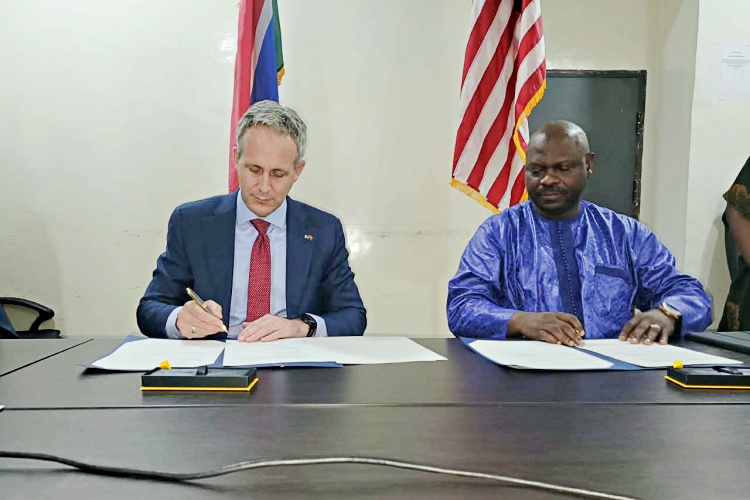
The US Chargé d’Affaires and The Gambia’s Minister of Finance, signing the Final Agreement for the transfer of funds from the sale of Yahya Jammeh’s former residence in the United States.
The significance of Friday’s agreement goes beyond the value of the money.
For the first time, a substantial overseas asset linked to the former regime is being converted into a financial resource specifically designated for victims.
The US Justice Department said the agreement requires the funds to be used to compensate eligible victims under The Gambia’s Victims Reparations Act 2023.
The legislation created the legal framework for reparations and provides for compensation and other forms of redress for people who suffered harm from human rights violations during the period covered by the transitional justice process.
This is particularly significant because reparations are one of the central pillars of the post-Jammeh transitional justice program.
The Truth, Reconciliation and Reparations Commission, established after Jammeh left power, investigated abuses committed during his rule and made recommendations covering reparations, accountability, institutional reform, reconciliation, and guarantees of non-recurrence.
The TRRC submitted its final report to President Adama Barrow in November 2021. The government subsequently accepted 263 of the 265 recommendations and produced an implementation plan covering the different areas of the transitional justice program.
The establishment of the Reparations Commission and the creation of a dedicated legal framework were therefore important steps in moving the process from testimony and recommendations towards actual redress.
The Potomac funds now provide another source of financing for that effort.
A gain for Barrow’s transitional justice record
For President Barrow, the agreement is a tangible development in one of the defining commitments of his administration: dealing with the legacy of the Jammeh era.
His government established the TRRC in 2017 and subsequently created the institutional and legal mechanisms intended to implement its recommendations.
The administration’s White Paper committed the government to implementing 263 recommendations, while the subsequent implementation plan established coordination mechanisms involving government institutions, civil society, victims, and other stakeholders.
Barrow has also repeatedly linked his administration’s transitional justice agenda to justice, accountability, reconciliation, and reparations for victims.
In 2024, when victims’ representatives called for faster implementation of the TRRC recommendations, Barrow said his government remained committed to ensuring that victims and survivors received attention for their health, compensation, and welfare.
The recovery of the Potomac proceeds consequently gives his government a concrete example of an asset associated with the former regime being recovered internationally and redirected towards victims.
It also demonstrates that the transitional justice process is not confined to events inside The Gambia. The recovery of assets allegedly moved abroad during Jammeh’s rule has become an important part of the accountability architecture.
The money will not end the reparations challenge
The US$2.5 million will nevertheless not resolve The Gambia’s wider reparations obligations.
The TRRC’s work established a much broader universe of victims and forms of harm, while the government has acknowledged the need for sustained implementation of reparations alongside accountability, institutional reform, and reconciliation.
The government’s own transitional justice authorities have said that reparations need to be accelerated and that the Reparations Commission must be fully operationalized.
That makes the management of the Potomac money almost as important as its recovery.
The agreement provides for the money to go into the Reparations Fund and to be administered independently by the Reparations Commission. This creates a mechanism through which the proceeds can be separated from ordinary government expenditure and directed towards eligible victims under the legal framework.
The broader test will now be whether the money reaches victims efficiently, transparently, and according to the reparations framework.
For victims who spent years giving testimony to the TRRC and waiting for compensation, the Potomac agreement therefore represents more than an international asset-recovery transaction.
It is a rare instance in which wealth associated with the former regime has traveled the full distance from an overseas asset, through a foreign legal process, back into The Gambia and into a fund intended to provide redress to those harmed during Jammeh’s rule.
It is also a significant milestone for the Barrow administration, in the unfinished transition from truth-telling to reparations, accountability, and institutional reform.
And for the United States, the return marks the completion of a case that began with an allegation that stolen or corruptly obtained Gambian money had been used to buy an American mansion, and ended with the proceeds being designated for the people who suffered under the regime that generated the wealth.








Leave a Reply