


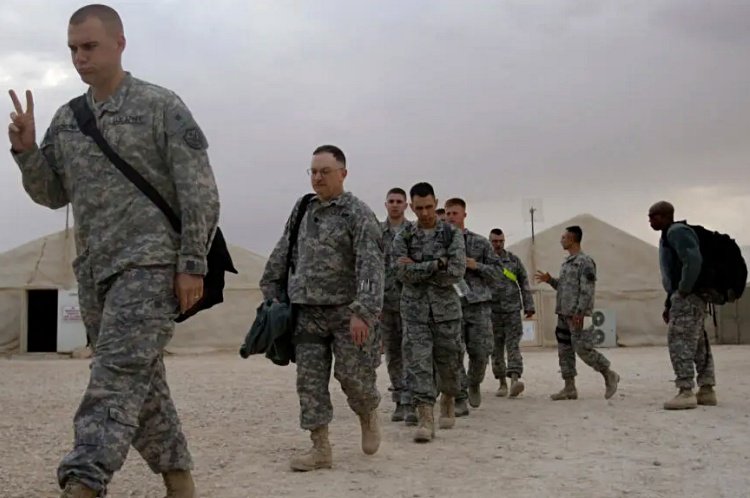
Gambiaj.com – (BAGHDAD, Irak) – The US-led military coalition that helped Iraq defeat Islamic State (IS) militants has formally ended its mission in the country, closing a major chapter in Iraq’s post-2003 history and paving the way for a new security arrangement centered on Iraqi forces.
The coalition, established in 2014 after IS seized large parts of northern and western Iraq, officially concluded its Iraq operation on Wednesday. The group had carried out mass killings, displaced communities, and subjected thousands of women and children to enslavement.
The US military presence in Iraq, however, dates back much further. American forces invaded Iraq in 2003 and toppled President Saddam Hussein before withdrawing at the end of 2011. They returned in 2014 at Baghdad’s request as IS rapidly expanded across the country.
The campaign against IS brought together Iraqi government forces, Kurdish Peshmerga fighters, and other armed groups, supported by coalition air strikes, intelligence, training, and military assistance. Iraqi forces eventually recaptured the territory held by IS, with Baghdad declaring the group territorially defeated in 2017.
Although IS was later driven from its last significant territory in Syria in 2019, its surviving cells continued to carry out attacks in both countries, prompting the coalition to maintain a military presence in Iraq.
A New Phase For Iraq
The United States and Iraq agreed in 2024 on a phased withdrawal of coalition forces, with troops gradually leaving military bases across the country.
“Today, the United States and our Coalition partners formally concluded Operation Inherent Resolve in Iraq,” the Pentagon said on Wednesday.
Washington said the end of the coalition’s military mission would not mean the end of security cooperation with Baghdad. The US will continue to provide targeted training and intelligence support to Iraqi forces as part of a narrower counterterrorism partnership.
Iraqi Prime Minister Ali al-Zaidi described the withdrawal as the beginning of a new phase built around national sovereignty and stronger state institutions.
“A new phase has begun, defined by Iraq’s sovereignty, the strength of its institutions, the readiness of its forces, unity of decision-making, and balanced partnerships with its friends,” he said.
The Iraqi government has designated 1 October as Sovereignty Day.
The Question of Armed Groups
The departure of coalition forces also places greater attention on one of Iraq’s most difficult domestic security questions: the presence of powerful armed factions that operate with varying degrees of independence from the state.
Iran-aligned paramilitary groups played a significant role in fighting IS and retain considerable political influence and military arsenals. Some of these factions have resisted calls to surrender their weapons, arguing that they are necessary to defend Iraq.
Iraq’s political and judicial leaders said this week that the continued presence of weapons outside state authority must be addressed.
Zaidi has pledged to strengthen the state’s monopoly over weapons. His government initially set 30 September as a deadline for armed factions to disarm, but subsequently abandoned the deadline as negotiations continued over how their weapons could instead be regulated.
Kataeb Hezbollah, one of the most powerful Iran-aligned factions, welcomed the coalition’s departure as “a start towards achieving full sovereignty.” At the same time, it warned that a government that failed to serve the interests of Iraqis could be removed “by all possible means”.
ISIS Threat Remains
The US withdrawal also comes as Iraq continues to face a residual threat from Islamic State cells.
Although the group no longer controls large areas of territory, its militants remain capable of launching attacks, particularly in remote areas. Iraqi security forces, including the Kurdish Peshmerga, will now carry primary responsibility for containing those remnants.
The coalition’s departure therefore represents both a political milestone and a security test for Baghdad.
For Iraq, the end of the mission marks the latest step away from the foreign military involvement that has shaped its security affairs since the 2003 invasion. For Washington, it represents a shift from a large-scale military operation to a more limited partnership focused on intelligence, training, and counterterrorism.
The withdrawal also closes the chapter on a coalition whose creation was itself rooted in the upheaval that followed the US-led invasion more than two decades ago, an intervention strongly opposed at the time by France under President Jacques Chirac, who argued that UN weapons inspections should continue rather than military action being taken against Saddam Hussein’s government.








Leave a Reply