



Gambiaj.com – (BANJUL, THE GAMBIA) – President Adama Barrow is leading his main challenger, United Democratic Party (UDP) leader Ousainu ANM Darboe, by 14 percentage points in voting intention ahead of the December 5 presidential election, according to a new nationwide opinion poll published by the Centre for Policy, Research and Strategic Studies (CepRass).
But Barrow’s lead comes amid widespread dissatisfaction with the economy, concerns about electoral integrity and public anxiety over political violence and misinformation.
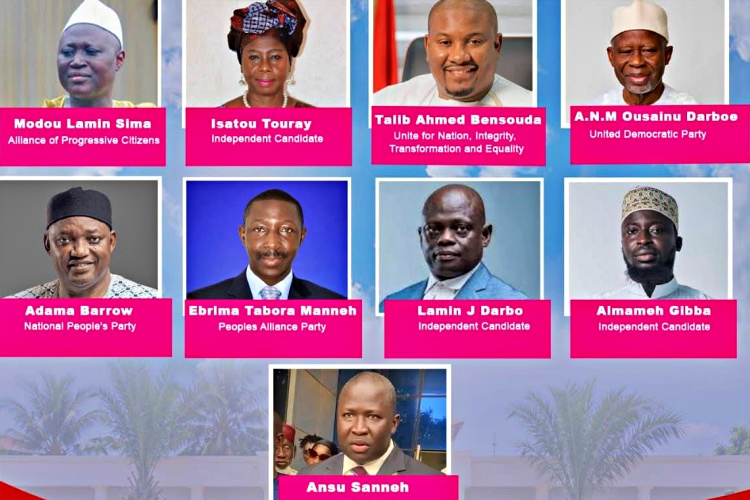
The second pre-election opinion poll, released on Monday, November 16, puts Barrow, who is seeking a third presidential term under the National People’s Party (NPP)-led Alliance, at 37.9 per cent, compared with 24.2 per cent for Darboe, the flagbearer of the Gambia First Coalition.
Talib Ahmed Bensouda, leading Coalition 2026, is in third position with 11.3 per cent, while Almameh Gibba of the No-To-Alliance records 5.8 per cent.
The Team Gambia Grand Coalition, led by Lamin J. Darboe, has 1.8 per cent, while the National Democratic Party (NDP), whose candidate Kebba Madi Bojang was subsequently rejected by the Independent Electoral Commission (IEC), records 1.3 per cent.
The survey also found that 11.6 per cent of respondents had not decided whom to support, while 4.2 per cent preferred not to disclose their voting preference.
The figures are based on respondents holding valid voter cards and reflect voting intentions at the time of the survey, rather than a prediction of the final election result.
Barrow Also Leads In Expected Election Outcome
Barrow’s position is even stronger when respondents are asked who they believe is most likely to win the December election.
Forty-eight per cent identified the incumbent as the likely winner, compared with 23 per cent for Darboe and eight per cent for Bensouda.
The difference between Barrow’s voting-intention figure and his expected-winner rating suggests that his perceived electoral prospects extend beyond his existing support base.
However, the report cautions that expectations about who will win should not be confused with respondents’ personal voting preferences.
Among respondents who expressed a candidate preference, 87 per cent said they were completely certain about their choice, while seven per cent indicated that their decision could still change.
The remaining uncertainty is also reflected in the proportion of undecided voters and those unwilling to disclose their preferences.
Geographically, the NPP-led Alliance recorded particularly strong support in Kuntaur, at 79.7 per cent, Basse, at 78 per cent, and Janjanbureh, at 61 per cent.
The contest appears considerably closer in other areas. In Brikama, the Gambia First Coalition leads with 29.6 per cent against 27.8 per cent for the NPP-led Alliance. In Kerewan, the two formations are almost level, with 37.6 per cent for Barrow’s alliance and 36.7 per cent for Darboe’s coalition.
Cost Of Living Dominates Election Concerns
Despite Barrow’s lead in voting intention, the poll paints a largely negative picture of public perceptions of the national economy.
Approximately 80 per cent of respondents rated the country’s economic conditions as either fairly bad or very bad.
The cost of living emerged as the single most important national election issue, cited by 43 per cent of respondents. Security came second with 18 per cent, followed by food prices at 14 per cent.
Combined, the cost of living and food prices accounted for approximately 57 per cent of responses, highlighting the importance of household purchasing power and affordability in the electoral debate.
When asked what mattered most in choosing a presidential candidate, 39 per cent identified competence, 22 per cent pointed to policies and manifestos, and 16 per cent cited integrity.
The findings suggest that voters are looking beyond political alliances and personalities to assess candidates’ ability to address the country’s economic and governance challenges.
Electricity supply also remains an important electoral issue. Fifty-two per cent of respondents said they experienced power outages daily or several times a week, while 66 per cent said the electricity situation was very or somewhat important to their voting decisions.
Furthermore, 46 per cent rated the government’s handling of electricity supply negatively.
The report also identifies a strong relationship between economic assessments and support for the incumbent. Support for Barrow’s alliance stood at 83 per cent among respondents with positive assessments of the economy, compared with 26 per cent among those with negative economic assessments.
Concerns Over Electoral Credibility And Violence
The survey raises significant questions about public confidence in the institutions responsible for managing the December election.
Only 49 per cent of respondents expressed some or a lot of confidence in the IEC to conduct a free and fair election.
Confidence in the accuracy of the final voters’ register was lower, at 41 per cent, while 48 per cent expressed doubts about its accuracy.
Awareness of the Revising Court process was also limited, with only 27 per cent saying they had heard about it.
The findings come amid continuing political debate over voter registration and the credibility of the electoral process.
Perceptions of electoral malpractice are also widespread. Sixty-seven per cent of respondents considered vote buying common or very common in elections.
Meanwhile, 86 per cent expressed concern about election-related violence or intimidation before, during or after the December 5 polls.
The report also found that 94 per cent were concerned that ethnic or tribal remarks in political discourse could undermine national unity.
When asked what would improve confidence in the election, 69 per cent identified greater independence and transparency of the IEC as the most important measure.
Thirty per cent called for impartiality among security forces, while 28 per cent supported stronger enforcement against ethnic or tribal hate speech.
Misinformation And Social Media Pose Additional Risks
The information environment is another major concern identified by the survey.
Eighty-seven per cent of respondents expressed concern that misinformation could affect the fairness or peaceful conduct of the election.
The report found that 71 per cent were aware of AI-generated political content, while 88 per cent expressed concern that artificial intelligence-generated content and deepfakes could mislead voters.
Social media has also become increasingly important as a source of political information. TikTok accounted for 28 per cent and Facebook 16 per cent in the platform distribution reported by the survey.
The findings underline the growing importance of responsible political communication and the need for voters to distinguish between credible information and manipulated content.
Dissatisfaction With Governance Persists
Beyond the immediate electoral contest, the poll identifies considerable dissatisfaction with the government’s performance.
Forty-six per cent of respondents said they were dissatisfied with the way democracy works in The Gambia, compared with 41 per cent who expressed satisfaction.
Fifty-two per cent rated the government ineffective or very ineffective in delivering on its promises, against 30 per cent who gave a positive assessment.
Public concerns also extend to accountability. Eighty-four per cent expressed concern about transparency and value for money in government expenditure associated with nationwide official tours.
On the fight against corruption, 67 per cent expressed negative assessments of government performance.
The poll also found that 51 per cent viewed ECOMIG’s contribution to peace and security negatively, while 62 per cent were dissatisfied with the continued presence of the regional mission.
Interestingly, 67 per cent agreed that ECOMIG had overshadowed the role of Gambian security forces, highlighting continuing public debate about the country’s security arrangements.
Economic Discontent Has Increased Since January
Comparisons with CepRass’s first pre-election poll, published in January 2026, indicate that dissatisfaction with economic management has intensified.
Negative assessments of the government’s handling of the economy increased from 60 per cent in January to 68 per cent in the latest survey, an eight-percentage-point rise.
Confidence in the IEC remained broadly unchanged, moving from 47 per cent to 49 per cent.
Access to social media increased from 76 per cent to 85 per cent, reflecting the growing importance of digital platforms in the country’s political and information landscape.
Despite the widespread economic dissatisfaction, the incumbent-associated political formation remained the most frequently identified likely winner in both polling rounds.
About The Survey
CepRass conducted the second national opinion poll between October and November 2026, interviewing 1,180 respondents through face-to-face household interviews across 118 enumeration areas, all eight Local Government Areas and 53 constituencies.
The survey used a multi-stage stratified random sampling approach, with data weighted to account for the sampling design. It targeted registered voters who would be at least 18 years old on election day.
The survey materials cite a nominal national margin of error of approximately plus or minus three percentage points at a 95 per cent confidence level, although the report notes that the design-adjusted margin should be confirmed using the final sampling weights.
An important methodological disclosure is that, in 77.4 per cent of interviews, the voting-intention section was answered by the household head rather than the respondent selected for the interview.
CepRass also cautions that the findings represent a snapshot of public opinion during the survey period. They measure stated voting intentions, not actual voting behavior, and do not incorporate a voter-turnout model.
The organization therefore warns against treating the results as a forecast of the December 5 election.
Overall, the findings present an electoral landscape in which Barrow holds a clear lead in stated voting intention, while economic dissatisfaction, questions about electoral credibility and concerns over political peace remain significant challenges as the country enters the final weeks before the presidential election.






Leave a Reply