


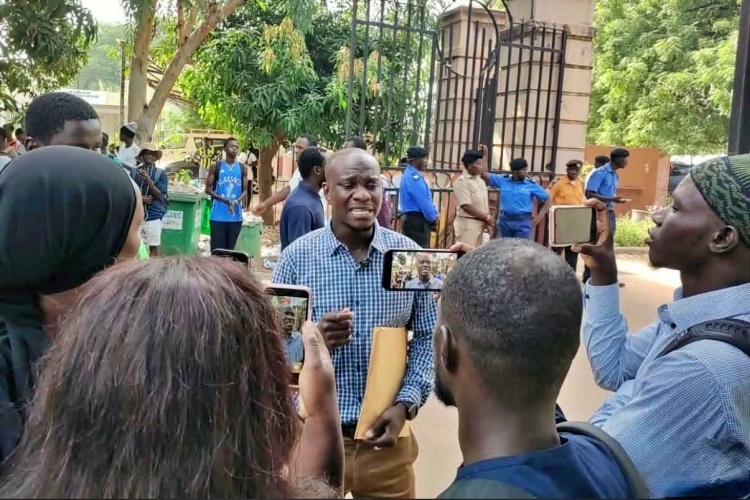
Gambiaj.com – (BANJUL, THE GAMBIA). The University of The Gambia’s student protest over welfare and campus conditions has sparked a wider debate about where genuine student activism ends and partisan politics begins, particularly as the country heads towards the December 5 presidential election.
Questions have emerged over the political affiliations of student leaders, the timing of Monday’s demonstration and the behavior of some protesters.
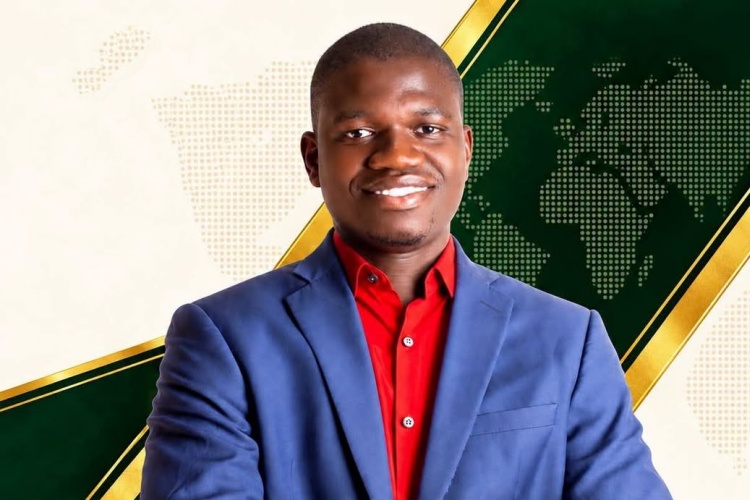
The debate intensified after Nanama Keita, a former UDP activist who now openly supports the UNITE coalition and its presidential candidate Talib Bensouda, questioned whether the political background of UTG Student Union President Ismaila Fadera could create a perceived conflict of interest.
Keita argued that Fadera’s reported affiliation with the opposition UDP, combined with the proximity of the presidential election, made it reasonable to ask whether the protest was entirely about student welfare.
“I am, and will always remain, a fervent defender of the right to peaceful protest,” Keita wrote, while stressing that genuine grievances should not be dismissed. But he argued that “the timing of such protests, the political affiliations of those leading them, and any real or perceived conflicts of interest deserve equal scrutiny.”
His intervention goes to the heart of a difficult question in Gambian politics: can people separate their political identities from institutional responsibilities, particularly during an election campaign?
Legitimate Grievances At The Centre
There is little doubt that UTG students have raised serious concerns.
Monday’s protest focused on food shortages, unreliable transportation, inadequate access to potable water, poor internet connectivity and shortcomings in learning facilities at the Faraba Campus. Students presented these as welfare and academic issues, rather than demands driven by party politics.
The government itself has acknowledged the concerns. Higher Education Minister Pierre Gomez has promised intervention, while the Ministry of Higher Education, Research, Science and Technology recognized the importance of reliable transport, catering, water supply, internet connectivity and adequate learning facilities.
That gives the student movement a clear and substantive basis that exists independently of political parties.
The real question, therefore, is not whether the grievances are genuine. It is whether a student leader with an established political affiliation can lead such a protest without creating doubts about his neutrality, especially when the government being challenged is facing an election in which his political party is seeking to replace it.
That distinction matters because in politics, perception can be almost as important as intent.
Questions Over Student Union Independence
Keita’s suggestion that future UTG Student Union presidents should maintain political neutrality has received support from some commentators.
Prince Sowe said students’ grievances should be addressed and their right to peaceful protest protected, but warned against allowing student activism to become a vehicle for partisan politics.
“A student union president has a duty to represent all students, not advance the interests of a political party,” he said, arguing that those seeking a change of government have an opportunity to express that choice through the December 5 election.
But there is another side to the argument.
Political affiliation, by itself, does not necessarily mean that a student leader is acting on behalf of a political party.
Ba-Kawsu Marenah argued that Fadera stopped engaging in partisan politics after being elected and that there was “no or minimal correlation” between his political background and the protest.
He also pointed to the reality that many student leaders may have political affiliations before taking office.
“Whoever was elected as the president of the university student union is directly or indirectly affiliated with a political party and I don’t see where the problem is,” Marenah said.
That raises an important counterargument: political neutrality may be desirable, but imposing it could be difficult in a democratic society where students, like everyone else, have the right to hold political views and belong to political organizations.
Was The Protest A UTGSU Presidential Decision?
Another important question is how the protest itself was authorized.
Muhammed Y. Darboe, a former UTGSU Secretary General, challenged the suggestion that the president alone initiated or controlled the demonstration.
According to Darboe, the student union’s structure gives significant decision-making powers to its general membership and affiliated associations. He said he had initiated calls for a protest during his own tenure and that major decisions could be reached through wider consultation.
He said Fadera initially resisted the idea of a protest but eventually joined after a general meeting supported it.
If that account is accurate, it makes it harder to view the protest simply through the political identity of the student union president.
It would suggest that Fadera was responding to an institutional decision rather than imposing a political agenda on the student body.
But that does not completely settle the issue of political perception.
In a highly polarized election environment, the people seen at the front of a protest can shape how the public understands its motives, regardless of how the decision was reached internally.
Abusive Conduct Becomes Part Of The Debate
The debate has also moved beyond the students’ demands to the way the protest was conducted.
Some commentators criticized what they described as confrontational behavior towards government officials, particularly the Higher Education Minister and the Minister of Information, who was reportedly booed and escorted away from the protest.
Famara Dubois said students have every right to protest but should not assault or disrespect public officials.
“You can protest and get your point across without assaulting someone especially a sitting member of the cabinet no matter how much you disagree with him,” he said.
That distinction is important.
Peaceful protest is a legitimate democratic way of demanding accountability. But physical confrontation, intimidation or personal abuse can undermine an otherwise legitimate campaign and give political opponents an opportunity to portray it as something more than a student welfare movement.
A Blurred Boundary
The UTG dispute highlights a broader challenge for civic activism in an election year.
A person’s political affiliation does not automatically make his or her grievances partisan. Likewise, a student leader’s political history does not by itself prove that a protest is being used to advance a party agenda.
But political affiliations also cannot simply be ignored when a protest is directed at a government less than six weeks before a presidential election.
The reality is more complicated than either side suggests.
Student unions need enough independence to challenge governments, university authorities and public institutions when students’ interests are at stake. At the same time, their leaders have a responsibility to ensure that institutional platforms do not become extensions of political parties.
The immediate test is whether the student union can keep its attention on the issues it has raised while keeping political parties and the presidential contest outside its institutional decision-making.
For the government, the test is equally important. Addressing the students’ complaints openly and effectively would reduce the political space for anyone seeking to exploit those grievances.
And for the students themselves, the December 5 election provides a separate democratic avenue for expressing political dissatisfaction.
The challenge is to ensure that genuine student welfare activism is neither dismissed as opposition politics nor allowed to become a substitute for electoral politics.
In an increasingly polarized campaign, that line may be difficult to draw. But the credibility of student representation depends on keeping that distinction clear.











Leave a Reply