


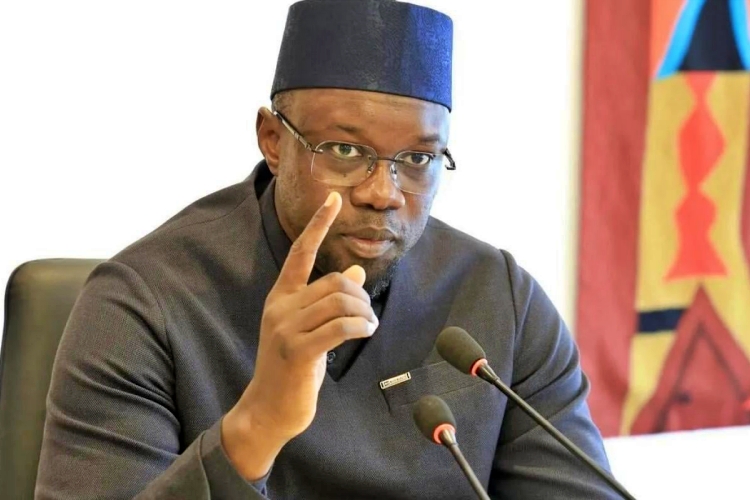
Gambiaj.com – (DAKAR, SENEGAL) – Ousmane Sonko’s opposition to Senegal’s revised 2026 budget has exposed a deepening rift within the country’s governing camp, raising questions about government stability, parliamentary authority, and the credibility of the country’s financial commitments ahead of crucial debt negotiations with the International Monetary Fund (IMF) and other creditors.
Speaking at a press conference in Dakar on Monday, October 19, the Pastef leader and prime minister’s former head of government criticized both the 2026 supplementary finance bill and the initial 2027 finance bill, warning that the parliamentary majority would not approve the government’s budget proposals without scrutiny.
A Rift Over Economic Policy
Sonko aimed to separate Pastef from the government’s economic decisions, urging the prime minister to cease claiming policies as party actions. He recounted a June 1 meeting with President Faye, where he was assured there would be no debt restructuring or price hikes. Sonko criticized the government’s move to restructure and increase prices, seeing it as a breach of prior commitments.
He labeled the budget proposals as “austerity,” highlighting cuts to investment and social ministries, which he argued would hinder public investment and social spending.
This disagreement signifies a broader conflict over economic policy direction and accountability for financial decisions. By distinguishing between Pastef’s program and the government’s policies, Sonko is positioning himself politically, particularly as economic adjustments may face voter backlash.
Why A Parliamentary Rejection Matters
The immediate question is whether Pastef’s refusal to support the revised 2026 budget could prevent the state from continuing to function.
Legal and economic specialists consulted by Senegalese newspaper Wal Fadjri argue that the rejection would not necessarily paralyze public administration, as the authorities have constitutional and legal mechanisms to maintain budget execution.
Dr. Mor Fall, a law lecturer at Cheikh Anta Diop University in Dakar, cited Article 68 of the Constitution and Article 57 of the organic law governing finance laws as provisions that could allow the executive to overcome a parliamentary impasse under specified conditions.
The underlying principle is continuity of public administration. As Fall explained, “There must be no interruption in the functioning of public authorities.”
Economist Meïssa Babou similarly argued that the revised budget would ultimately be implemented, regardless of the mechanism used to validate it.
Dr Abdoul Aziz Mbodji, meanwhile, noted that parliamentarians’ ability to amend budget proposals is constrained by the organic finance law.
These legal safeguards suggest that a rejection of the supplementary budget would not automatically bring public spending to a halt. The state could continue operating under existing budgetary authorizations, while the president could, under applicable legal conditions, issue advance appropriations requiring subsequent regularization.
However, the distinction between maintaining administrative continuity and securing a politically legitimate budget is critical.
A government may retain legal means to finance its operations while simultaneously losing the parliamentary support needed to demonstrate that its economic program commands a stable political majority.
The 2027 Budget Could Become the Bigger Test
Although the immediate confrontation concerns the 2026 supplementary finance bill, the implications extend to the initial 2027 budget.
The two bills are legally distinct and subject to separate parliamentary procedures. Nevertheless, they form part of a connected fiscal framework, with expenditure planning, performance assessments, and budget implementation extending across financial years.
A prolonged confrontation could therefore complicate the transition from the current budget to the next one, particularly if parliament also refuses to approve the 2027 finance bill.
Journalist and former minister Souleymane Jules Diop has pointed to Article 86, paragraph 6, of the Constitution as a possible route for the government to secure adoption of a finance bill without a parliamentary vote.
The procedure is comparable in broad political effect to France’s Article 49.3, which allows a government to push legislation through the National Assembly subject to the possibility of a motion of no confidence.
Such a move could enable the executive to overcome legislative resistance, but it would carry considerable political risks. Opposition to the budget could become a direct challenge to the government’s survival, particularly if legislators responded by seeking a motion of censure.
A Dangerous Signal Ahead Of Debt Negotiations
The timing adds another layer of uncertainty.
Senegal is approaching negotiations with the IMF and other creditors over its debt situation, making political cohesion and confidence in fiscal governance particularly important.
Sonko’s challenge could raise concerns among financial partners about the government’s ability to secure parliamentary authorization for future expenditure and implement the fiscal measures underpinning its economic commitments.
The dispute comes against the backdrop of Senegal’s previously undisclosed debt and the difficult choices confronting the authorities as they seek to restore confidence in public finances.
For creditors, the immediate issue is not simply whether lawmakers approve one supplementary budget. It is whether the country’s institutions can agree on a credible fiscal framework and sustain it over time.
A parliamentary majority openly challenging the government’s economic direction could make that task more difficult, especially if disagreement spills over into the 2027 budget.
The confrontation also carries implications for Senegal’s borrowing prospects and its relationship with international financial institutions. However, the political dispute alone does not establish that negotiations will fail or that future financing will automatically be blocked.
Much will depend on whether the government can demonstrate that it retains the legal authority and political capacity to execute its financial commitments.
From Budget Dispute To Constitutional Confrontation
If the dispute spreads to the 2027 finance bill, the political stakes would rise considerably. The executive could seek to use constitutional mechanisms to overcome the deadlock, while legislators could attempt to challenge the government through parliamentary procedures.
The prospect of President Faye invoking the exceptional powers provided under Article 52 of the Constitution has also been raised as a possible scenario should the confrontation develop into a severe institutional crisis. Such an outcome would represent a major escalation, not an automatic consequence of a budget rejection.
The dispute is further complicated by disagreements over special funds, with Sonko’s parliamentary majority reportedly seeking a reversal of the executive’s position despite the issue having already been examined by the Constitutional Council.
That dimension raises a separate question about the boundaries between political bargaining and respect for constitutional adjudication. Where a matter has been settled by a competent court, efforts to reopen it through political pressure could deepen institutional tensions.
A Test of the Governing Cohabitation
Senegal’s current predicament exposes a fundamental weakness in the political arrangement that brought Faye and Sonko to power: the distinction between control of the executive and control of the governing political movement.
Although Faye occupies the presidency and the government is responsible for implementing economic policy, Sonko retains considerable influence through Pastef and its parliamentary majority.
The budget confrontation demonstrates that this influence can become a source of institutional friction rather than a guarantee of legislative stability.
It also raises questions about whether the disagreements reflect a substantive dispute over economic priorities, a struggle over political authority, or both.




Leave a Reply