



Gambiaj.com – (ZIGUINCHOR, SENEGAL) – In Mangoucouro, history is not confined to books or archives. It lives in the soil, in a traditional shrine and in memories passed down through generations. The place is also associated with the beginnings of one of Senegal’s longest-running separatist conflicts.
In 1982, early activists of the Movement of Democratic Forces of Casamance (MFDC) reportedly gathered here, held meetings and performed traditional libations before launching their rebellion against the Senegalese state.
More than four decades later, the same site has once again drawn the attention of the authorities.
A joint operation by the Senegalese Army and Gendarmerie in the Lyndiane Coboda area of Ziguinchor resulted in the arrest of 28 people, including nine women. Seventeen mobile phones, documents, MFDC flags and insignia were also seized.
On the surface, the operation may appear to be another security intervention in a region long accustomed to military and police operations. But the choice of location gives it a significance that goes beyond the arrests and seized materials.
A Site Loaded With Memory
According to a source close to the investigation, MFDC sympathizers had gathered at a compound used as a base in Mangoucouro to commemorate the death anniversary of Abdou Elenkine Diatta, a former prominent member of the movement, targeted and shot dead on October 27, 2019 by armed men on motorcycles believed to be under the command of Salif Sadio, another MFDC faction leader.
Abdou Elinkine Diatta was riding his way from attending a traditional king’s enthronement ceremony in Mlomp.
At the Mangoucouro commemoration ceremony, MFDC flag was reportedly displayed during the gathering, prompting the authorities to intervene. The flag was brought down during the operation, according to the same source.
That moment captures the significance of the raid: a flag associated with decades of conflict with the Senegalese state being removed from a site linked to the movement’s early history.
Mangoucouro is more than an address in Ziguinchor. Its shrine and its association with the MFDC’s early activities have given it a particular place in the history of the Casamance rebellion.
The intervention can therefore be seen not only as an attempt to dismantle a suspected gathering point, but also as an effort to prevent a historically significant site from becoming a renewed centre of separatist mobilization.
From Shrine To Security Concern
Mangoucouro’s transformation from a place associated with traditional rites and the early history of the separatist movement into a security concern reflects the complicated legacy of the Casamance conflict.
The rebellion that emerged in the early 1980s has left behind decades of suffering, displacement and loss, alongside unresolved political grievances, negotiations and attempts to restore peace.
For many people, these memories remain deeply personal. For others, they have acquired a political meaning that continues to shape how the conflict is understood.
This makes places such as Mangoucouro difficult to treat as ordinary locations. For the state, they may represent potential rallying points for separatist sentiment. For others, they are part of Casamance’s historical experience and collective memory.
The latest operation suggests that the Senegalese authorities are determined to prevent sites and symbols associated with the armed struggle from becoming centers of renewed political mobilization.
The Arrest That Came Before The Dismantling
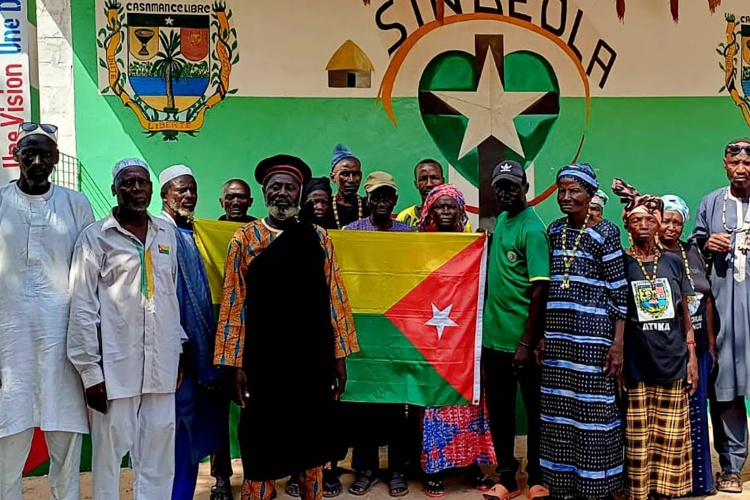
The men and women keepers of the Mangoucouro sanctuary of the MFDC rebellion in the outskirts of Ziguinchor
The operation also follows a significant development in August 2025, when the Ziguinchor Gendarmerie Research Section arrested Hamidou Djiba, the self-proclaimed spokesperson of the MFDC Mangoucouro faction.
Djiba was accused by the authorities of making statements considered hostile to the Republic and its institutions.
According to reports at the time, investigators tracked him from Djibock before intercepting him near Boulome, close to the Guinea-Bissau border. He was subsequently transferred to Dakar for further questioning.
His arrest suggested that the authorities were already monitoring the Mangoucouro faction and its activities.
The latest operation therefore appears to be part of a broader effort to contain separatist networks and prevent hardline voices from regaining prominence as Senegal seeks to consolidate peace in Casamance.
A Peace Process Tested By Memory
The timing is significant.
Senegal has made progress towards ending the Casamance conflict, including through peace agreements with sections of the MFDC. But such agreements cannot, on their own, erase the political grievances, social divisions and emotional scars left by decades of violence.
Mangoucouro illustrates that challenge.
Peace agreements can help silence weapons, but they cannot erase the places where a rebellion took shape, the people who participated in it or the memories attached to them.
The Senegalese state must therefore balance two difficult responsibilities: protecting the country’s territorial integrity and preventing a return to armed separatism, while recognizing that the conflict’s history remains deeply rooted in parts of Casamance.
The dismantling of the Mangoucouro site carries a message that extends beyond the immediate arrests. The authorities are signalling that places associated with the armed separatist struggle will not be allowed to serve as centers of renewed mobilization.
Yet the operation also highlights the limits of what a security intervention can achieve.
Mangoucouro remains significant because its history has not disappeared. Removing an MFDC flag may be relatively straightforward; changing the meaning that generations have attached to the place is far more difficult.
That is perhaps the deeper significance of the operation in Ziguinchor: the state is confronting not only the remnants of a separatist rebellion, but also the physical landscape in which that rebellion first took shape.
















Leave a Reply